TheJakartaPost
Please Update your browser
Your browser is out of date, and may not be compatible with our website. A list of the most popular web browsers can be found below.
Just click on the icons to get to the download page.


Popular Reads
Top Results
No results found. Please check your search term and try again
Can't find what you're looking for?
View all search results
Popular Reads
Top Results
No results found. Please check your search term and try again
Can't find what you're looking for?
View all search resultsGerman firms' investments in China boomed in 2025 on US trade war worries
Change text size
Gift Premium Articles
to Anyone
Share the best of The Jakarta Post with friends, family, or colleagues. As a subscriber, you can gift 3 to 5 articles each month that anyone can read—no subscription needed!
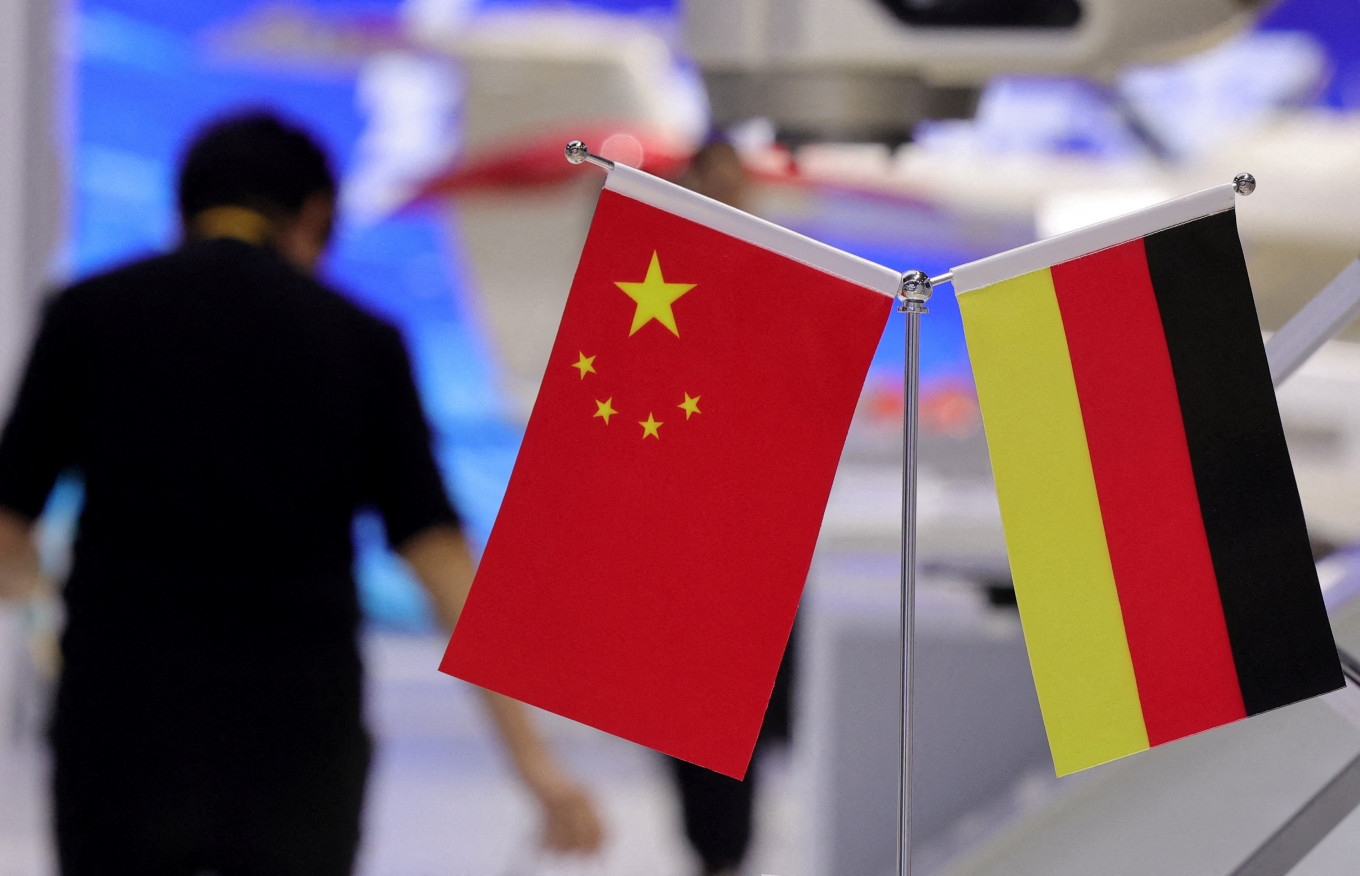 A person walks next to the national flags of China and Germany at the 8th China International Import Expo (CIIE) in Shanghai, China, on Nov. 5, 2025. (Reuters/Maxim Shemetov)
G
erman companies' investments in China hit a four-year high in 2025, according to data compiled for Reuters, underscoring how US President Donald Trump's trade war is pushing industries and governments to boost business ties elsewhere.
The data, from the IW German Economic Institute and previously unreported, showed investments in China climbed to over 7 billion euros (US$8 billion) between January and November last year, up 55.5 percent from the 4.5 billion euros in 2024 and 2023.
The investment figures show how Trump's aggressive trade policies in his first year in office, including far-reaching US tariffs on EU imports, have pushed firms in Europe's top economy to shift their focus to China as an alternative.
It comes as Britain's government heads to China with a delegation hoping to seal more business deals from cars to pharmaceuticals, the EU nearing a deal with South America, and Canada seeking to expand trade deals with China and India.
Berlin, meanwhile, has sought to balance toughening its stance towards Beijing over trade and security while trying to avoid damaging the fundamental relationship with its top trade partner.
"German companies are continuing to expand their activities in China – and at an accelerated pace," Juergen Matthes, head of international economic policy at the IW institute, told Reuters, citing a trend to strengthen local supply chains.

Reuters reported last week that German companies nearly halved their investments in the United States in the first year of President Donald Trump's second term.
Fear of 'geopolitical conflicts'
The shift was also driven by concerns "about geopolitical conflicts" that were prompting companies to bulk up their China business so it could operate more independently in case of any major trade disruptions, Matthes said.
"Many companies say: 'if I'm only producing in China for China, I'm reducing my risk of being affected by possible tariffs and export restrictions'."
German companies ranging from BASF and Volkswagen to Infineon and Mercedes-Benz remain heavily dependent on the Chinese market, where most of the world's cars and chemicals are sold.
German fan and motor maker ebm-papst said that last year it invested 30 million euros in the expansion of its Chinese operations, accounting for more than a fifth of total investments, in order to produce more where its customers are.
"This model has proven to be an important anchor of stability, especially in times of tariffs and geopolitical tensions," the company said in a statement, adding it was also planning to expand its US business this year.
The overall investment figure for 2025 also beats the 6 billion euro average for the period from 2010 to 2024, the IW report, which draws on data from Germany's Bundesbank, showed.
China last year reclaimed its spot as Germany's top trading partner after being overtaken by the United States in 2024, driven by rising imports from the world's second-largest economy.