The Jakarta Post
Please Update your browser
Your browser is out of date, and may not be compatible with our website. A list of the most popular web browsers can be found below.
Just click on the icons to get to the download page.


Popular Reads
Top Results
No results found. Please check your search term and try again
Can't find what you're looking for?
View all search results
Popular Reads
Top Results
No results found. Please check your search term and try again
Can't find what you're looking for?
View all search resultsIndonesia’s economy: Closing 2025 on a firmer footing
Strong household consumption, fiscal acceleration and transmission from government capital spending to investment may be sufficient to grow economic growth faster in Q4 2025.
Change text size
Gift Premium Articles
to Anyone
Share the best of The Jakarta Post with friends, family, or colleagues. As a subscriber, you can gift 3 to 5 articles each month that anyone can read—no subscription needed!
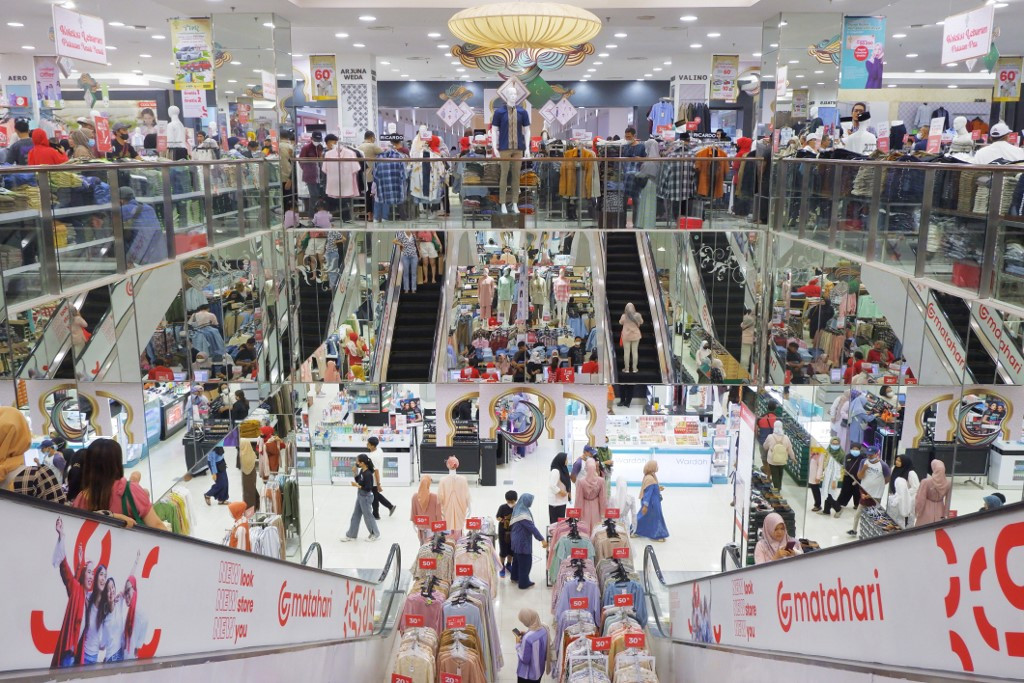 People shop at a mall in Serang, Banten, on April 9, 2023. (AFP/Dziki Oktomauliyadi)
A
s Indonesia approaches the release of its fourth-quarter and full-year 2025 GDP figures, the discussion should go beyond whether headline growth aligns with the government target.
More importantly, the data will reflect how Indonesia navigated a year shaped by global fragmentation, persistent uncertainty and uneven recovery across regions. The outcome for 2025 is not only about acceleration, but also about resilience and the effectiveness of domestic momentum amid mounting external and domestic frictions.
Globally, 2025 remained a challenging year. Trade fragmentation continued as major economies recalibrated supply chains and industrial strategies, while geopolitical tensions stayed high across several regions. Although global monetary conditions gradually eased, financial markets remained sensitive to shifts in sentiment, keeping volatility risks elevated. For many emerging economies, including Indonesia, the main spillovers from global developments were transmitted through financial channels rather than trade volumes, limiting external support for growth.
Against this backdrop, macroeconomic stability played a central role in anchoring domestic activity. Inflation remained manageable, external buffers were preserved and fiscal operations continued to function within prudent boundaries.
Headline inflation ended 2025 at 2.92 percent year-on-year (yoy), while average monthly inflation throughout the year was contained at around 0.2 percent month-to-month (mtm), indicating limited underlying price pressures despite periodic food volatility. This inflation backdrop helped preserve household purchasing power and allowed domestic demand to remain resilient toward year-end, even as financial markets experienced episodes of volatility and portfolio outflows.
Historically, the fourth quarter has been critical for Indonesia’s growth performance. Year-end consumption typically strengthens, while government spending accelerates as budget execution peaks. In 2025, this seasonal dynamic carried added importance. Growth in the first quarter was relatively moderate at 4.9 percent yoy, placing greater weight on the fourth quarter to support full-year outcomes. As such, the final quarter became a key test of whether domestic drivers could compensate for limited external support.

Household consumption remained a key pillar of growth in the fourth quarter, supported by improving year-end demand. Retail sales growth strengthened to around 5 percent yoy in Q4 2025, up from 4 percent in the previous quarter, reflecting firmer spending toward the holiday period.