The Jakarta Post
Please Update your browser
Your browser is out of date, and may not be compatible with our website. A list of the most popular web browsers can be found below.
Just click on the icons to get to the download page.


Popular Reads
Top Results
No results found. Please check your search term and try again
Can't find what you're looking for?
View all search results
Popular Reads
Top Results
No results found. Please check your search term and try again
Can't find what you're looking for?
View all search resultsNew agreement, new tariff, what’s next?
Indonesia should respect US domestic policy development, while mitigating profound structural risks from the tariff deal by planning a strategic approach over the coming months.
Change text size
Gift Premium Articles
to Anyone
Share the best of The Jakarta Post with friends, family, or colleagues. As a subscriber, you can gift 3 to 5 articles each month that anyone can read—no subscription needed!
 Set as preferred source
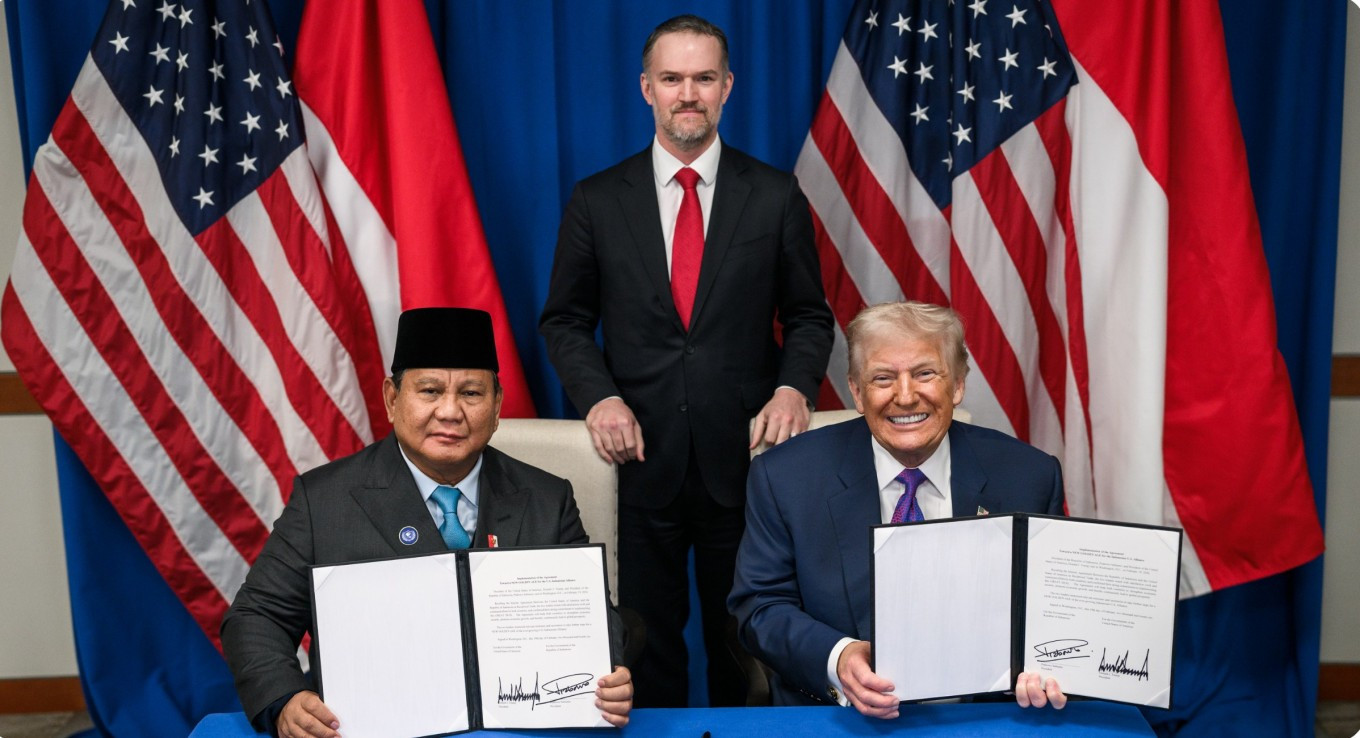 Indonesia President Prabowo Subianto (left) and United States President Donald Trump show the signed trade deal documents on Feb. 19 in Washington, DC, the US, as witnessed by US Trade Representative Jamieson Greer. Indonesia and the US finalized a trade deal locking in tariff rates and non-tariff barriers to commerce. (Office of the United States Trade Representative)
“Any Country that wants to 'play games' with the ridiculous Supreme Court decision, especially those that have 'Ripped Off' the USA. for years, and even decades, will be met with a much higher Tariff, and worse, than that which they just recently agreed to. Buyer beware!” That is what United States President Donald Trump posted on Truth Social, a warning to countries that plan to back away from trade commitments.
To summarize, since Friday last week, there has been rapid development in the US import tariff levels that has confused the business sector.
The US Supreme Court issued a landmark ruling invalidating the “Liberation Day” tariff under the International Emergency Economic Powers Act (IEEPA) as a broad-based global tariff. This judicial intervention stripped away the underlying legal mechanism that had established the 32 percent threat and the subsequent 19 percent negotiated rate for Indonesian goods, plunging the bilateral trade environment into chaos as the US administration rapidly pivoted to alternative statutory authorities to maintain its protectionist policy.
In response, President Trump announced a new global tariff of 10 percent and quickly raised it to 15 percent the next day, under Section 122 of the Trade Act of 1974. The new tariff will be applied to imported products coming into the United States on Feb. 24. The confusion for businesses caused by the rapid changes in US domestic policy raised questions about the faithfulness of the bilateral agreement signed as a result of negotiations based on the “Liberation Day” past tariff over the past several months.
What everyone knows for sure is that the reinstated tariff will be in place for the next 150 days. However, to add more complexity, Trump will need congressional approval to extend the imposition of new tariffs.
Thus, the question now is: what would be the consequences of those recent developments for the status of our bilateral Agreement on Reciprocal Tariff (ART)? Not only Indonesia, but also countries like India, the United Kingdom and Japan, which already have bilateral agreements with the US, have felt uncertain about implementing their commitments. They try to digest the latest development and explore possible outcomes.

For Indonesia, our message is clear: respect US domestic policy development.