The Jakarta Post
Please Update your browser
Your browser is out of date, and may not be compatible with our website. A list of the most popular web browsers can be found below.
Just click on the icons to get to the download page.


Popular Reads
Top Results
No results found. Please check your search term and try again
Can't find what you're looking for?
View all search results
Popular Reads
Top Results
No results found. Please check your search term and try again
Can't find what you're looking for?
View all search resultsOil rises as expanding US-Israel war with Iran heightens supply risks
Brent crude futures LCOc1 were at $80.89 a barrel, up $3.15, or 4.1 percent, by 0745 GMT. On Monday, the contract surged to as high as $82.37, its highest since January 2025, though it pared those gains to settle 6.7 percent higher.
Change text size
Gift Premium Articles
to Anyone
Share the best of The Jakarta Post with friends, family, or colleagues. As a subscriber, you can gift 3 to 5 articles each month that anyone can read—no subscription needed!
 Set as preferred source
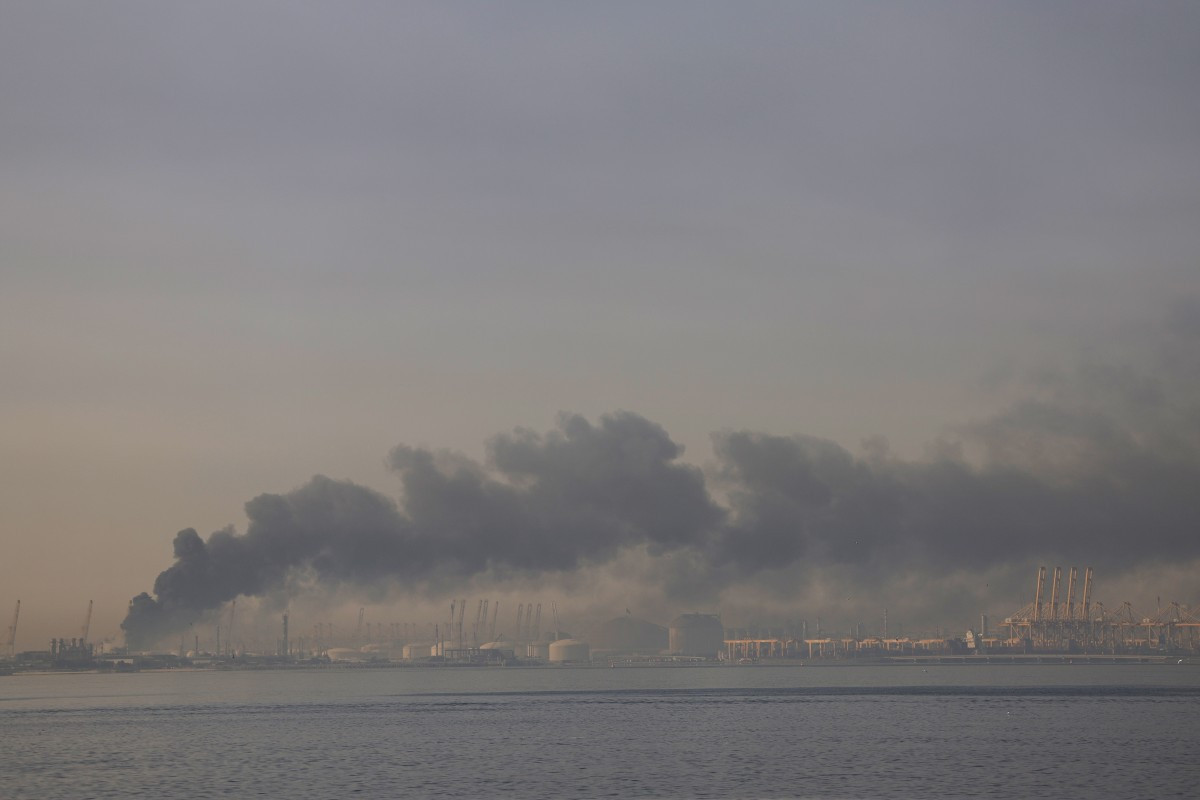 A plume of smoke rises from the port of Jebel Ali following a reported Iranian strike in Dubai on March 1, 2026. (AFP/Fadel Senna)
B
rent rose more than $3 on Tuesday for a third day of gains as the widening US-Israeli conflict with Iran and threats to shipping via the Strait of Hormuz heightened fears of supply disruptions from the key Middle East producing region.
Brent crude futures LCOc1 were at $80.89 a barrel, up $3.15, or 4.1 percent, by 0745 GMT. On Monday, the contract surged to as high as $82.37, its highest since January 2025, though it pared those gains to settle 6.7 percent higher.
US West Texas Intermediate crude CLc1 climbed $2.55, or 3.6 percent, to $73.78 a barrel. In the previous session, the contract initially climbed to its highest since June 2025 before sliding back to settle up 6.3 percent.
"With no quick de-escalation in sight, the Strait of Hormuz effectively closed and Iran showing a willingness to target energy infrastructure in the region, upside risks remain and they grow the longer the conflict drags on," Tony Sycamore, IG market analyst, said in a note.
The US and Israeli air war against Iran widened on Monday with Israel attacking Lebanon and Iran responding with strikes against energy infrastructure in Gulf countries and against tankers in the Strait of Hormuz.
Tankers and container ships are also avoiding the waterway as insurers have canceled their coverage for vessels, while global oil and gas shipping rates have soared. Concerns about transiting the waterway increased after Iranian media reported on Monday that a senior Iranian Revolutionary Guards official said the Strait of Hormuz is closed and warned Iran will fire on any ship trying to pass.

About 20 percent of the world's oil and gas pass through the Strait of Hormuz.
"The market continues to digest the risk of escalation in the Middle East," said ING analysts in a note on Tuesday.
"While there are concerns about oil flows through the Strait of Hormuz, a greater risk to the market would be Iran targeting additional energy infrastructure in the region. This could lead to more prolonged outages."
Israeli Prime Minister Benjamin Netanyahu said on Monday that the US and Israel's war against Iran may take "some time" but it will not take years.
Analysts expect oil prices to remain elevated over the coming days while markets focus on the impact of the escalating Middle East conflict.
Bernstein on Monday raised its 2026 Brent oil price assumption to $80 a barrel from $65, but sees prices reaching $120-$150 in an extreme case of prolonged conflict.
Refined product futures are also gaining as the Middle East is a key supplier of fuels and their processing facilities are at risk. On Monday, Saudi Arabia shut its biggest domestic oil refinery after a drone strike.
US ultra-low-sulfur diesel futures HOc1 were up 8.3 percent at $3.1404 per gallon after reaching a two-year high on Monday, while gasoline futures RBc1 were up 3.8 percent at $2.4620 per gallon after climbing 3.7 percent in the previous session.
European gasoil futures LGOc1 gained 9.2 percent to $967.75 a metric ton, after climbing 18 percent on Monday.