The Jakarta Post
Please Update your browser
Your browser is out of date, and may not be compatible with our website. A list of the most popular web browsers can be found below.
Just click on the icons to get to the download page.


Popular Reads
Top Results
No results found. Please check your search term and try again
Can't find what you're looking for?
View all search results
Popular Reads
Top Results
No results found. Please check your search term and try again
Can't find what you're looking for?
View all search resultsRamadan 2026: A two-speed season
Unlike in 2025, saving conditions entering Ramadan this year are weaker across income segments, limiting the spending before the disbursement of holiday bonuses.
Change text size
Gift Premium Articles
to Anyone
Share the best of The Jakarta Post with friends, family, or colleagues. As a subscriber, you can gift 3 to 5 articles each month that anyone can read—no subscription needed!
 Set as preferred source
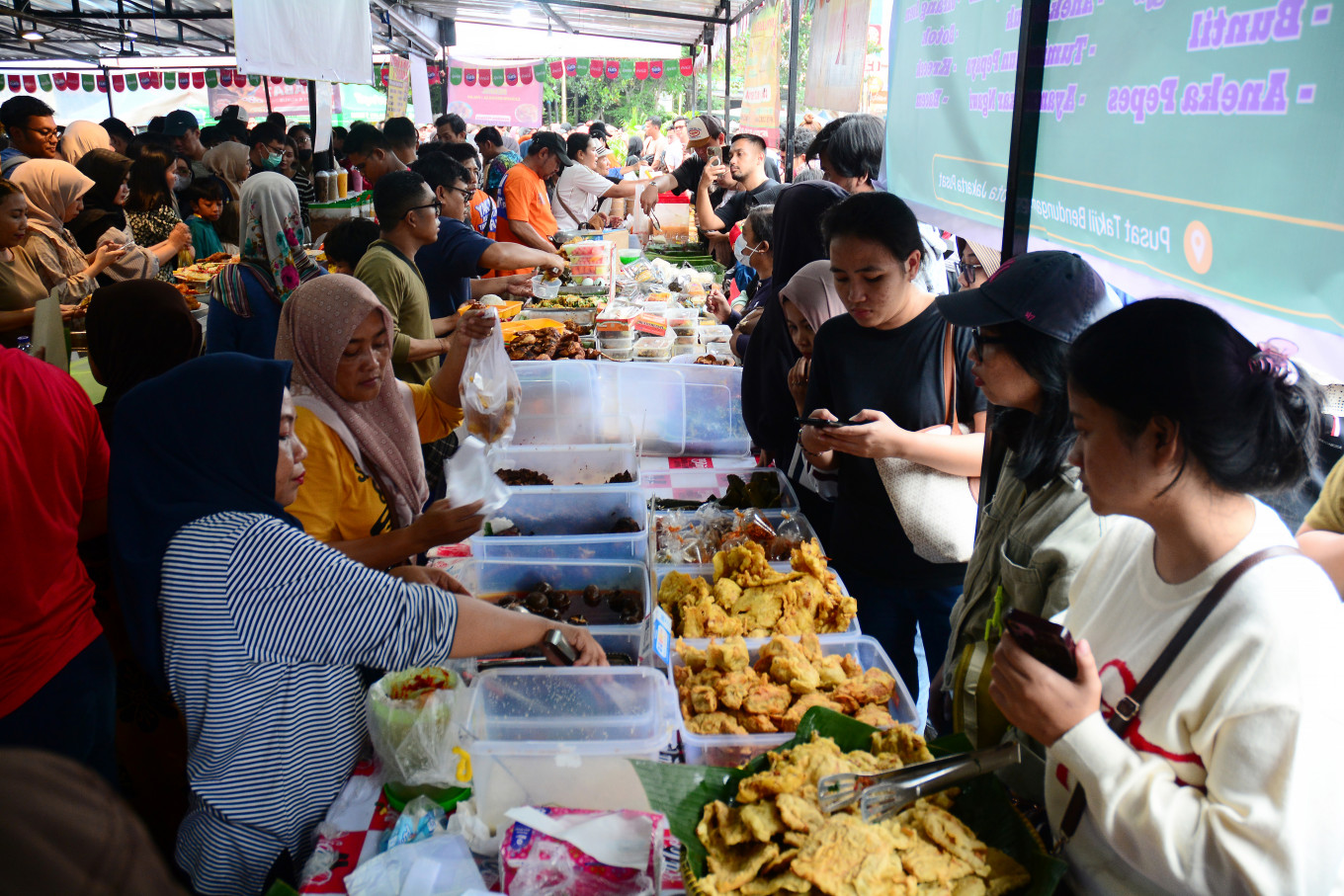 Shoppers crowd to choose snacks at Pasar Takjil Ramadhan Bendungan Hilir in Jakarta, on Sunday, Feb. 22, 2026. The Benhil Ramadan market draws large numbers of visitors during the holy month of Ramadan seeking a variety of iftar dishes. (JP/Iqro Rinaldi)
Leo Tolstoy once wrote that “all happy families are alike, each unhappy family is unhappy in its own way.”
Consumption cycles follow a similar logic. When household balance sheets are healthy, festive seasons move in sync. When buffers thin, divergence follows.
For much of the past decade, Indonesia’s Ramadan cycle fell into a predictable pattern. Excluding the pandemic years, household consumption growth in quarters when Idul Fitri occurred between 2015 and 2025 averaged about 0.13 percentage points higher than in other quarters. Half of those Idul Fitri quarters ranked among the strongest growth periods in the sample, compared with fewer than one-fifth of non-Idul Fitri quarters.
The question in 2026 is whether Indonesia’s consumption cycle still resembles the “happy family”, broadly uniform and shared, or whether the differences between households are starting to matter more. Early signals suggest that the headline figures remain resilient, but the growth is shifting toward a more segmented, two-speed economy.
At the aggregate level, the picture remains reassuring. According to the latest leading indicator Mandiri Spending Index (MSI), consumption grew 6.4 percent year-on-year (yoy) in the first week of Ramadan, slightly above last year’s 6.2 percent.
Regionally, the timing differs. Java recorded 5.9 percent growth in the opening week and continued to strengthen while several non-Java regions remained more sensitive to the disbursement of Idul Fitri-related holiday bonus (THR). Although Sulawesi (10.7 percent) and other eastern regions post higher yoy rates, acceleration outside Java still appears closely linked to liquidity timing.

On the surface, Ramadan 2026 looks typical. The difference lies not in the headline rate, but in who is driving it. To understand that shift, it helps to revisit 2025.
2025: A tale of three households
The opening week of Ramadan 2025 was driven by lower-income households. Spending in that segment rose 9.6 percent, compared with 7 percent for the middle segment and 3.4 percent for the upper segment. The gap between the lower and upper segments exceeded six percentage points.
However, the source of that lift was not uniform.
For lower-income households, spending continued to increase into Idul Fitri even as savings remained negative throughout the festive period. Consumption improved while financial buffers narrowed. The lift was visible, but it was accompanied by a decline in saving.
Middle-income households showed a liquidity-sensitive pattern. Savings declined ahead of Ramadan and improved once THR were disbursed. Spending rose during Ramadan and peaked at Idul Fitri, closely tracking income inflows. After the festive period, however, both spending and savings softened again. That pattern suggests part of the expansion relied on short-term financing that required post-season adjustment.
Upper-income households behaved differently. They accumulated savings prior to Ramadan and drew them down during Idul Fitri. Spending was more measured at the start of the cycle and accelerated later, supported by earlier buffer building. Their consumption was largely pre-funded.
The 2026 shift, a narrowing gap
In the first week of Ramadan this year, lower-income spending grew 7 percent. Middle-income spending rose by 6.5 percent, with upper-income close behind at 6 percent. The gap between the lower and upper has narrowed from more than six percentage points a year ago to roughly one point today.
Unlike 2025, this convergence rests on a thinner buffer base. Saving conditions entering Ramadan are weaker across segments. Lower-income savings sit around historical norms (z-score 0.0), the middle-income is below its typical range (minus 0.7) and upper-income savings are also softer than last year (minus 0.2).
Income dynamics help explain the shift. Bank Indonesia’s Current Income Index shows the upper-income segment strengthening into early 2026, with a z-score around 1.2. The middle-income improves modestly (plus 0.4), while lower-income income conditions remain flat near 0.0.
Taken together, spending, income and saving indicators point in the same direction. Spending remains positive across groups, but its foundation has changed. Upper-income consumption appears increasingly income-supported, while lower and middle segments operate with thinner buffers than a year earlier.
The path forward
If lower-income households entered 2026 with thinner buffers after last year’s decline in savings, their spending during this festive season will be more constrained than it was in 2025. Their ability to absorb higher food prices or transport costs is narrower. A quick and targeted boost to purchasing power would therefore have an outsized impact. In practice, that means maintaining food price stability and ensuring that support measures reach households without delay.
For the middle segment, timing remains crucial. In past cycles, spending picked up almost immediately after THR was disbursed. With income growth softer than a year ago, part of festive consumption will depend heavily on holiday allowances and, in some cases, short-term borrowing to smooth expenses.
For businesses, the structure implies a two-speed Ramadan. Premium and aspirational categories appear supported by stronger upper-income balance sheets. The mass market remains more sensitive to pricing, installment options and promotional timing aligned with household cash flow. A uniform festive strategy may underestimate that segmentation.
Ultimately, the early 2026 data points to a shift away from the era of the uniformly “happy” consumer. Ramadan still tilts Indonesia’s consumption cycle upward. Whether it remains broadly shared across households, or increasingly segmented by income and liquidity, will depend on the strength of household balance sheets in the weeks ahead.
*****
The writer is an analyst at Mandiri Institute