The Jakarta Post
Please Update your browser
Your browser is out of date, and may not be compatible with our website. A list of the most popular web browsers can be found below.
Just click on the icons to get to the download page.


Popular Reads
Top Results
No results found. Please check your search term and try again
Can't find what you're looking for?
View all search results
Popular Reads
Top Results
No results found. Please check your search term and try again
Can't find what you're looking for?
View all search resultsIndonesia to keep budget deficit below 3% of GDP as Middle East conflict lifts oil prices
Purbaya said expenditure on Indonesia's free meals program could be scaled back, saving the country about Rp 100 trillion ($6 billion).
Change text size
Gift Premium Articles
to Anyone
Share the best of The Jakarta Post with friends, family, or colleagues. As a subscriber, you can gift 3 to 5 articles each month that anyone can read—no subscription needed!
 Set as preferred source
 This handout satellite image courtesy of Vantor taken and released on March 2, 2026, shows damage at the Saudi Aramco's Ras Tanura refinery. The massive Ras Tanura refinery on Saudi Arabia's Gulf coast went into partial shutdown on March 2 after a strike by drones, three days into the Middle East war. (AFP/Vantor/-)
T
he government is ready to adjust budget expenditure to keep its fiscal deficit below 3 percent of GDP as the conflict in the Middle East threatens to drive up oil prices and pile more pressure on the economy, Finance Minister Purbaya Yudhi Sadewa said on Tuesday.
Even before the current crisis, the rupiah and the Indonesian stock index have been among Asia's worst performers in 2026, with the currency weakening more than 1 percent against the US dollar and the Indonesian stock exchange shedding as much as 7.5 percent, putting President Prabowo Subianto's ambitious economic goals in jeopardy.
The finance ministry has assessed that if the global oil price reaches up to around $90 per barrel, it could widen Indonesia's budget deficit to around 3.6 percent of GDP, Purbaya told Reuters in his first one-on-one interview with foreign media since he took office last year as a surprise replacement for the respected veteran Sri Mulyani Indrawati.
Sri Mulyani's conservative fiscal policies were long seen as a bulwark for the financial discipline that has underpinned investor confidence in the G20 economy since the Asian financial crisis.
Purbaya was seen as a pro-growth replacement appointed to achieve Prabowo's 8 percent GDP growth target, raising investor concerns about fiscal stability.
"Assuming the worst case, if the oil price goes as high as $90 to $92 per barrel, in those conditions, without adjusting our current budget, the deficit will increase to around 3.6 percent of GDP," he said.

The 2026 budget assumed a domestic crude oil price of $70 per barrel.
"Of course, we'll cut expenditure that creates the least impact to the economy," he said, adding that the ministry has already drawn up contingency plans.
Brent crude reached a 14-month high at $82.37 per barrel in the wake of the air attacks against Iran, $10 higher than Friday's close. US crude hit an 8-month high of $75.55 per barrel.
A quarter of Indonesia's crude oil imports come from the Middle East, while the region also accounts for 30 percent of the country's liquefied petroleum gas (LPG) imports, energy minister Bahlil Lahadalia said on Tuesday.
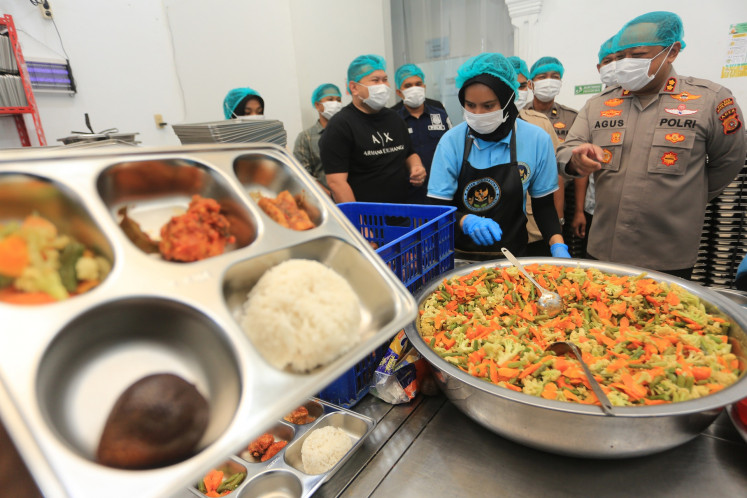
Purbaya said expenditure on Indonesia's free meals program could be scaled back, saving the country about Rp 100 trillion ($6 billion).
The ambitious $20 billion scheme, which seeks to provide daily nutritious meals to up to 83 million Indonesians, has been a major bone of contention for investors, raising concerns that it will undermine fiscal discipline in Southeast Asia's largest economy.
In February, global rating agency Moody's cut Indonesia's credit rating outlook to negative from stable, also mentioning social programs like free meals as one of the key concerns. Ratings agency Fitch also met Purbaya and other officials in Jakarta last week as it prepares its own review of the country.
"They (Fitch) are concerned about how Danantara affects our fiscal condition," he said, referring to Indonesia's new sovereign wealth fund.
"Their (Danantara's) debt is not affecting our debt, their project is not affecting our financing. If they fail, they can finance their failure with their dividend that they receive from their companies," he added.
Purbaya said he believed he will achieve Prabowo's 8 percent GDP growth goal while staying within the 3 percent fiscal deficit ceiling, and fears about crossing the legal limit were misplaced.
"Growth is important. Fiscal sustainability is important. But the most important thing is to optimize the existing fiscal conditions in creating economic growth," he said.
The deficit would only narrow over the next two years, he said.
"I won't surpass that limit anytime soon or in the future."