The Jakarta Post
Please Update your browser
Your browser is out of date, and may not be compatible with our website. A list of the most popular web browsers can be found below.
Just click on the icons to get to the download page.


Popular Reads
Top Results
No results found. Please check your search term and try again
Can't find what you're looking for?
View all search results
Popular Reads
Top Results
No results found. Please check your search term and try again
Can't find what you're looking for?
View all search resultsIndonesia’s nickel at a crossroads in the EV battery race
As non-nickel EV batteries gain ground globally, the strategy of developing nickel-based batteries is reaching a critical juncture.
Change text size
Gift Premium Articles
to Anyone
Share the best of The Jakarta Post with friends, family, or colleagues. As a subscriber, you can gift 3 to 5 articles each month that anyone can read—no subscription needed!
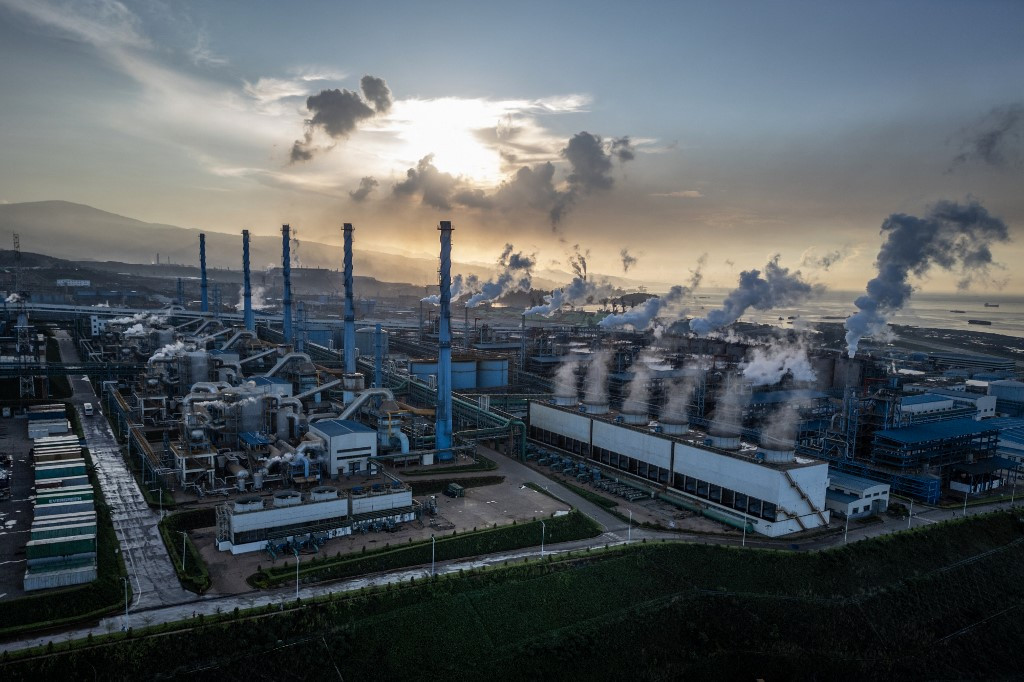 Smoke rises at Weda Bay Industrial Park (WBIP), a major nickel processing and smelting hub, in Lelilef Sawai, Central Halmahera, North Maluku. (AFP/-)
I
ndonesia holds a central position in the global nickel industry. In recent years, the government has tried to maximize the value of this strategic resource through a combination of abundant reserves, export restrictions on unprocessed ore and sustained downstream policy.
After building and maintaining a production chain for stainless steel from upstream to downstream, Indonesia is starting to focus on the development of nickel-based EV batteries. However, given the rapid development of the global battery industry, especially after the rise of non-nickel EV batteries in the global market, the strategy for developing a nickel-based battery is starting to reach a critical point for its future.
Since moving to halt nickel ore exports in 2019, with the ban fully taking effect in 2020, Indonesia has rapidly repositioned itself as a key player in the global nickel-processing industry. What was once largely an exporter of raw ore is now emerging as a major producer of higher-value nickel products.
Driven by a steady inflow of foreign investment, much of it from China, Indonesia has built a more complete nickel supply chain, particularly for saprolite-based ore, allowing domestic processors to turn raw materials into Nickel Pig Iron (NPI), ferronickel, nickel matte and, ultimately, stainless steel and refined nickel.
By 2025, there were 49 Rotary Kiln Electric Furnace (RKEF) nickel smelters operating in Indonesia, processing saprolite nickel ore. This shift marks more than an industrial success story. It reflects Indonesia’s broader ambition to capture more value at home, strengthen its role in global manufacturing and turn its vast mineral wealth into a foundation for long-term economic growth.
After successfully building a saprolite-based nickel ore production chain, Indonesia is seeking to extend its downstream strategy to limonite ore, a key input for the electric vehicle battery industry. Indonesia has, in fact, begun to establish a limonite-based production chain. By 2025, Indonesia has five operating High Pressure Acid Leaching (HPAL) and looking to build more.

However, right now, its capabilities remain concentrated in intermediate products such as Mixed Hydroxide Precipitate (MHP) and nickel sulphate. These are important milestones, but they are not yet the final products of the battery value chain. Additional processing is still needed before they can be transformed into finished battery chemistries such as Nickel Manganese Cobalt (NMC) or Nickel Cobalt Aluminum (NCA), both of which are widely used in EV batteries, particularly in higher-performance vehicle segments.
In that sense, Indonesia has made meaningful progress, but its ambition to become a fully integrated force in the global EV battery industry is still taking shape.
That challenge has become more pronounced as the global battery market shifts. Nickel-based batteries were especially attractive when the EV boom accelerated early in the decade, because automakers were prioritising driving range and performance, particularly companies such as Tesla and European car brands. According to the International Energy Agency (IEA), in 2022, nickel-based batteries still accounted for about 60 percent of the global EV battery market.
But the landscape has changed quickly. LFP batteries, which held less than 10 percent of the electric car market in 2020, have since surged and accounted for half of the global EV battery market in 2025. In the future, Bloomberg also expects the market share of nickel-based batteries to fall to less than 40 percent of the global battery market.
LFP’s rise has been driven by prices that are, on average, more than 40 percent lower than those of nickel-based battery alternatives. China’s ability to mass-produce LFP batteries has been central to this market shift. China dominates LFP production, accounts for nearly 80 percent of global EV battery cell manufacturing and has pushed battery prices sharply lower.
Even in Indonesia’s EV market, more than 90 percent of EV cars sold in 2025 used LFP batteries instead of nickel-based batteries. This is because cars that use nickel-based batteries are more expensive and therefore less relevant to most Indonesian consumers. In addition, as a country with high temperatures, the use of nickel-based batteries may pose additional risks for consumers.
However, the market is not abandoning nickel-based batteries, rather, it is using them more selectively. LFP is gaining ground in lower-cost, mass-market vehicles, while nickel-based batteries are increasingly concentrated in longer-range, premium and performance-oriented segments.
For Indonesia, that means nickel-based batteries still have a future, but they can no longer be treated as the only future of the EV industry. Looking further ahead, emerging technologies such as solid-state batteries could add another layer of competitive pressure, although their near-term commercial role remains limited.
Indonesia should not abandon its EV battery ambitions, because battery-grade nickel processing will remain strategically important in the global energy transition. But the next step in policy should be broader and more flexible.
Rather than focusing too narrowly on battery intermediates alone, such as MHP and nickel sulphate, Indonesia would be better served by expanding its ability to process limonite into higher-purity nickel and other refined nickel products. Refined nickel offers wider industrial uses beyond EVs, including alloys, plating and specialty chemicals, giving Indonesia access to a broader and potentially more resilient market base.
Stainless steel is still by far the largest source of global nickel demand, while batteries remain an important but smaller share, which is precisely why diversification matters.
In practical terms, the government should continue supporting battery projects, but place equal emphasis on upgrading refining capacity, improving processing technology and attracting investment into high-purity nickel products with multiple ends uses. Such a strategy would leave Indonesia less exposed to shifts in battery chemistry while strengthening its position as a producer not only of battery inputs, but also of refined nickel products that remain valuable across a much wider industrial landscape.
*****
The writer is an industry and regional analyst at Bank Mandiri