The Jakarta Post
Please Update your browser
Your browser is out of date, and may not be compatible with our website. A list of the most popular web browsers can be found below.
Just click on the icons to get to the download page.


Popular Reads
Top Results
No results found. Please check your search term and try again
Can't find what you're looking for?
View all search results
Popular Reads
Top Results
No results found. Please check your search term and try again
Can't find what you're looking for?
View all search resultsAsian stocks slide as Iran war keeps oil near $100, dents rate-cut bets
Change text size
Gift Premium Articles
to Anyone
Share the best of The Jakarta Post with friends, family, or colleagues. As a subscriber, you can gift 3 to 5 articles each month that anyone can read—no subscription needed!
 Set as preferred source
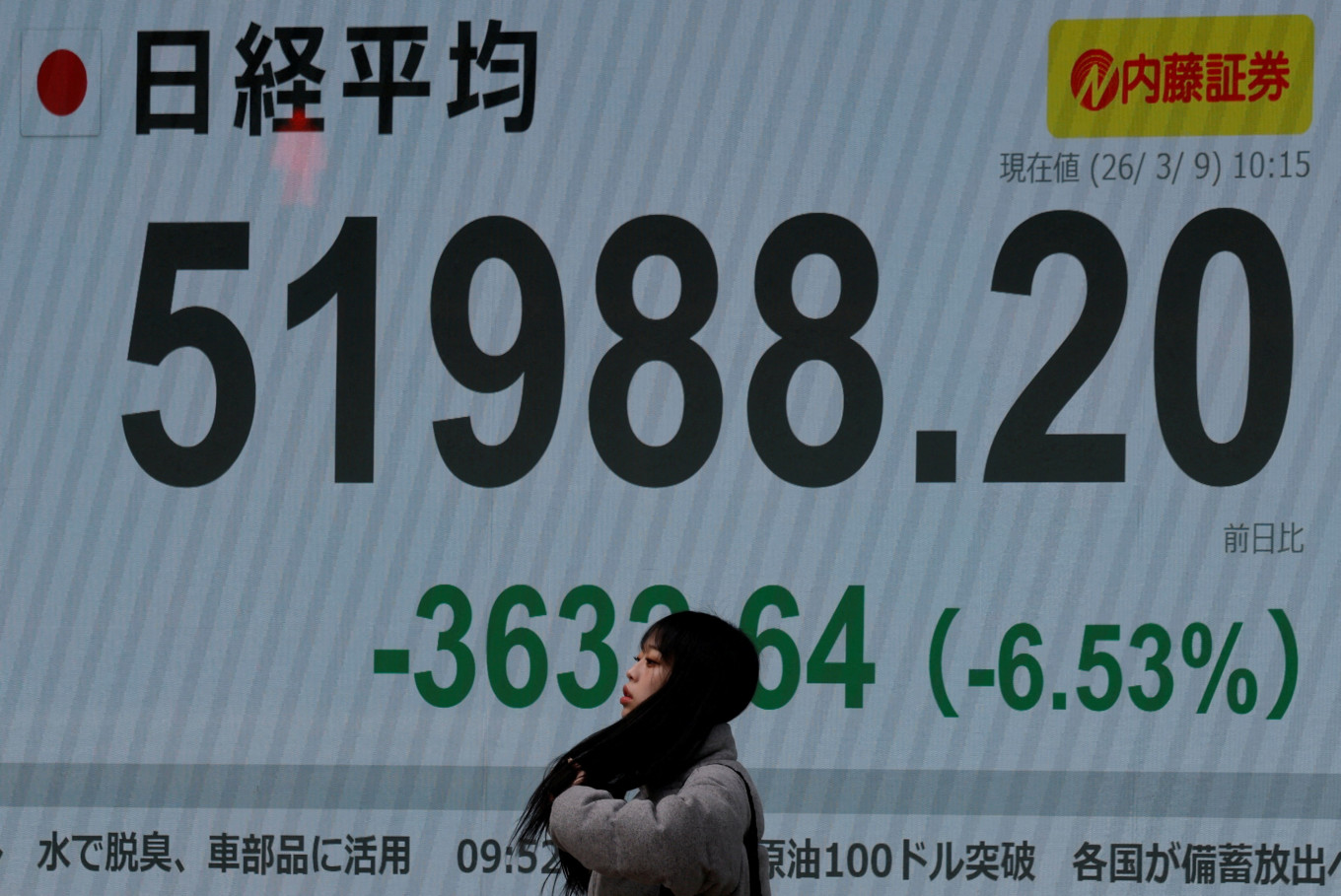 A Pedestrian stands in front of a stock quotation board showing the Nikkei share average outside a brokerage in Tokyo on March 9, 2026. (Reuters/Kim Kyung-Hoon )
A
sian stocks slumped on Friday, poised for a second straight weekly decline as fast-dwindling hopes of a resolution to the US and Israel's war with Iran kept oil prices aloft, casting a shadow over global markets and spurring inflation fears.
The US dollar has become the safe-haven of choice during the tumult, putting most other currencies under pressure. The dollar was set for a second consecutive week of gains and is up 2 percent since the war broke out at the end of February.
Oil prices remained close to the closely watched $100 per barrel level, although they eased a bit in early trading on Friday after US issued a 30-day license for countries to buy Russian oil and petroleum products currently stranded at sea.
Brent futures were last at $99.85 a barrel, while West Texas Intermediate crude was at $95.05 a barrel.
In Asia, MSCI's broadest index of Asia-Pacific shares eased 0.5 percent, on course for a 1.5 percent decline for the week. Japan's Nikkei fell 1.3 percent, while tech-heavy South Korean stocks slid nearly 2 percent and Taiwan equities fell 1 percent.
With Iran stepping up attacks across the Middle East as its new Supreme Leader Mojtaba Khamenei vowed to keep the Strait of Hormuz shipping lane closed, investors are bracing for a prolonged conflict and higher oil prices.

The specter of rising inflation has led markets to rapidly reprice what they expect from central banks this year, with traders now anticipating just 20 basis points of easing from the Federal Reserve compared to 50 bps of cuts priced in last month.
"Markets were positioned for Fed cuts this year but the runway to justify Fed cuts is no longer there with the U.S. excursion into Iran," said Prashant Newnaha, senior rates strategist at TD Securities. "The markets are recalibrating for a higher terminal rate."
The selloff in global stocks and bonds shows no signs of easing. US stocks fell sharply overnight and the two-year Treasury yields, which typically move in step with Fed interest rate expectations, scaled a six-month high on Thursday.
"With the possibility of higher oil prices still elevated, investors should be prepared for continued volatility and potentially further downside in the near term," said Vasu Menon, managing director of investment strategy at OCBC in Singapore.
Jose Torres, senior economist at Interactive Brokers, said the negative impact of rising oil prices on corporate margins, inflation expectations, rate-cut prospects and yields is sparking market volatility, leaving participants with few places to hide.
"Indeed, sinking optimism about Fed rate reductions amid strengthening cost pressures is weighing on traditional safe havens such as silver, gold, and government debt."
The two-year note yield eased 3 bps to 3.730 percent after hitting its highest level since August 22 on Thursday. The yield has gained 35 bps in the two weeks since the war started.
The yield on the longer-dated 30-year bond has risen 24 bps this month.
Investor focus will switch to a slate of policy meetings next week with the Fed, the Bank of Japan, the European Central Bank and the Bank of England all due to meet, with most expected to keep rates unchanged. The Reserve Bank of Australia is broadly expected to hike rates next week.
In currencies, the euro last fetched $1.1527, inching higher on the day but still on course for a weekly decline of nearly 1 percent. The dollar index was at 99.599, set for an 0.8 percent rise for the week.
The yen firmed a bit to 159.13 per dollar, hovering around the 160 mark but the noise around possible intervention has been fairly muted. Analysts said the bar for intervention from Tokyo is higher due to the oil price shock.
"What was once a 'line in the sand' at 160 has evolved into more of a moving goalpost," said Tony Sycamore, market analyst at IG.
"Against such a hostile macro backdrop, it makes little sense for authorities to waste precious intervention ammunition—whether verbal or physical, trying to defend the 160ish level this time around."
Gold was 0.7 percent higher at $5,114 per ounce on Friday but set for a 1 percent drop for the week.