The Jakarta Post
Please Update your browser
Your browser is out of date, and may not be compatible with our website. A list of the most popular web browsers can be found below.
Just click on the icons to get to the download page.


Popular Reads
Top Results
No results found. Please check your search term and try again
Can't find what you're looking for?
View all search results
Popular Reads
Top Results
No results found. Please check your search term and try again
Can't find what you're looking for?
View all search resultsRamadan 2026: More selective, not slower
Spending during Ramadan this year marked an overall shift in composition as consumers moved away from leisure toward necessities, giving policymakers clues as to how best to realign seasonal measures.
Change text size
Gift Premium Articles
to Anyone
Share the best of The Jakarta Post with friends, family, or colleagues. As a subscriber, you can gift 3 to 5 articles each month that anyone can read—no subscription needed!
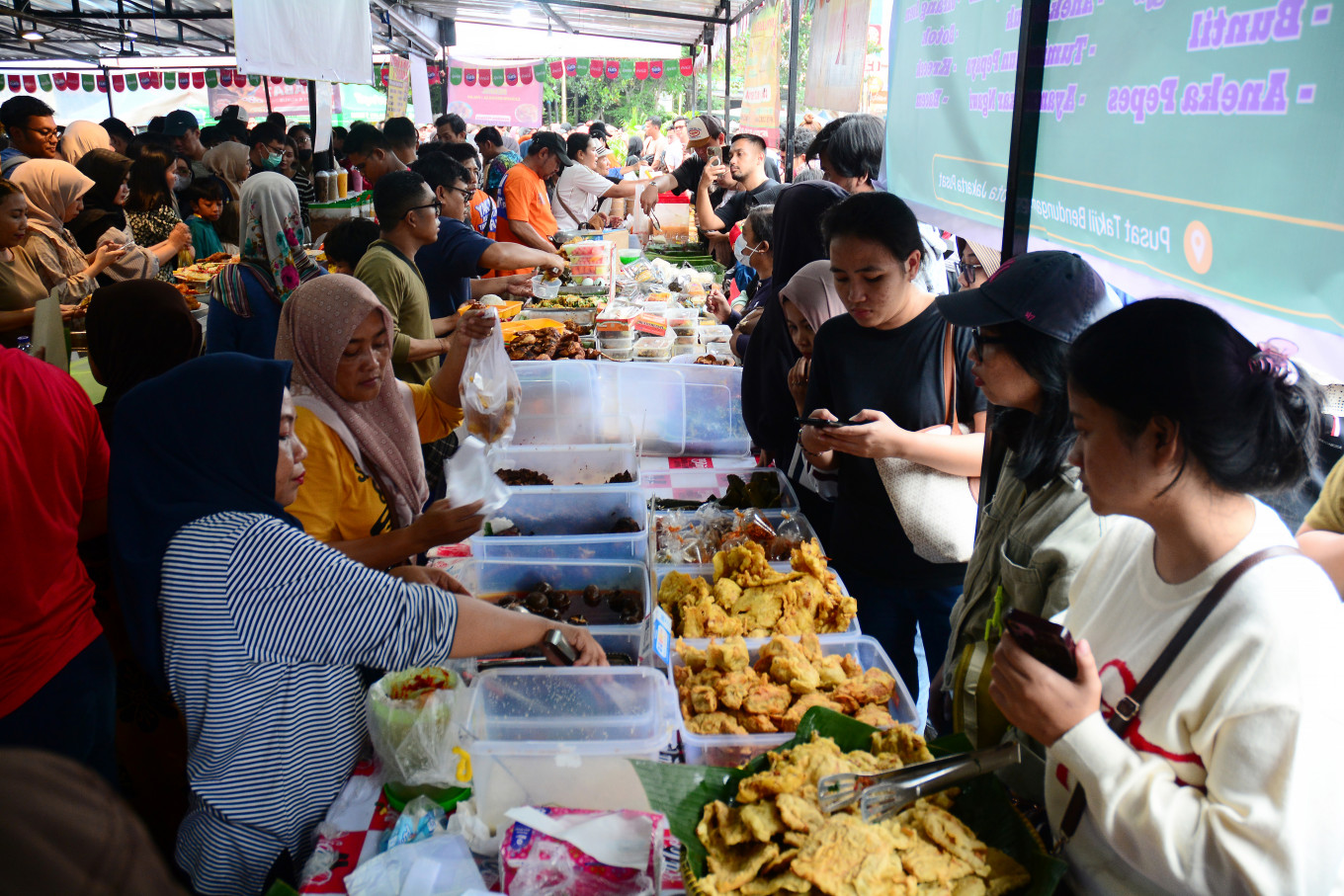 People crowd around vendors selling snacks for iftar on Feb. 22, 2026, at the Bendungan Hilir Ramadan Takjil Bazaar in Tanah Abang, Central Jakarta. (JP/Iqro Rinaldi)
R
amadan has long stood as one of Indonesia’s most critical economic periods, when increased mobility typically translates into stronger consumption. For years, the linkage appeared straightforward: as people moved more, they spent more.
Ramadan 2026, however, tells a more nuanced story. Spending remains robust but the mechanisms behind it are beginning to evolve.
At the aggregate level, the overall picture remains constructive. Spending during Ramadan expanded at a faster pace this year than last year. The compound growth rate from the start of Ramadan to the third week reached around 0.61 percent, compared to 0.50 percent in 2025, implying a roughly 22 percent year-on-year (yoy) acceleration in the pace of spending growth.
Yet this stronger growth came with a notable shift in timing. Spending in 2026 prior to Ramadan fell to around 0.7 percent below the baseline, significantly deeper than the roughly 0.1 percent decline observed in 2025.
In effect, the initial slowdown was nearly seven times more pronounced. However, once Ramadan commenced, spending rebounded quickly, rising to around 0.9-1.8 percent above baseline in the following weeks.
This pattern suggests that households are becoming more intentional, delaying spending earlier and then accelerating more decisively during peak periods.

A second shift is in the composition of growth across income groups. While all segments experienced improvement, the upper-middle income group exhibited the strongest acceleration. Its growth from the baseline to the third week increased by around 0.14 percentage points (pp) relative to 2025, compared to 0.10 pp for the middle income segment and 0.09 pp for the lower income segment.
More notably, the upper-middle segment’s yoy growth in 2026 was approximately 2 to 2.5 times higher than in 2025. This indicates that the upper-middle segment is not only leading consumption, it is amplifying its role as the primary growth driver.
The most revealing change, however, appears in mobility.
Last year, mobility built steadily throughout Ramadan, peaking in the later weeks and reinforcing consumption momentum. In 2026, mobility remained positive but its trajectory was more subdued. Growth in mobility-related spending ranged between 5.2 and 6.1 percent yoy and even higher, reaching up to 9 percent in certain segments, compared to 5.8-6.5 percent in 2025.
This indicates that while mobility did not weaken outright, its expansion was flatter and less pronounced this year than the previous year.
Timing patterns further reinforce this shift. In 2025, mobility gains continued to strengthen toward the end of Ramadan. By contrast, mobility activity in 2026 rose earlier but then plateaued. As a result, overall intensity across the period was lower, even though activity remained present.
Changes in spending composition make this transformation even clearer. In Ramadan 2026, growth was primarily driven by categories such as groceries, electronics, fashion and transportation, suggesting a concentration in essential and preplanned expenditures.
Meanwhile, categories typically associated with discretionary and mobility-driven consumption, such as restaurants, hotels, airlines, entertainment and fuel, recorded weaker performance relative to the overall trend.
This marked a departure from previous patterns. In 2025, sectors like airlines and hotels were among the main beneficiaries of Ramadan activity. In 2026, however, their contribution to incremental growth diminished noticeably.
In relative terms, this indicates a shift in spending composition from leisure-oriented consumption toward necessity-driven spending. Although total expenditure continued to rise, a greater portion of that increase was directed toward essential categories.
This reflects a more selective consumer mindset. Households are not cutting back outright; rather, they are reprioritizing. Essential spending remains protected, while discretionary spending has become more conditional.
At the macro level, these behavioral adjustments are increasingly shaping broader economic patterns. Growth remains evident, but it is becoming more moderate and differentiated.
Regional data show that provinces across Java and Sulawesi continue to post strong and positive spending momentum, suggesting that demand remains active in key economic hubs. At the same time, the overall pattern of consumption appears more mature, less evenly distributed, more dependent on timing and increasingly driven by segments with stronger purchasing power.
This evolution carries important implications for policymakers. As spending becomes more concentrated in specific periods, timing emerges as a critical lever. Aligning fiscal interventions with peak consumption windows could enhance their effectiveness.
Equally, the widening divergence across income groups highlights the importance of sustaining the middle class. While higher income households currently drive momentum, long-term resilience depends on broader participation in consumption.
Maintaining stability in essential sectors is also crucial as spending becomes increasingly concentrated in these areas, requiring reliable supply and stable pricing.
Finally, the changing role of mobility suggests that policy frameworks may need to adapt. Mobility alone is no longer sufficient to drive consumption. Greater impact can be achieved by linking mobility more closely with economic ecosystems, ensuring that movement translates more effectively into spending activity.
Ramadan 2026 ultimately delivers a clear message. Indonesian consumers are not stepping back; they are becoming more strategic. Spending is being delayed, prioritized and reallocated. And within this shift lays a deeper transformation: the future of consumption is no longer defined by how much people spend but by how deliberately they choose to spend it.
*****
The writer is an analyst at the Mandiri Institute.