The Jakarta Post
Please Update your browser
Your browser is out of date, and may not be compatible with our website. A list of the most popular web browsers can be found below.
Just click on the icons to get to the download page.


Popular Reads
Top Results
No results found. Please check your search term and try again
Can't find what you're looking for?
View all search results
Popular Reads
Top Results
No results found. Please check your search term and try again
Can't find what you're looking for?
View all search resultsDollar surges in Asia as war's safe-haven shelter
Change text size
Gift Premium Articles
to Anyone
Share the best of The Jakarta Post with friends, family, or colleagues. As a subscriber, you can gift 3 to 5 articles each month that anyone can read—no subscription needed!
 Set as preferred source
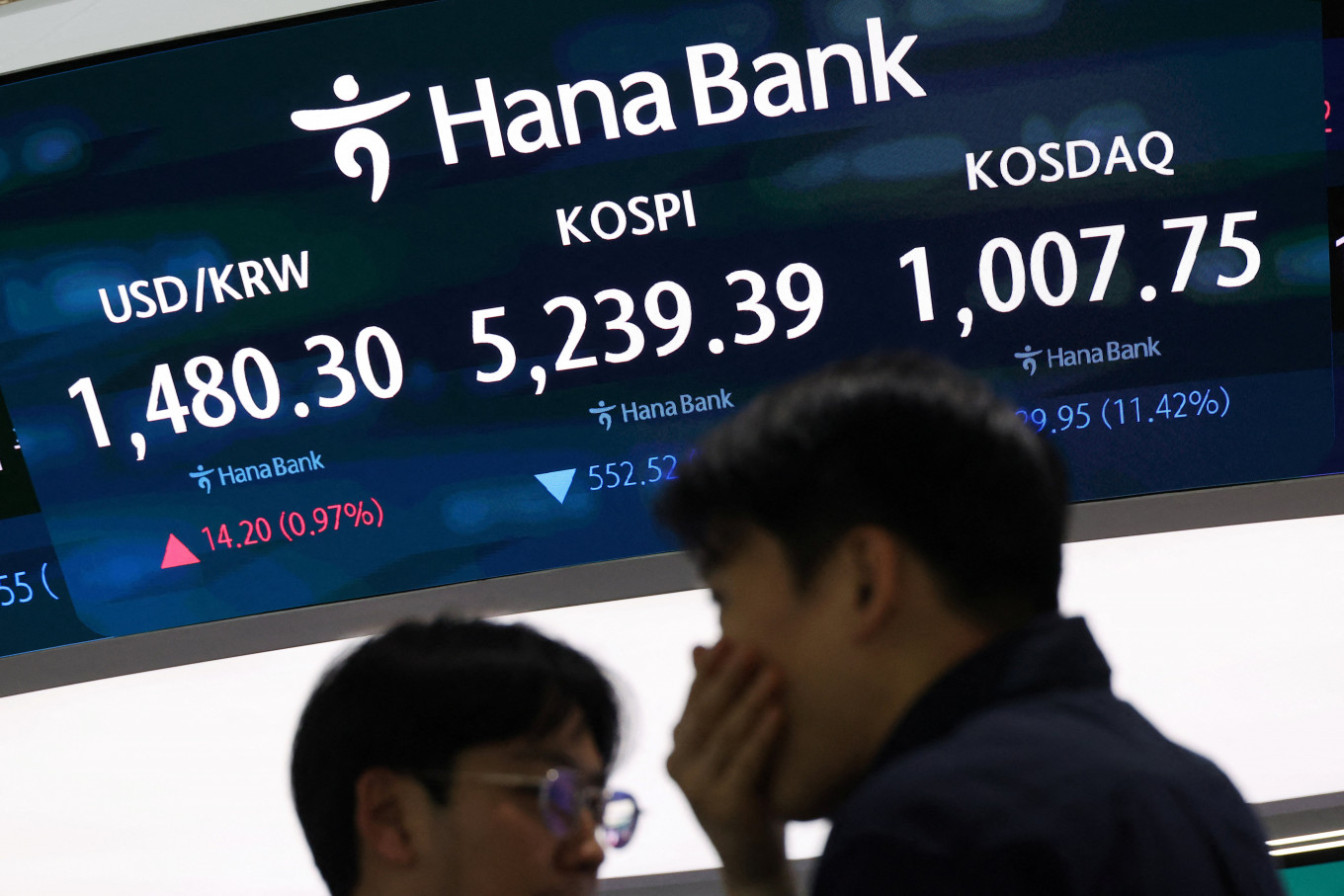 Currency dealers talk in front of an electronic board displaying the Korea Composite Stock Price Index (KOSPI), the exchange rate between the US dollar and South Korean Won and the Korea Securities Dealers Automated Quotations (KOSDAQ) at the dealing room of a bank in Seoul on March 4, 2026. (Reuters/Kim Hong-JI)
T
he dollar headed for its biggest monthly gain since July on Tuesday and stands out as the strongest so-called safe asset as war in the Middle East has set oil prices surging, nearly everything else sinking and raised the risk of global recession.
A Wall Street Journal report that US President Donald Trump is willing to end attacks on Iran without forcing open the Strait of Hormuz, according to unnamed officials, set crude slightly lower in Asia trade but hardly budged the dollar.
It pushed 1 percent higher on South Korea's won to 1,534 won, levels touched only in the wake of the global financial crisis in 2009 and the Asian financial crisis in 1997 and 1998.
The euro was kept below US$1.15, while sterling and the Australian and New Zealand dollars were pinned to multi-month lows.
Renewed threats of intervention from Tokyo spared extra selling pressure on the yen, which touched its weakest since July 2024 on Monday and trades at 159.52 per dollar.
The dollar has been supported by the US status as an energy exporter, by rising US Treasury yields and by investors' flight to cash over the past month of conflict, with Asian currencies suffering some of the largest losses.

"Barring any clear, conciliatory messages from the Iranian side, it is hard to see the dollar handing back this month's gains anytime soon," said Chris Turner, ING's global head of markets.
Dollar stands tall
Bonds, gold and safe-haven currencies such as the yen and Swiss franc have all fallen through March, as the energy shock delivered by $100-a-barrel crude oil exposed weaknesses.
The US dollar index meanwhile touched its highest since last May on Monday at 100.61 and, last sitting at 100.47, is up 2.9 percent through March, its sharpest monthly rise since July.
A looming inflation spike has hurt bonds. A positioning clearout has sunk gold, while the energy shock hurts Japan's terms of trade and Swiss authorities have indicated they would intervene to stem any steep gains for the franc.
The dollar is up nearly 4 percent for the month on the franc at 0.80 francs and has broken resistance levels for the Aussie and kiwi in recent sessions. The kiwi, down six straight sessions, is on the verge of breaking below 57 cents.
The Aussie has fallen for eight sessions and hit a a two-month low of $0.6834, down 3.7 percent for March and under major support at $0.6897. Sterling hovered just above $1.32.
The main risk to the dollar might come from labour data due out in the liquidity vacuum of Good Friday, or, warned strategists at Union Bancaire Privee, a breakdown in the relationship that usually sees the dollar higher if stocks fall.
"FX – equity correlations have been quite stable since the outbreak of the conflict, though this could change if markets move to price in a more prolonged conflict – with still uncertain outcomes," they said.
March inflation data is due later in the session in Europe and is likely to rip back above the European Central Bank's 2 percent target.