The Jakarta Post
Please Update your browser
Your browser is out of date, and may not be compatible with our website. A list of the most popular web browsers can be found below.
Just click on the icons to get to the download page.


Popular Reads
Top Results
No results found. Please check your search term and try again
Can't find what you're looking for?
View all search results
Popular Reads
Top Results
No results found. Please check your search term and try again
Can't find what you're looking for?
View all search resultsNavigating oil shock: Fiscal challenges, policy choices for Indonesia
While Indonesia faced a similar situation in 2022, the ongoing Iran war represents a different dynamic that will require critical policies that balance fiscal stability and purchasing power toward maintaining resilience.
Change text size
Gift Premium Articles
to Anyone
Share the best of The Jakarta Post with friends, family, or colleagues. As a subscriber, you can gift 3 to 5 articles each month that anyone can read—no subscription needed!
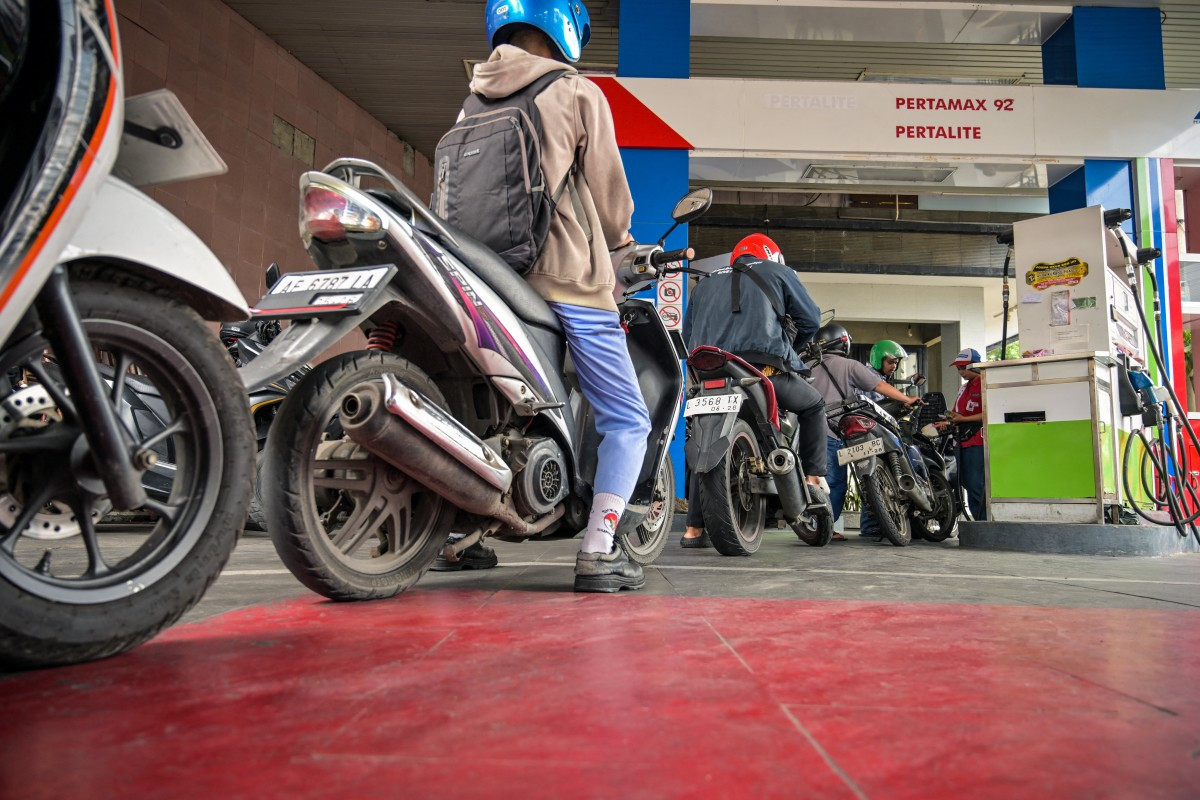 Motorists wait in line to fill their tanks on March 9, 2026, at a gas station in Surabaya, East Java.
(AFP/Juni Kriswanto)
Motorists wait in line to fill their tanks on March 9, 2026, at a gas station in Surabaya, East Java.
(AFP/Juni Kriswanto)
G
lobal uncertainty has intensified once again amid the ongoing United States-Israeli war with Iran, leading to rising global energy prices. For Indonesia, this development is particularly concerning, given its position as a net oil importer, making the economy highly sensitive to movements in global oil prices.
Higher energy prices will add pressure to the state budget through increased energy subsidies and compensation. Furthermore, if domestic fuel prices are adjusted, it will also cause inflationary pressures.
Nevertheless, compared to other countries in the region, Indonesia’s resilience to oil supply disruptions remains relatively strong. Indonesia’s oil and gas imports from the Middle East account for only around 20 percent of total imports. This is significantly lower than the figures for Malaysia, which relies on Middle Eastern crude oil for approximately 69 percent of its imports, and the Philippines, where the share reaches around 95 percent.
Such high dependence on a single region makes these countries more vulnerable to supply disruptions and price volatility. In contrast, Indonesia benefits from import diversification across the US, Africa and Brazil.
Despite this, price is still the primary risk. The likelihood of Brent Crude Oil prices staying above US$100 per barrel remains significant, particularly if negotiations between Iran and the US fail to reach a resolution.
From the fiscal perspective, this condition is critical. If the Indonesian Crude Price (ICP) averages above $82 per barrel throughout the year, the fiscal deficit could potentially exceed the 3 percent of GDP threshold.

Historically, ICP has tended to be approximately $2 below Brent prices over the past decade. With Brent currently at around $76 per barrel (year-to-date average), prices have already surpassed the budget assumption of $70 per barrel and could push the deficit beyond the initial target.
Under such conditions, the government faces a complex policy dilemma. To maintain the fiscal deficit below the mandated 3 percent cap, adjustments to subsidized fuel prices become nearly unavoidable, as was seen in 2022. However, such measures have direct implications for inflation and household purchasing power. A 10 percent increase in the price of Pertalite and diesel, for instance, is estimated to add around 0.3 percentage point (pp) to inflation, thereby narrowing the policy space further.
We faced similar situation in 2022 during Russia-Ukraine war, which also led to a rise in the Brent Crude price to a maximum $117.5 per barrel.
From a fiscal standpoint, the elasticity of ICP increases in 2026 reflects a different dynamic compared to 2022.
Four years ago, the rise in oil prices was also followed by a steep rise in the prices of other commodities such as coal and crude palm oil (CPO). Thus, despite surging energy prices, the fiscal deficit was contained due to additional revenues from commodity windfalls, particularly from the two abovementioned commodities, supported by improved terms of trade.
In 2026, however, rising oil prices may add bigger pressure to fiscal balances. This is consistent with Indonesia’s position as a net oil importer, which means it must bear higher subsidy and compensation burdens amid an increasingly rigid fiscal structure. Meanwhile, the potential windfall from coal and CPO may be lower than in 2022, as the present impact on the prices of these commodities are so far milder than it was then, influenced by a slowing global economy.
Fiscal challenges in 2026 are further compounded by weakening household purchasing power compared to the post-pandemic period. In 2022, despite price increases of more than 30 percent for subsidized fuel, purchasing power remained relatively resilient, supported by elevated household savings and pent-up demand.
However, the current conditions differ. Household savings, particularly among lower- and middle-income groups, have declined significantly. The average savings balance for accounts below Rp 100 million ($5,900) has fallen by approximately Rp 1.7 million as of February, marking the lowest level in the past decade.
This condition is likely to make these income groups more defensive in their consumption behavior. Data from the National Socioeconomic Survey (SUSENAS) indicate these groups tend to reduce fuel consumption when prices increase, while higher-income groups trade down from nonsubsidized to subsidized fuel.
Consistent with this trend, the durable goods purchasing index has declined to a level below the post-pandemic period, from 109 points in 2021 to 100.1 points.
In addition, data from the Mandiri Spending Index (MSI) indicate a shift in spending allocation from nonessential items toward fuel. Among lower- and middle-income groups, the share of spending on fuel increased by an average of 0.8 pp during 2021-2022.
In contrast, spending on other nonessential items declined, including fashion (1.0 pp), electronics (1.1 pp) and automotive (0.4 pp). These findings suggest that rising energy prices not only affect fiscal balances but also have the potential to dampen domestic consumption growth, the main engine of the economy.
In this context, budget efficiency policies become increasingly critical. The government has initiated several cost-saving measures, including a work from home (WFH) arrangement for civil servants to reduce national fuel consumption. These measures serve not only as short-term responses but also as part of broader demand-side energy management strategies. The government has also indicated an initial fiscal buffer of approximately Rp 80 trillion from several efficiency efforts.
If oil price pressures persist, however, a much larger buffer will be required. Other reallocation or efficiency measures for priority programs may be unavoidable.
Furthermore, strengthening structural policies remains key to ensuring fiscal sustainability. Increasing the tax ratio to 12 percent of GDP, comparable to the rate in countries such as Malaysia and Thailand, represents an important step in reinforcing state revenues. In addition, accelerating the energy transition through electric vehicle adoption could help reduce fossil fuel dependence over the medium to long term.
Ultimately, the government faces a classic dilemma: maintaining fiscal stability without undermining household purchasing power. In an increasingly uncertain global environment, balancing these objectives becomes even more critical. Therefore, a combination of short-term policies, such as energy efficiency, price adjustments and structural reforms on both the revenue and expenditure sides is unavoidable.
Fiscal resilience is not merely about keeping the deficit within safe limits but also about ensuring that the state budget continues to function as a shock absorber and a tool for stabilization. Amid growing global pressures, the government’s ability to strike this balance will be a key determinant of Indonesia’s economic resilience going forward.
*****
The writer is an economist at Bank Mandiri.