TheJakartaPost
Please Update your browser
Your browser is out of date, and may not be compatible with our website. A list of the most popular web browsers can be found below.
Just click on the icons to get to the download page.


Popular Reads
Top Results
No results found. Please check your search term and try again
Can't find what you're looking for?
View all search results
Popular Reads
Top Results
No results found. Please check your search term and try again
Can't find what you're looking for?
View all search resultsEnsuring quality education in the 3T regions
Change text size
Gift Premium Articles
to Anyone
Share the best of The Jakarta Post with friends, family, or colleagues. As a subscriber, you can gift 3 to 5 articles each month that anyone can read—no subscription needed!
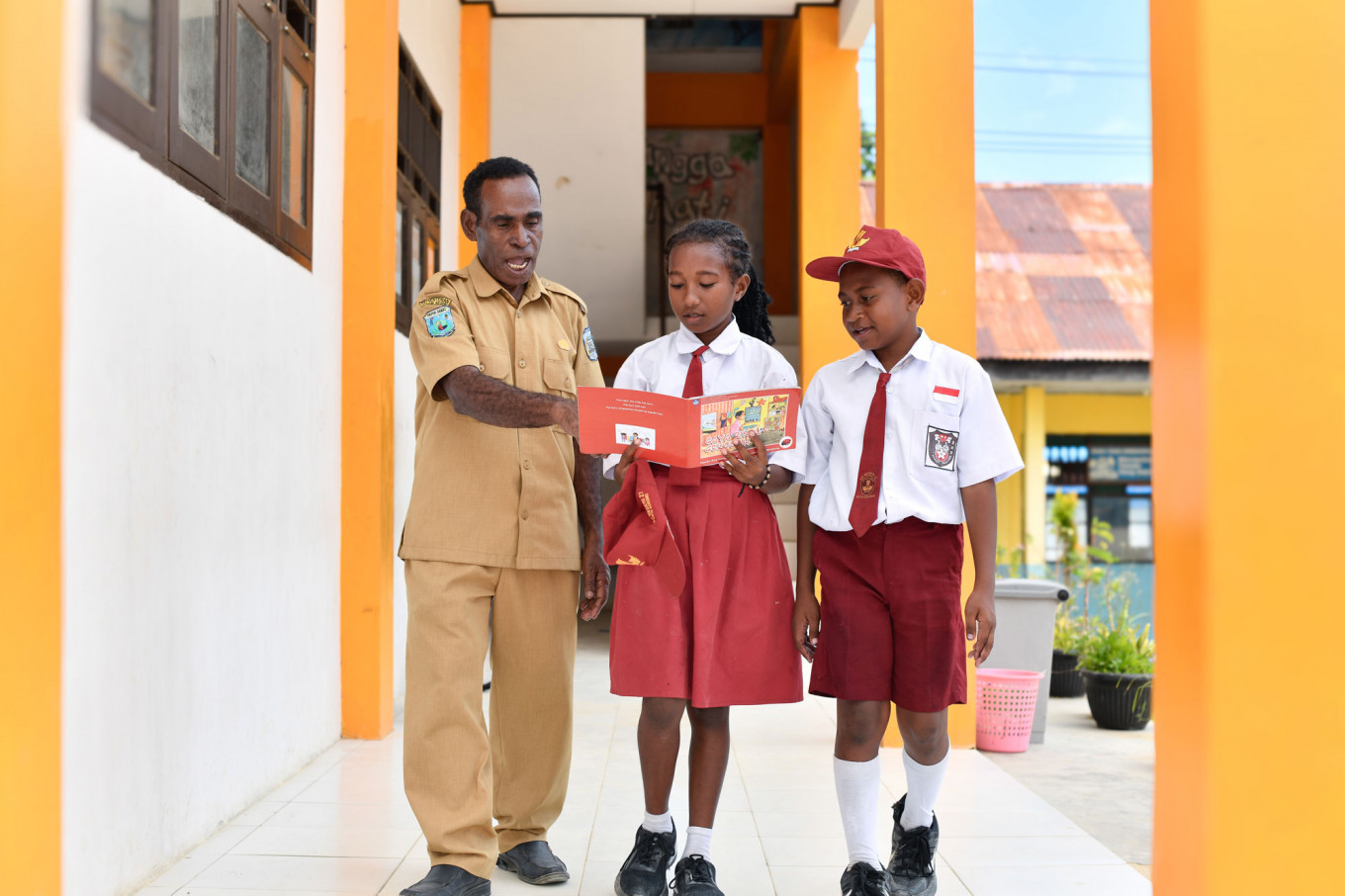 (Images courtesy of the Ministry of Primary and Secondary Education)
I
n Barma Baru village, Meyado district, Teluk Bintuni regency, West Papua, change is evident. TK Negeri Barma Baru, a kindergarten that for years had to endure a cramped, plywood-partitioned space, now stands in a more suitable building with much more adequate facilities.
The kindergarten's revitalization efforts were spearheaded by a grant of Rp 780.5 million, which was used to build new classrooms, a school health unit (UKS) room, proper sanitation facilities and a children's play area.
Despite constraints such as a limited communication network and frequent rainy weather, the construction was finally completed after 120 working days, and the school now provides a safer and more comfortable learning space for the children.
Supriyanti, the principal of TK Negeri Barma Baru, said the revitalization program assistance was received at the end of 2025 after a long wait. "We never get tired of it. We’ve always put in the effort. God willing, if we don't get it this year, maybe we will next year," she said.
The school’s revitalization assistance is just one example of the government’s continuous efforts to strengthen education services in frontier, outermost and disadvantaged (3T) regions, aiming to promote equitable access to quality education.
The policy focus is directed at school revitalization and accelerating the digitalization of learning.

The school revitalization program focuses on classroom renovation, school building rehabilitation and the provision of more suitable and safe learning facilities and infrastructure.
Nationally, the program has reached more than 16,000 educational units, with budget realization exceeding 90 percent. To date, a total of 1,079 educational units in 3T regions have been revitalized.
The push to accelerate the school revitalization program aligns with President Prabowo Subianto's prioritizing of education as a determining factor in the nation's future.
"Education determines whether this country will be poor or a nation that is good for its people. We must improve as many schools as possible throughout Indonesia as quickly as possible," he said at the commemoration of the 2025 National Education Day in Bogor, West Java.
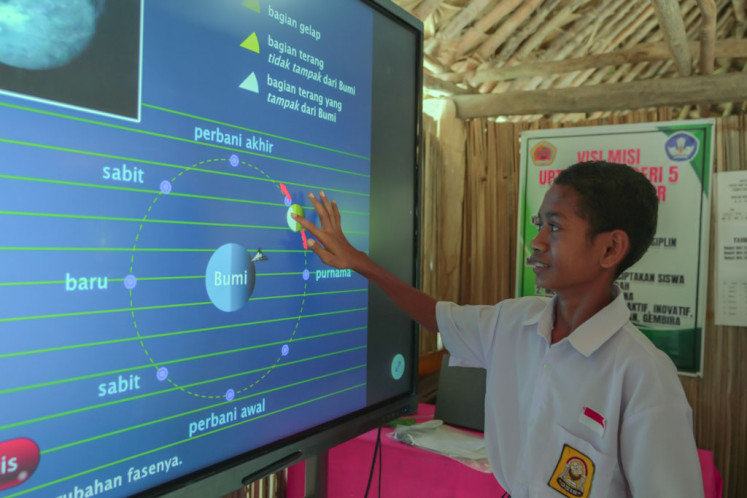
In line with physical revitalization, the government is also pushing to accelerate the digitalization of learning in educational institutions. The program, which began in mid-2025, has reached more than 288,000 schools nationally, with more than 13,000 schools located in the 3T areas.
Through this program, devices such as digital interactive boards or interactive flat panels (IFPs) have begun to be distributed to various schools, including those in the 3T regions.
At TK Pembangunan Yapis in Skanto District, Keerom regency, Papua, the technology has begun to transform the way students learn, as the IFP devices allow children to directly interact with learning materials through digital screens.
The kindergarten’s principal, Winarsih, said the digital devices were a new experience for teachers and students. "This is truly extraordinary. We've never known or understood what this technology looks like before," she said.
Similar changes have been seen in other areas of Papua. In Sentani District, Jayapura regency, the use of digital interactive boards has created a much more dynamic learning environment in the classroom.
The principal of TK Kristen Baik, Heti Syawfaruddin, revealed that this change has had a direct impact on student engagement. "Previously, during morning exercise, the children were often lethargic. Some just sat there, others ran around aimlessly. But now, everyone moves and follows the movements on the screen," she said.
Along with the distribution of IFPs, the program is also augmented with training for 33,166 educators and education personnel (PTK), as well as the provision of 2,856 digital learning content to support the use of technology in the classroom.
In 2026, the program will focus on strengthening the quality of implementation, with the government targeting the addition of up to 3,750 digital learning materials, training for 30,750 PTK, and optimizing the use of devices in the teaching and learning process.
PIP and ADEM scholarship
Beyond strengthening infrastructure and digitalization, the government is also expanding its interventions through educational assistance programs and human resource development.
The Smart Indonesia Program (PIP) serves as a key instrument for maintaining educational continuity, particularly for students from vulnerable families in the 3T regions.
Nationally, PIP has reached approximately 19 million students with a near-perfect budget realization rate. In the 3T regions, the program targets more than 900,000 students with a total budget of Rp 631.9 billion, demonstrating that the intervention is specifically targeted to reach the groups most in need.
Furthermore, the Secondary Education Affirmation (ADEM) program also expands access for groups facing structural barriers, including students in special regions and Papua. By 2025, the program reached 1,798 students with budget support of over Rp 35 billion.
Going forward, the government also plans to increase the value of assistance and expand its coverage to strengthen equity in secondary education.
Supporting teacher welfare
Efforts to equalize education are also balanced by strengthening teacher competency and welfare, particularly in the 3T regions.
As of 2025, 82,712 teachers nationwide will have participated in various capacity-building programs, including technology-based training, artificial intelligence (AI), coding and STEM.
Specifically in 3T regions, the teacher professional education (PPG) program reached 39,961 teachers across all levels, while academic qualification improvement is also continuously encouraged for hundreds of early childhood education (PAUD) and elementary school teachers.
At the same time, the government is strengthening welfare through various assistance schemes. In 3T regions, the distribution of the teacher professional allowance (TPG) for non-civil servants reached 10,797 teachers with a value of over Rp 218 billion.
In addition, special allowances were provided to 14,643 teachers with a total budget of approximately Rp 310 billion, as well as incentives for 16,508 non-civil servant teachers worth nearly Rp 35 billion. This policy is also reinforced by an increase in the monthly incentive for non-civil servant teachers from Rp 300,000 to Rp 400,000.
Along with improving the quality of learning, the policy aims to ensure the sustainability of education services in regions with complex geographic and social challenges.
For 2026, the focus is on accelerating certification through the PPG program, strengthening digital competencies and improving teacher welfare as part of a strategy to sustainably maintain the quality of education.
A directed, sustainable approach
The impact is also evident in the distribution of beneficiaries across various 3T regions.
For example, in East Nusa Tenggara, the number of education assistance recipients is concentrated in areas with high levels of vulnerability, such as South Central Timor regency and Kupang regency.
This more targeted approach is also supported by improvements in data systems. The government has begun optimizing the use of more up-to-date targeting data to ensure that education assistance is targeted appropriately.
With a more precise database, the distribution of programs such as the PIP and other affirmative assistance programs has become more effective in reaching community groups that truly need support.
Furthermore, the implementation of education programs in 3T regions has also demonstrated significant economic impact.
The school revitalization program, for example, is implemented using a community-based self-management approach involving tens of thousands of micro-entrepreneurs and local workers. This approach simultaneously stimulates the local economy and strengthens community ownership of the educational facilities being built.
With a variety of complementary interventions, the national education policy now demonstrates an increasingly comprehensive approach, expanding access while also ensuring the quality and sustainability of education services, particularly for communities in the 3T regions.