The Jakarta Post
Please Update your browser
Your browser is out of date, and may not be compatible with our website. A list of the most popular web browsers can be found below.
Just click on the icons to get to the download page.


Popular Reads
Top Results
No results found. Please check your search term and try again
Can't find what you're looking for?
View all search results
Popular Reads
Top Results
No results found. Please check your search term and try again
Can't find what you're looking for?
View all search resultsAt Samsung, the global AI boom spurred a looming strike and deep divisions
A looming 18-day strike at South Korean chip giant Samsung that has triggered worries within the government, rattled foreign investors and threatened global supply chains rests on one crucial question: who should share in the spoils of the AI boom?
Change text size
Gift Premium Articles
to Anyone
Share the best of The Jakarta Post with friends, family, or colleagues. As a subscriber, you can gift 3 to 5 articles each month that anyone can read—no subscription needed!
 Set as preferred source
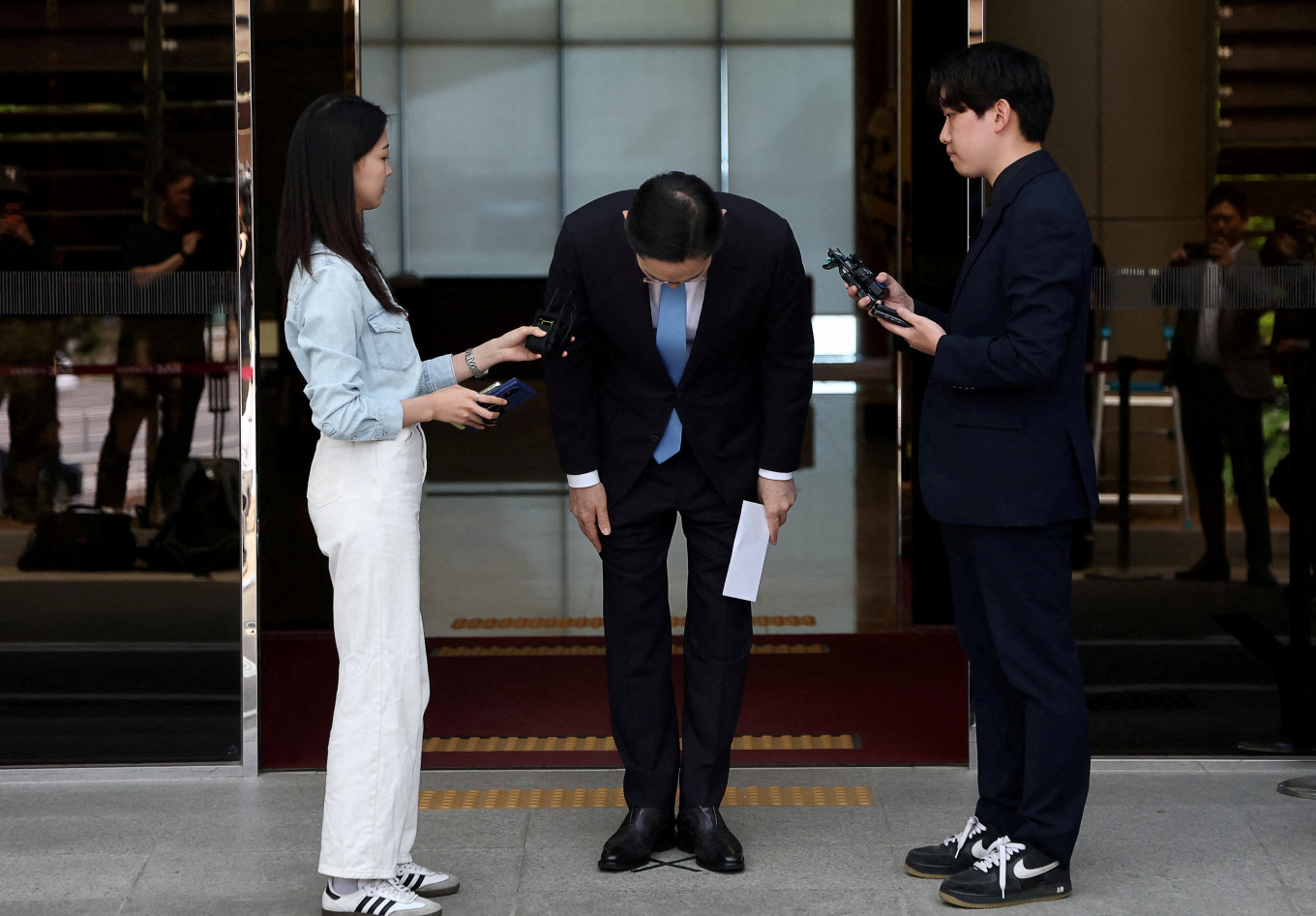 Samsung Electronics Chairman Jay Y. Lee bows as he apologizes over Samsung's labor dispute in his first public comments on the issue, in Seoul, on May 16, 2026. (Reuters/Yonhap)
A looming 18-day strike at South Korean chip giant Samsung that has triggered worries within the government, rattled foreign investors and threatened global supply chains rests on one crucial question: who should share in the spoils of the AI boom?
More than 45,000 workers are threatening to stage the largest strike in the conglomerate's history from May 21, reducing production of memory chips that are crucial components in AI data centers, smartphones and laptops, as Samsung and its union struggle to find a compromise over bonus payouts.
Samsung Electronics, which has reaped huge profits from a global memory shortage, has offered to pay generous bonuses to staff. But it wants to give 27,000 memory chip employees at least six times more than its other workers in its logic chip design and manufacturing businesses.
Its union argues that the firm's other 23,000 workers who are responsible for making AI chips for Tesla and Nvidia and often work in the same buildings as their memory colleagues, should not be left behind, despite suffering billions in losses in recent years as the foundry business floundered.
Reuters reviewed hundreds of pages of transcripts covering Samsung internal wage negotiations and spoke with more than 10 workers, including union leaders, and sources familiar with the discussions.

They spoke of deep divisions, described employee departures and revealed how this could be traced to – and threaten – Samsung’s unusual goal to become the world's only semiconductor company offering a "one-stop" shop that spans different types of chips and services, unlike more specialized competitors like Micron or TSMC.
The internal discussions showing friction between the company divisions and employee departures have not been previously reported.
JPMorgan estimated the strike could impact Samsung's operating profit by 21 trillion won to 31 trillion won (US$14.08 billion to $20.79 billion), while sales losses could stand at about 4.5 trillion won.
Samsung's Device Solutions Division includes three main businesses – memory, system LSI, and foundry – and the AI boom has made these divisions wildly unequal in profitability. Samsung is the world's top memory chipmaker by sales but also makes televisions and smartphones.
The issues are "partly self-inflicted by the company," Namuh Rhee, a Yonsei University professor and chairman of a Korean corporate governance group, said on social media.
He said Samsung's move to put different businesses together created a complex business structure that results in a valuation discount while causing conflicts of interest and limiting business opportunities. "Samsung must enable foundries to become self-reliant."
Talent drain threat
Discontent among Samsung workers grew last year after rival SK Hynix abolished its bonus pay cap for 10 years. This resulted in bonuses more than three times higher than those offered to Samsung workers, which later lured some people to jump ship.
In March, Samsung proposed that memory chip workers receive bonuses that would top those of SK Hynix employees, or 607 percent of their annual salary, according to transcripts of its wage negotiations. The company's memory and logic chip businesses used to receive the same bonus plan.
But employees in its other businesses who work primarily on logic chips, such as "base die" which are crucial components of AI chips, would receive bonuses of 50 percent to 100 percent, according to the documents.
Union officials argued that the big gap in bonuses would push logic chip employees to leave for the memory unit or for other companies, crippling it after Samsung Chairman Jay Y. Lee said he wants to be the "clear No. 1" in the logic chip market by 2030.
"If the memory division gets 500 million won while the foundry division only gets 80 million won, what motivation would those employees have to keep working?" said union leader Choi Seung-ho during negotiations, according to the transcripts.
Some workers said an exodus was already underway. A worker who identified himself by his surname, Lee, a foundry engineer in Pyeongtaek, said his team has shrunk sharply in the past couple of years as some of them moved to Samsung's memory division and SK Hynix.
Two other employees who declined to be named said many of their colleagues are currently applying for jobs with SK Hynix and other companies. SK Hynix did not provide an immediate comment.
The union's demands include requests for Samsung to abolish a bonus cap of 50 percent of annual salaries and allocate 15 percent of annual operating profit to a bonus pool distributed to workers.
Samsung negotiators say performance bonuses should be paid out according to merit.
"They, the logic chip business, posted losses in the trillions of won and honestly, if it had not been for our company, they probably would have gone out of business or closed down," said Samsung executive and negotiator Kim Hyung-ro, according to the transcripts. "So how can you justify giving performance bonuses?"
"The company still has faith in this business and continues to invest consistently in facilities - and in reality, those investments are being funded with money earned from the memory business."
In a statement, Samsung said "the logic chip business is a strategically significant business which we have continuously invested in, guided by our long-term vision."
"Samsung Electronics will offer its employees the best compensation in the industry" with the latest proposal, it said.
Samsung also said that should the strike go ahead, a failure to deliver to customers would result in "a complete loss of trust."
Ripple effect
Samsung's top leadership, the South Korean government and investors have voiced concerns about how the potential strike could threaten Samsung and affect the broader economy.
In an internal memo earlier this month, Samsung's board chairman said apart from business disruptions, a strike could trigger capital outflows, a drop in tax revenue and a weakening of the won.
In late April, South Korean President Lee Jae Myung said some unions were making excessive demands, in remarks that were widely perceived as aimed at Samsung's unions.
The American Chamber of Commerce in Korea said the labor uncertainty could affect confidence in Korea's reputation as a dependable partner in global manufacturing and supply chains.
Analysts said other companies were watching the dispute as a potential barometer for labor-management relations.
"If Samsung sets a precedent in which union demands are pushed through by means of a strike, companies could find themselves in a very unfavorable bargaining position in the future," Korea University law professor Park Ji-soon said.
Reuters spoke to protesting workers who said Samsung did not recognize its employees' contributions to making it a world-leading company.
Lee, a chip researcher for 30 years, told Reuters on the sidelines of a rally of about 40,000 workers in late April that many of his colleagues had left for other companies and that he had applied to work at Micron.
"I attended the rally because I am infuriated," he said. "I can't just sit in the office and work."
"I no longer have pride in Samsung."