TheJakartaPost
Please Update your browser
Your browser is out of date, and may not be compatible with our website. A list of the most popular web browsers can be found below.
Just click on the icons to get to the download page.


Popular Reads
Top Results
No results found. Please check your search term and try again
Can't find what you're looking for?
View all search results
Popular Reads
Top Results
No results found. Please check your search term and try again
Can't find what you're looking for?
View all search resultsChina's economy loses steam at start of Q2
Better-than-expected exports and China's domestic fuel-pricing controls have helped weather the energy shock, but higher input costs threaten to squeeze already weak factory margins and further dampen consumer spending if the conflict drags on.
Change text size
Gift Premium Articles
to Anyone
Share the best of The Jakarta Post with friends, family, or colleagues. As a subscriber, you can gift 3 to 5 articles each month that anyone can read—no subscription needed!
 Set as preferred source
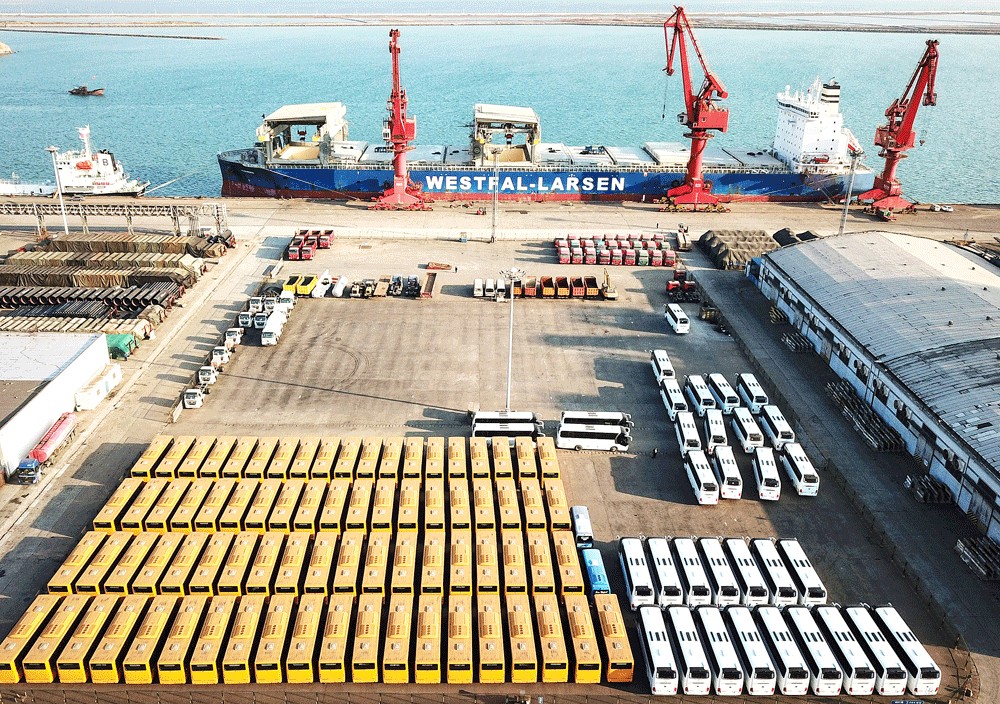 Slow manufacturing: New buses are seen lined up for export at a port in Lianyungang in east China’s Jiangsu province on Wednesday. Chinese factory activity slowed in October, official data showed on Wednesday, adding to a growing list of bad news for the Asian giant as it struggles to maintain economic momentum in the face of United State tariffs and a weakening yuan. (AFP/-)
C
hina's growth lost momentum in April, with industrial output cooling and retail sales sinking to over three-year lows as the world's second-biggest economy wrestled with higher energy costs from the Iran war and persistently weak domestic demand.
Better-than-expected exports and China's domestic fuel-pricing controls have helped weather the energy shock, but higher input costs threaten to squeeze already weak factory margins and further dampen consumer spending if the conflict drags on.
Factory output grew 4.1 percent from a year earlier last month, compared with a 5.7 percent rise in March, data from the National Bureau of Statistics (NBS) showed on Monday, missing a Reuters poll forecast for 5.9 percent growth and marking the slowest growth since July 2023.
"The strong performance of the exporters helped to mitigate the weaknesses in domestic demand, but not enough to fully offset it," said Zhiwei Zhang, president and chief economist at Pinpoint Asset Management.
Exports gathered pace in April as factories raced to meet a wave of orders from AI-related industries and other buyers seeking to stockpile components amid fears the Iran war could push global input costs even higher.
Zhang didn't expect the government to change its policy stance on just one month of weak data and said Beijing will likely reassess its policy stance in July when the second-quarter GDP data is available.

Retail sales, a gauge of consumption, rose just 0.2 percent in April, cooling sharply from 1.7 percent in March and sliding to their weakest gain since December 2022. The figures were also well below forecasts centred on a 2 percent increase.
The fragility of household consumption was underscored in April domestic car sales, which dropped 21.6 percent in April from a year earlier for their seventh straight month of decline, even as automakers ramped up efforts to expand in overseas markets to offset weakness at home.
"Retail sales growth in the first four months of 2026 points to still-weak household demand, with consumers concentrating spending on selective discretionary and upgrade categories rather than broad-based consumption," said Yuhan Zhang, principal economist at the Conference Board's China Center.
He said the split highlights a two-speed recovery: steady spending on small lifestyle and tech upgrades, but weak appetite for big-ticket, credit-driven purchases tied to housing and income.
The nationwide survey-based jobless rate nudged down to 5.2 percent in April from 5.4 percent in March.
Adding to the gloom, fixed-asset investment (FAI) contracted 1.6 percent in the first four months of 2026, compared with a 1.7 percent rise in the January-March period and a 1.6 percent expansion forecast.
Domestic crude steel output echoed the weak investment data, falling 2.8 percent from a year earlier.
"We believe weaker credit demand and heavy rainfall in southern China may have contributed to the April FAI decline compared with the first quarter," Lisheng Wang, economist at Goldman Sachs said in a note, cautioning that the occasional NBS "statistical correction" of previously reported data may have amplified the volatility.
China stocks looked past the weak data and were broadly flat, as investors turned their focus to escalating tensions in the Middle East and a global bond selloff.