The Jakarta Post
Please Update your browser
Your browser is out of date, and may not be compatible with our website. A list of the most popular web browsers can be found below.
Just click on the icons to get to the download page.


Popular Reads
Top Results
No results found. Please check your search term and try again
Can't find what you're looking for?
View all search results
Popular Reads
Top Results
No results found. Please check your search term and try again
Can't find what you're looking for?
View all search resultsG7 finance chiefs seek to tackle imbalances in wake of bond selloff
Ministers are set to discuss the economic fallout from the conflict and volatility on global bond markets, which are of particular concern to Japan, as they also seek common ground on tackling economic tensions and global imbalances.
Change text size
Gift Premium Articles
to Anyone
Share the best of The Jakarta Post with friends, family, or colleagues. As a subscriber, you can gift 3 to 5 articles each month that anyone can read—no subscription needed!
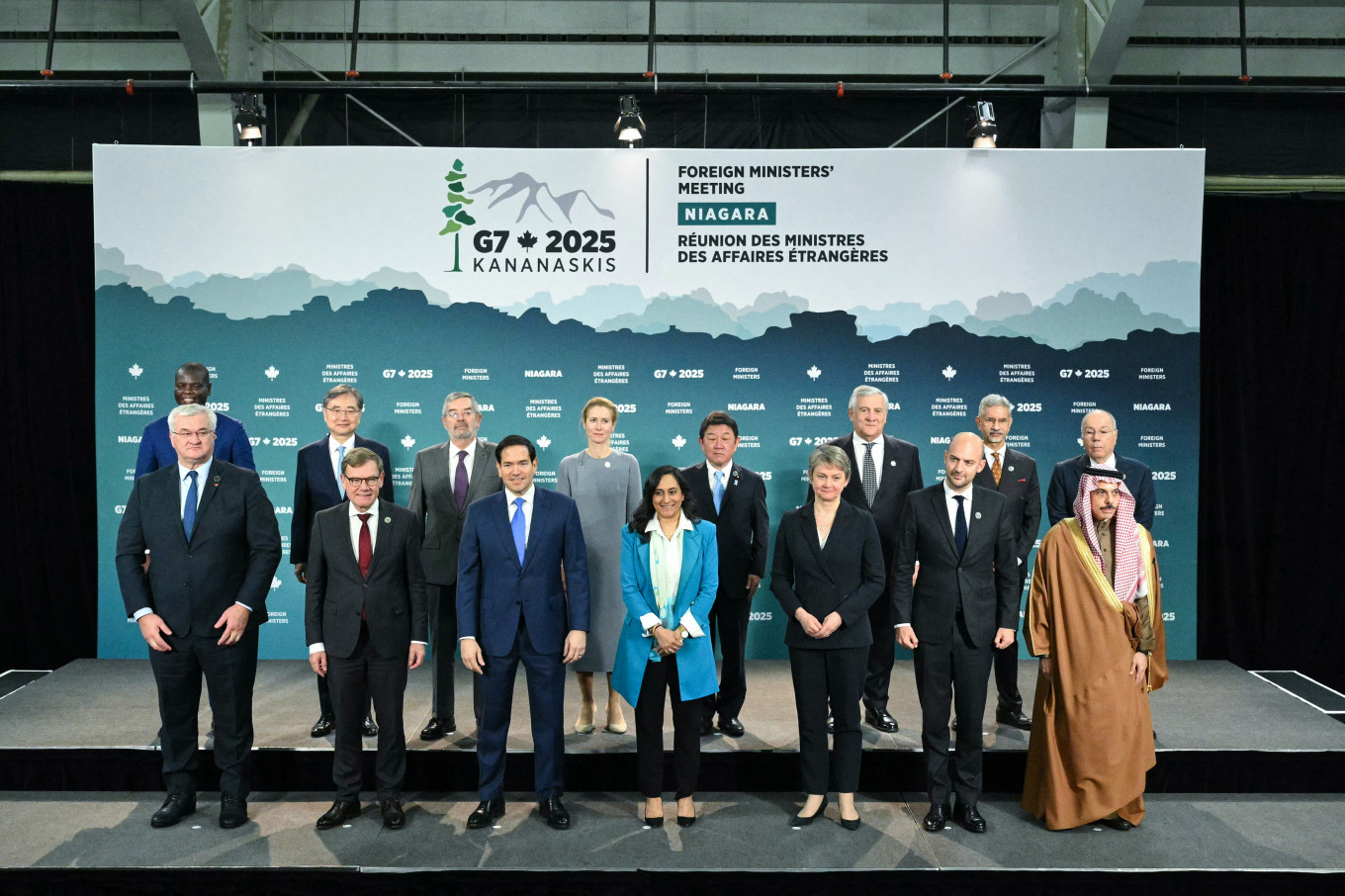 Meeting of ministers: (From left) Top diplomats of South Africa, Ukraine, South Korea, Germany, Mexico, the United States, the European Union, Canada, Japan, the United Kingdom, Italy, France, India, Brazil and Saudi Arabia stand for a family photo during the Group of Seven Foreign Ministersʼ meeting on Wednesday, Nov. 12, 2025 in Niagara-on-the-Lake, Canada. (AFP/Pool/Mandel Ngan)
G
7 finance ministers acknowledged mounting concern over public debt and bond market volatility as they met in Paris on Monday in the wake of a bond market selloff triggered by fears over inflation risks from the Iran war.
Ministers are set to discuss the economic fallout from the conflict and volatility on global bond markets, which are of particular concern to Japan, as they also seek common ground on tackling economic tensions and global imbalances.
Bonds from Tokyo to New York extended losses on Monday, with investors betting on central bank rate hikes over worries that rising energy prices could stoke inflation.
Asked if bond markets were collapsing, French Finance Minister Roland Lescure said: "They’re undergoing a correction - I wouldn't say they’re collapsing."
"We are no longer in a period where public debt is not a subject," he told reporters as he arrived at the meeting.
The meeting, which will also be attended by representatives from G7 central banks, will tackle how countries can co-ordinate their response to shocks such as inflation through temporary, targeted and reversible measures, the French finance ministry said.

German central bank head Joachim Nagel said that policymakers could do a lot to calm markets and give them positive momentum.
Asked on arrival if she was worried by the bond selloff, European Central Bank head Christine Lagarde told reporters: "I always worry, that's my job.”
Japanese Finance Minister Satsuki Katayama said she was instructed by Prime Minister Sanae Takaichi to "minimize various risks", when asked about the rise in long-term interest rates, without elaborating.
The G7 finance ministers will try to find common ground on tackling global economic tensions and coordinating critical raw material supplies. But divisions within the G7 complicate efforts to project unity as ministers prepare for a June 15 to 17 leaders' summit in the spa town of Evian.
"Don't put in place measures that would make the situation worse," International Monetary Fund chief Kristalina Georgieva said as she arrived for the meeting.
At the core of the Paris agenda will be what Lescure described prior to the meeting as deep-seated global economic imbalances that are fueling trade friction and risk a turbulent unwinding in financial markets.
"The way the global economy has been developing for the past 10 years or so is clearly unsustainable," he said, pointing to a pattern in which China under-consumes, the United States over-consumes and Europe under-invests.
Lescure, who will host the talks, said the G7 offered an opportunity for frank dialogue among allies at a time of widening disagreements with Washington.
"These discussions are not easy. I'm not going to tell you that we agree on everything, including, of course, first and foremost with our American friends," he told journalists ahead of the meeting.
The two-day meeting follows a summit between US President Donald Trump and Chinese President Xi Jinping in Beijing that yielded few concrete economic breakthroughs, as tensions over Taiwan and trade simmered beneath a display of diplomatic cordiality.
Finance ministers will be looking for an update on US-China relations following the Trump-Xi summit and the latest US efforts to re-open the Strait of Hormuz.
US Treasury Secretary Scott Bessent said the trip to China had been very successful, adding that he would urge the G7 to follow sanctions to target Iran's "war machine".
Merely agreeing each side bears some responsibility for the trade and capital flow imbalances would be a success, French officials involved in preparations said, though the US side is likely to be reluctant.
Another priority will be critical minerals and rare earths, where G7 governments are trying to coordinate efforts to reduce reliance on China, which dominates supply chains vital for technologies such as electric vehicles, renewable energy and defense systems.
Lescure said the G7 would push for stronger coordination to monitor markets, anticipate disruptions and develop alternative supplies, including through joint projects spanning allied economies. The aim is to ensure that "no country can ever again have a monopoly" over such materials, he said.
G7 countries are trying to make progress on a common toolbox of measures to stabilize markets and encourage domestic investment, possibly through price floors for producers, pooled purchases and also tariffs.