The Jakarta Post
Please Update your browser
Your browser is out of date, and may not be compatible with our website. A list of the most popular web browsers can be found below.
Just click on the icons to get to the download page.


Popular Reads
Top Results
No results found. Please check your search term and try again
Can't find what you're looking for?
View all search results
Popular Reads
Top Results
No results found. Please check your search term and try again
Can't find what you're looking for?
View all search resultsArtemis II lunar mission draws flood of conspiracy theories
The misinformation spread as four astronauts, who returned to Earth following a high-risk splashdown on Friday afternoon local time, captivated the world with stunning visuals from their fly-by of the Earth's natural satellite from aboard the Orion spacecraft.
Change text size
Gift Premium Articles
to Anyone
Share the best of The Jakarta Post with friends, family, or colleagues. As a subscriber, you can gift 3 to 5 articles each month that anyone can read—no subscription needed!
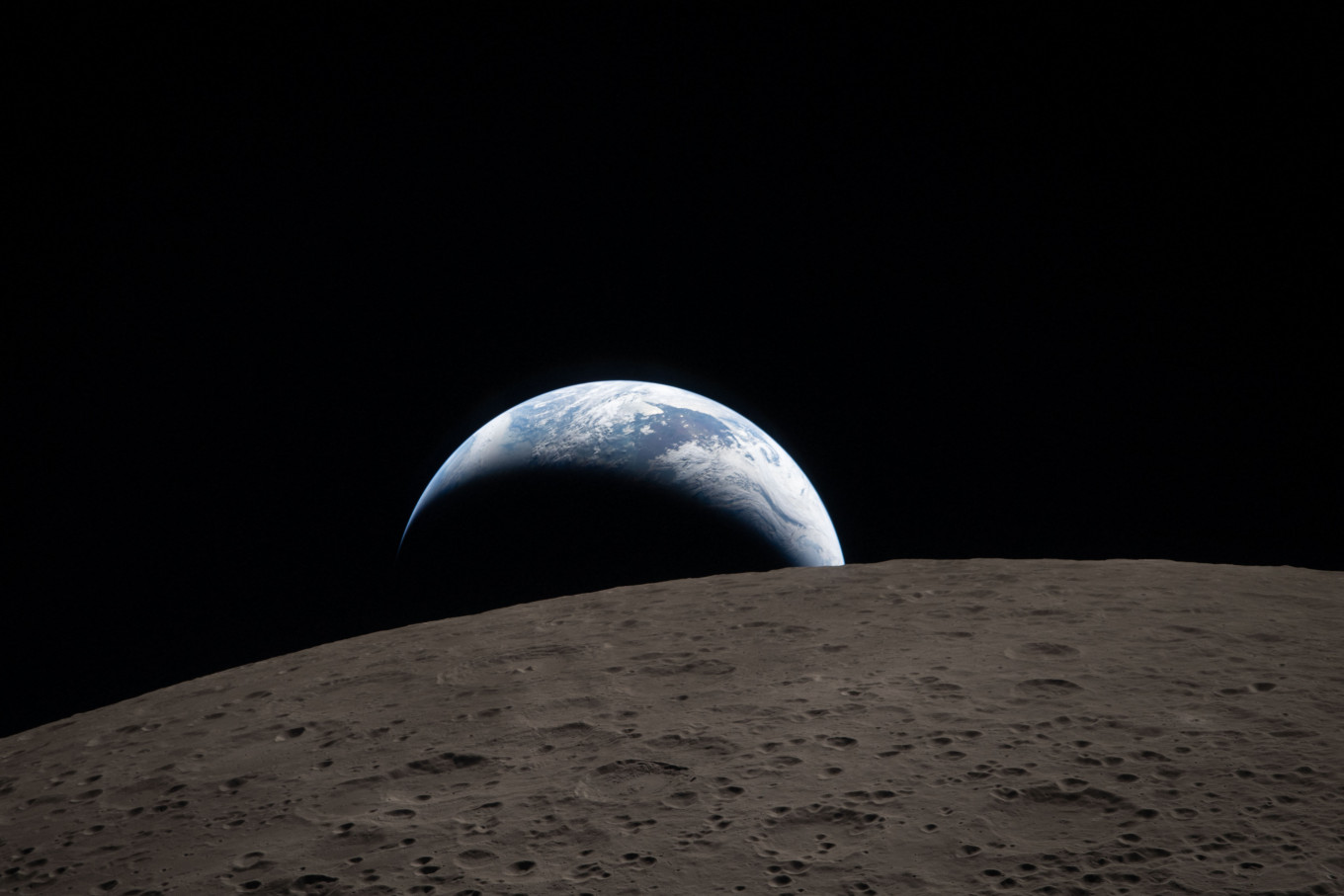 This handout picture released on April 7, 2026, by NASA shows Earth as it dips beyond the lunar horizon, also known as “Earthset,“ as seen from the Orion spacecraft on April 6, 2026. The Artemis II astronauts wrapped up their lunar flyby as they continue their journey back to Earth on Tuesday, bringing with them rich celestial observations including little-known lunar craters, a solar eclipse and meteor strikes that scientists hope will open doors. (AFP/NASA/Handout)
F
rom false claims that a historic lunar fly-by was staged in a movie studio to unfounded narratives that footage of the crew was generated by artificial intelligence (AI), the Artemis II mission has been clouded by a blizzard of misinformation.
The falsehoods, circulating across tech platforms including X, TikTok and Facebook, have also added fresh fuel to a longstanding conspiracy theory that NASA's 1969 Apollo 11 moon landing was faked.
Hashtags such as "fake space" and "fake NASA" have gained traction online since NASA's lunar fly-by sent astronauts farther from Earth than any human before.
Among the falsehoods was an image, viewed over a million times on X, purporting to show the Artemis II crew floating before a green screen and facing film cameras, suggesting their mission was staged in a studio, but in reality bore the hallmarks of AI manipulation.
Some users also shared a video showing text appearing through the mission's official mascot as purported proof the flight was staged.
But a digital forensics expert told AFP's fact-checkers that the anomaly was the result of a failed text overlay by a news station that had syndicated the official feed.
Unfounded claims that the Artemis II mission detected a mysterious moving object on the moon's surface also racked up millions of views across platforms.
The misinformation spread as four astronauts, who returned to Earth following a high-risk splashdown on Friday afternoon local time, captivated the world with stunning visuals from their fly-by of the Earth's natural satellite from aboard the Orion spacecraft.
Internet wild-west
Once confined to the internet's fringes, conspiracy theories have moved squarely into the mainstream amid growing mistrust of public institutions and traditional media.
Scientific achievements such as the lunar mission present "very easy content for conspiracy influencers," said disinformation researcher Mike Rothschild. "There are some people whose reflexive reaction to any kind of major event is to claim it's fake and staged, no matter what it is."
Many of them "pass themselves off as experts in science and physics because it's somehow more believable to their followers than just going with 'the official story.'"
The trend underscores a Wild West internet landscape that is largely bereft of guardrails as false narratives erode digital trust. Several tech platforms have gutted trust and safety teams and scaled back moderation, making them what researchers call a hotbed for misinformation.

Further sowing online confusion were claims that the entire Artemis II mission was a hoax powered by AI tools.
The assertion underscores how the rise of cheap and widely available AI tools has given misinformation peddlers a handy incentive to cast doubt on authentic content, a tactic researchers have dubbed as the "liar's dividend."
'Secret knowledge'
The swirl of falsehoods has also bolstered one of the longest enduring conspiracy theories: that NASA faked the 1969 Apollo 11 moon landing, broadcasting visuals shot in a Hollywood studio.
The conspiratorial discourse has seeped into pop culture, becoming a plotline in movies like romantic comedy Fly Me to the Moon, with Scarlett Johansson's character tasked with faking a moon landing, and some celebrities also amplifying the claim.
"The moon landing is an example of a conspiracy that will not die," Timothy Caulfield, a misinformation expert from the University of Alberta in Canada, told AFP. "These conspiracies are attractive for a host of reasons including that they are linked to the allure of having 'secret knowledge' or being aware of things others don't know."
Though easy to debunk, such theories persist as Artemis II comes decades after the previous lunar missions, events today's internet-savvy generation has little recollection of.
"In many ways, it is a testament to how hard it is for humans to travel to the moon; after all, we did it from 1968 to 1972, and it has taken until 2026 to do it again. It makes many people wonder if it ever happened," space exploration expert Francis French told AFP.
"Right now we are seeing remarkable photographs and video of the Earth and the moon [...] These photos alone should remove doubt and show once again the amazing things humans are capable of."



More from The Weekender
Siapa Anda? Mengapa Anda?
What begins as a small grammatical curiosity becomes a larger question about language, culture and the way we understand ourselves in relation to others - and, ultimately, about what we risk losing in a world increasingly impatient with reflection, ambiguity and the humanities.

A passport to the kingdom of the sick
A breast cancer diagnosis, a journey to the kingdom of the sick and a determination to describe what lies there without metaphor, euphemism or the word “fight.”

The weight of time
Richard Mille’s newest ultralight timepiece pares down haute horlogerie to its mechanical necessities, proving that sophistication often comes from knowing what to leave out.