The Jakarta Post
Please Update your browser
Your browser is out of date, and may not be compatible with our website. A list of the most popular web browsers can be found below.
Just click on the icons to get to the download page.


Popular Reads
Top Results
No results found. Please check your search term and try again
Can't find what you're looking for?
View all search results
Popular Reads
Top Results
No results found. Please check your search term and try again
Can't find what you're looking for?
View all search resultsPolice arrest multiple manufacturers in relation to Minyakita scandal
The Minyakita scandal comes in the midst of the Islamic holy month of Ramadan, during which household consumer spending traditionally rises ahead of the Idul Fitri celebration.
Change text size
Gift Premium Articles
to Anyone
Share the best of The Jakarta Post with friends, family, or colleagues. As a subscriber, you can gift 3 to 5 articles each month that anyone can read—no subscription needed!
 Set as preferred source
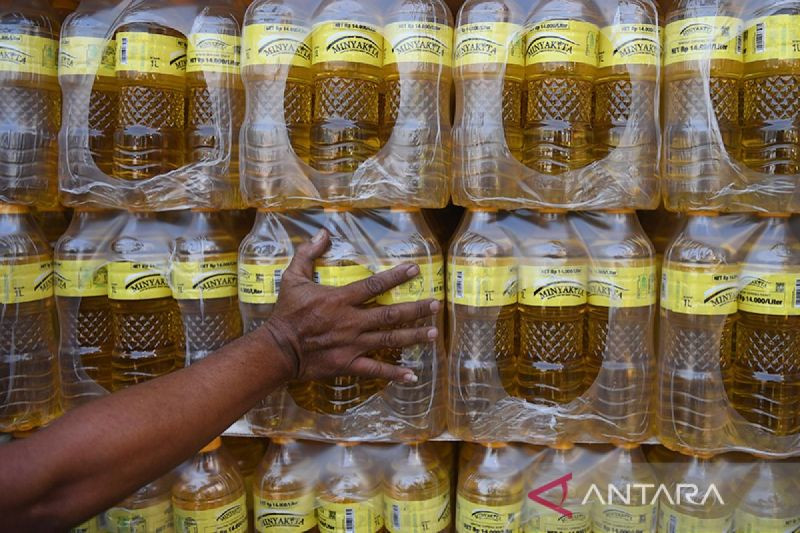 Slippery scheme: A port officer prepares to deliver crates full of bottled Minyakita cooking oil to eastern Indonesia on March 3 at Jakarta’s Tanjung Priok Port. The National Police launched a probe on March 9 into three producers of the state-subsidized cooking oil following reports that quantities being sold on retail shelves fell short of the amounts stated on product labels. (Antara/Akbar Nugroho Gumay)
T
he National Police have arrested several manufacturers of the state-promoted cooking oil brand Minyakita for allegedly underfilling their containers, as part of a broader crackdown on fraudulent activities related to the production of the subsidized oil.
The National Police’s Criminal Investigation Department (Bareskrim) detained on Tuesday the owner and manager of a Minyakita manufacturing facility in Depok, West Java, for allegedly selling oil in quantities smaller than the amount stated on the label.
“Although the label claims each container holds 1 liter of oil, our tests found the actual volumes ranged from just 700 to 860 milliliters,” head of the police’s Food Task Force, Brig. Gen. Helfi Assegaf, said at a press conference on Tuesday.
Helfi stated that the suspect, identified only by his initials AWI, was appointed as a vendor to produce Minyakita by PT MSI and PT ARN, which had obtained the right to manufacture Minyakita from the Trade Ministry.
“We will recommend that the government revoke the permit for both companies to use the Minyakita brand,” he said.
AWI allegedly started the fraudulent operation in February, with his facility capable of producing between 400 and 800 cartons of cooking oil daily.

He faces multiple charges for his alleged illicit actions, including violations of Article 62 of the 1999 Consumer Protection Law, Article 102 of the 2012 Food Law and Article 120 of the 2014 Industry Law. These offenses carry a maximum sentence of five years in prison and a fine of up to Rp 5 billion (US$121,700).