TheJakartaPost
Please Update your browser
Your browser is out of date, and may not be compatible with our website. A list of the most popular web browsers can be found below.
Just click on the icons to get to the download page.


Popular Reads
Top Results
No results found. Please check your search term and try again
Can't find what you're looking for?
View all search results
Popular Reads
Top Results
No results found. Please check your search term and try again
Can't find what you're looking for?
View all search results‘Rafflesia’ or ‘padma’? Debate renewed over flower renaming
The recent rediscovery of a rare plant was met by renewed debate among researchers and public alike about academic colonialism. The concerns hinged on whether the Rafflesia, which was named after a European colonial figure, should be renamed to better represent its Southeast Asian origin and remove its colonial legacy.
Change text size
Gift Premium Articles
to Anyone
Share the best of The Jakarta Post with friends, family, or colleagues. As a subscriber, you can gift 3 to 5 articles each month that anyone can read—no subscription needed!
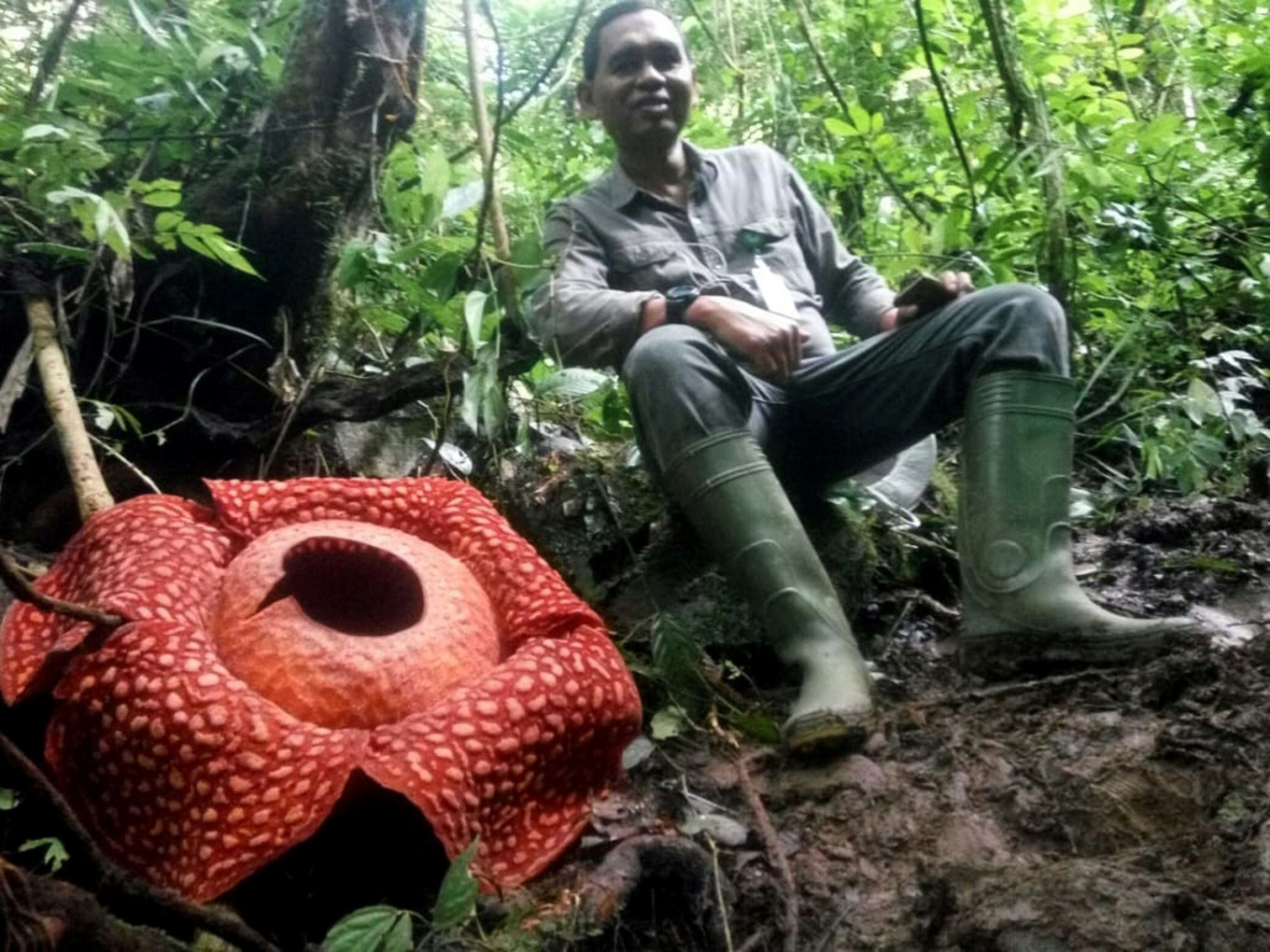 A man sits next to a giant Rafflesia tuan-mudae, a fleshy red flower with white blister-like spots on its enormous petals and measuring 111 centimeters in diameter, at the Maninjau nature preserve in Agam, West Sumatra, on Jan 2, 2020. (AFP/Handout/West Sumatra BKSDA)
I
n November, people on social media rejoiced for a few weeks following the rediscovery of a rare species of the Rafflesia parasitic flower in West Sumatra.
However, the rediscovery was met by renewed debate among researchers and public alike about academic colonialism. The concerns hinged on whether the Rafflesia, which was named after a European colonial figure, should be renamed to better represent its Southeast Asian origin and remove its colonial legacy.
Among the world’s largest flowers, the Rafflesia first entered Western scientific records in 1818 after it was spotted by a local guide working with British surgeon and naturalist Joseph Arnold in the then-British colony of Bencoolen, present-day Bengkulu.
The family of the flower was later named the Rafflesia, after the Bencoolen lieutenant-governor Sir Thomas Stamford Raffles.
The species spotted by Arnold was later named Rafllesia arnoldii after the surgeon who died not long after finding the flower. Meanwhile, the type recently discovered in West Sumatra is Rafflesia hasseltii, which was named after Dutch botanist Arend Ludolf van Hasselt.
As of today, the name Rafflesia is still used by the global scientific community to describe a genus that includes at least 42 species found in Indonesia, Malaysia, Thailand and the Philippines.

But the Rafflesia never had just one name. Across Indonesia, it is commonly called the padma, pakma or ambai-ambai, depending on the region, language and species, said Joko Witono, botanist at the National Research and Innovation Agency (BRIN) who studies monocots, including Rafflesia.