The Jakarta Post
Please Update your browser
Your browser is out of date, and may not be compatible with our website. A list of the most popular web browsers can be found below.
Just click on the icons to get to the download page.


Popular Reads
Top Results
No results found. Please check your search term and try again
Can't find what you're looking for?
View all search results
Popular Reads
Top Results
No results found. Please check your search term and try again
Can't find what you're looking for?
View all search resultsYearender: Jakarta’s public space grow, but unevenly delivered
Change text size
Gift Premium Articles
to Anyone
Share the best of The Jakarta Post with friends, family, or colleagues. As a subscriber, you can gift 3 to 5 articles each month that anyone can read—no subscription needed!
 Set as preferred source
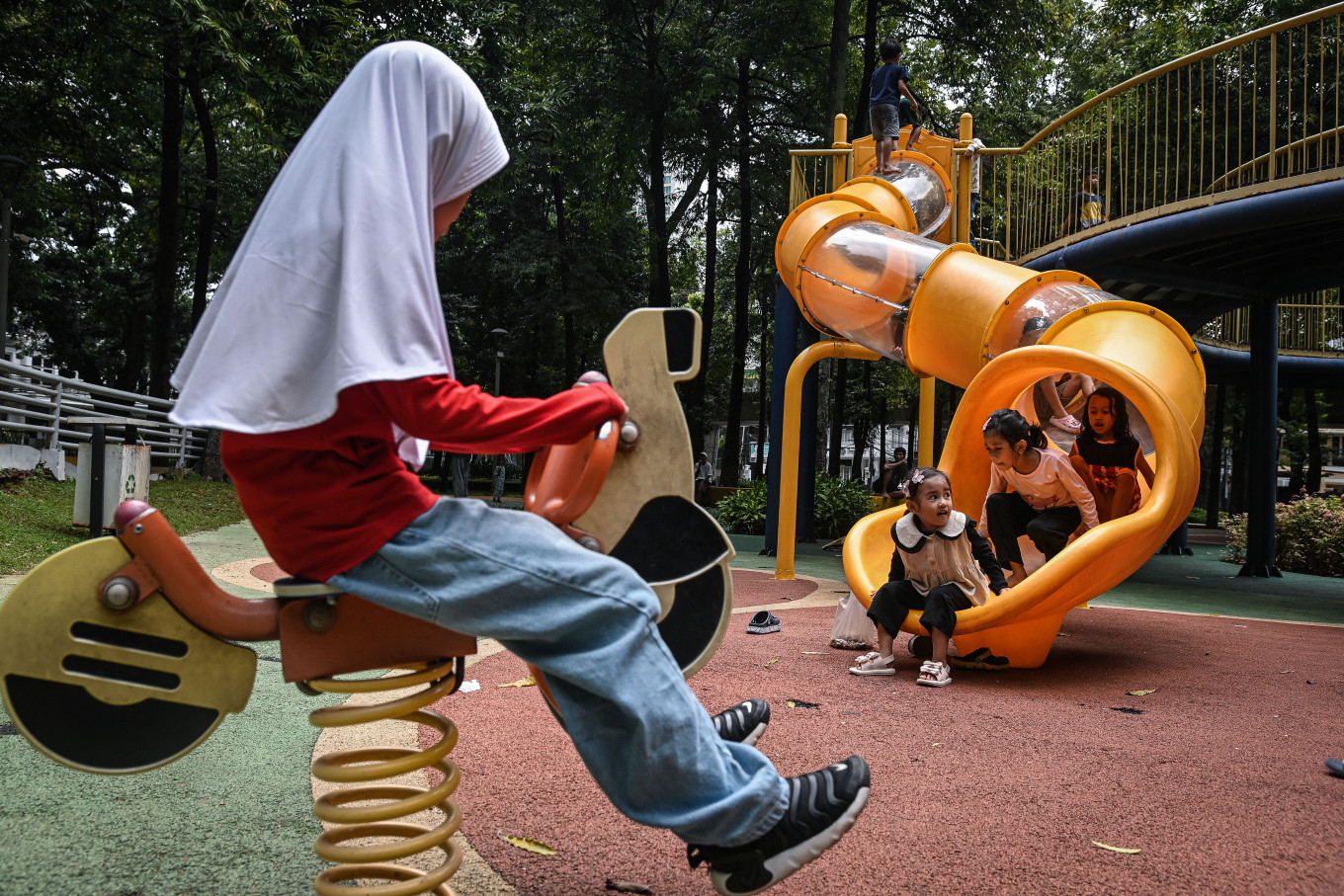 Children play at Puring Park in Jakarta on Dec. 28, 2025. Green open spaces which feature children’s playgrounds and fountains offer a free alternative recreational destination for the public. (Antara/Sulthony Hasanuddin)
F
rom 24-hour city parks to libraries extending their evening hours, Jakarta closed the year with a series of public space initiatives. Yet these expansions remain concentrated around economic hubs, reinforcing the spatial inequality that has long shaped the capital.
Throughout 2025, the Jakarta provincial administration sought to make the city more accessible by, among other measures, opening five public parks around the clock, namely Martha Tiahahu, Langsat and Ayodya in South Jakarta, as well as Menteng and Lapangan Banteng in Central Jakarta.
The move was largely welcomed by residents, although lingering security concerns remain.
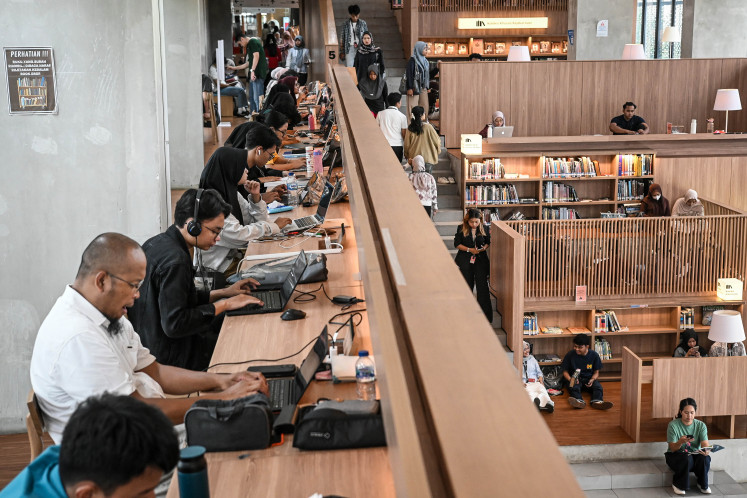
Several public libraries, including the newly revitalized Jakarta Library at the Ismail Marzuki Park cultural complex, also extended their operating hours until 10 p.m., attracting visitors who could only come during the evening.
Read also: Lively libraries, bookshops defy ‘myth’ of low reading interest
The Jakarta Library recorded a 50 percent surge in footfall, drawing nearly 750,000 visitors after the policy was introduced in May.

Meanwhile, green space coverage in the city rose to more than 6 percent of Jakarta’s total area from 5.74 percent last year, though still far short of the 20 percent target mandated under the 2007 Spatial Planning Law.
More than infrastructure
However, expanding public or green spaces is not merely a matter of increasing coverage, but also of ensuring equal and inclusive distribution, said Hayati Sari Hasibuan, an environmental science expert at the University of Indonesia.
The distribution of such spaces in Jakarta, she said, “remains centered in the city’s [economic core]”.
In October, Jakarta Governor Pramono Anung announced an ambitious plan to convert land beneath toll roads and other idle spaces into around 300 parks and greenery across the city within the next two years, aiming to distribute green spaces more evenly.
Hayati argued that sustaining new parks requires more than infrastructure, noting the need for community involvement to keep public spaces active and relevant.
In Jakarta, parks often function primarily as aesthetic features or environmental buffers rather than as genuine community spaces.
“Parks should also serve as melting pots for residents from diverse social and cultural backgrounds to build a sense of community,” Hayati said earlier this month.
Rakhmat Hidayat, a sociologist at the Jakarta State University (UNJ), echoed the concern, saying many residents still lack a sense of ownership over public spaces, making long-term sustainability difficult.
In the northern part of the capital, he added, investment in open and green spaces remains particularly limited, perpetuating the inequality that has long characterized the area.
He argued that the issue stems from urban planning that has prioritized commercial and industrial development at the expense of accessible public spaces.
“The vision of building a human-centered city has largely been sidelined,” Rakhmat told The Jakarta Post on Dec. 10, “A humanist city is built by developing public urban spaces as widely, and as equally, as possible.”
Green irony
The push for green initiatives has also been marred by reports of forced evictions.
In October, at least 137 long-time traders at Barito Market in South Jakarta were ordered to vacate the area as part of a plan to merge three nearby parks into a single six-hectare green corridor named Bendera Pusaka Park, according to a November report by the Jakarta Legal Aid Foundation (LBH Jakarta).
The plan drew strong opposition before many traders agreed to relocate to a new market built by the administration, some 15 kilometers away.
LBH Jakarta noted that this eviction led several traders to lose their livelihoods and goods.
Read also: Jakarta to turn idle spaces into child-friendly parks
A top global city?
As Indonesia’s capital and economic powerhouse, Jakarta has set an ambitious target to be one of the world’s top 50 cities by 2029. According to the Global Cities Index by United States-based consulting firm Kearney, the city ranked 71st out of 158 cities in the 2025 edition.
To boost the city’s standing, Governor Pramono has rolled out a range of initiatives, including transforming South Jakarta’s Blok M into a 24-hour economic and cultural hub.
Stephen Cairns, an urban design expert at Monash University Indonesia, said that while the ambition is laudable, Jakarta must look to comparable major cities for benchmarks that better reflect its real conditions.
He cited Bangkok and Manila as more relevant reference points, as they face challenges similar to those confronting Jakarta.
Cairns also urged the provincial administration not to overlook surrounding areas. “Otherwise, [Jakarta risks becoming] a global city that ignores its own hinterland.”