TheJakartaPost
Please Update your browser
Your browser is out of date, and may not be compatible with our website. A list of the most popular web browsers can be found below.
Just click on the icons to get to the download page.


Popular Reads
Top Results
No results found. Please check your search term and try again
Can't find what you're looking for?
View all search results
Popular Reads
Top Results
No results found. Please check your search term and try again
Can't find what you're looking for?
View all search resultsHumility in a time of disaster: Listening to the displaced
At a Jakarta Arts Council lecture, scholars challenged the state and the public to rewrite disaster history from the perspective of the displaced, as Sumatra struggles to recover from deadly floods and landslides.
Change text size
Gift Premium Articles
to Anyone
Share the best of The Jakarta Post with friends, family, or colleagues. As a subscriber, you can gift 3 to 5 articles each month that anyone can read—no subscription needed!
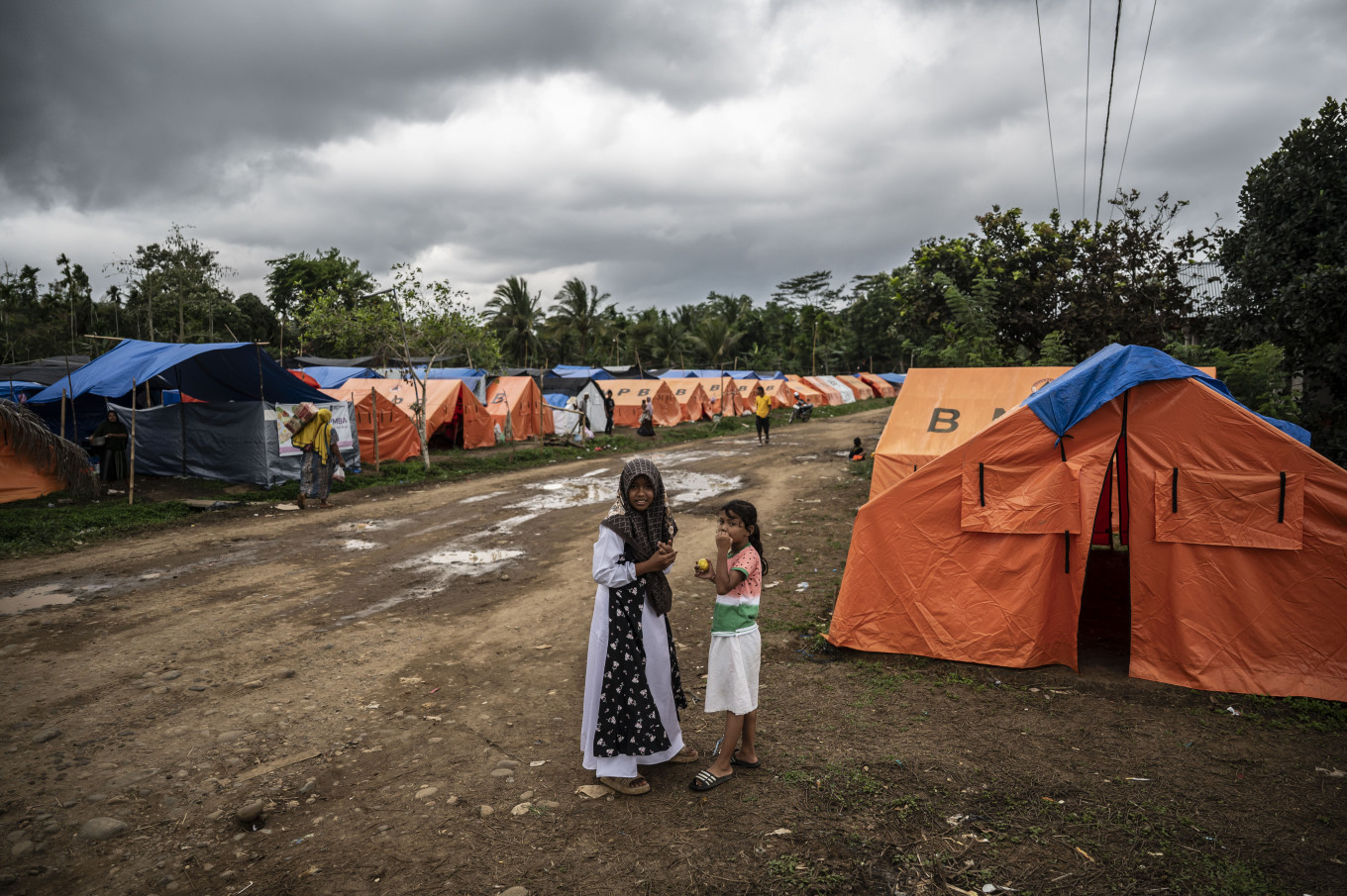 Interrupted childhood: Two children from Gampong Gunci village stand in a temporary housing complex on Feb. 16 in Sawang, North Aceh, Aceh. A total of 326 residents from 85 families have been living in the emergency shelters for three months after flash floods and landslides struck their village in late November 2025. They are scheduled to relocate to temporary housing at the start of Ramadan. (Antara/Aprillio Akbar)
I
n a recent Jakarta Arts Council public lecture at Taman Ismail Marzuki, writer Intan Paramaditha and Acehnese historian Raisa Kamila, both of Sekolah Pemikiran Perempuan, discussed how the experiences of disaster survivors are often sidelined and reduced to mere statistics.
A song, Untong Kamoe Nyoe (Our Good Fortune), played softly on Jan. 28, accompanying Raisa’s lecture on displacement.
The song captures fragility, exhaustion, gratitude and the confusion of displaced people.
For Raisa, it evoked memories of displacement in Aceh that she witnessed during the armed conflict and in the aftermath of the tsunami more than two decades ago.
Raisa said authorities often simplify displaced residents into numbers, overlooking their memories and local wisdom in decision making and in historical records.
In the archives she studied, history is mostly recorded from the perspective of the settled and the powerful, including sultans, nobles and religious leaders. Displaced people appear only as background figures or footnotes, rarely accounted for as subjects with their own memories, knowledge and survival strategies.

“By placing displaced people at the center of history, we can get a more nuanced understanding of disaster history. Forced mobility is not just a momentary response to a crisis. It reshapes people’s lives, social ties and how they survive risk,” she said.