The Jakarta Post
Please Update your browser
Your browser is out of date, and may not be compatible with our website. A list of the most popular web browsers can be found below.
Just click on the icons to get to the download page.


Popular Reads
Top Results
No results found. Please check your search term and try again
Can't find what you're looking for?
View all search results
Popular Reads
Top Results
No results found. Please check your search term and try again
Can't find what you're looking for?
View all search resultsJakarta mulls expanding Bantar Gebang landfill despite deadly landslide
Handling nearly 8,000 tonnes of waste generated daily in Jakarta, the Bantar Gebang landfill now holds 80 million tonnes of waste, some 30 million tonnes more than its maximum capacity.
Change text size
Gift Premium Articles
to Anyone
Share the best of The Jakarta Post with friends, family, or colleagues. As a subscriber, you can gift 3 to 5 articles each month that anyone can read—no subscription needed!
 Set as preferred source
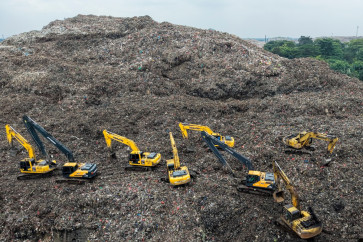
 This aerial picture shows a rescue team using heavy machinery to search for people following a landslide at Bantar Gebang landfill in Bekasi, West Java, on March 9, 2026. A landslide at the country's biggest landfill buried trucks and food stalls, killing four people, rescuers said on March 9 as they searched for at least five more reported missing. (AFP/Bay Ismoyo)
T
he Jakarta administration is considering expanding the capacity of the already overloaded Bantar Gebang landfill in Bekasi, West Java, to keep up with the ever-increasing waste produced by the capital, as environmentalists express concerns following a fatal landslide at the site.
On Tuesday, more than 300 search and rescue personnel called off a three-day rescue operation at the landslide location after they recovered seven bodies from under tonnes of waste at Bantar Gebang’s Zone 4, according to the Jakarta Disaster Mitigation Agency (BPBD).
The collapse occurred on Sunday afternoon following hours of heavy rain, sending seven garbage trucks tumbling and trapping 13 people, six of whom survived the incident.
Following the landslide, the Jakarta Environment Agency, which manages the site, has temporarily reduced Bantar Gebang’s capacity, while also planning to expand the landfill into surrounding areas.
“The agency has coordinated with private land owners around Bantar Gebang [to turn their land] into waste disposal sites,” Jakarta Environment Agency head Asep Kuswanto said in a statement on Tuesday, calling the expansion the “last resort” for the city.
Located around 25 kilometers from Jakarta, Bantar Gebang holds over 80 million tonnes of the capital city’s waste, according to a figure from the Environment Ministry, some 30 million tonnes more than its maximum capacity.

The site, handling nearly 8,000 tonnes of Jakarta’s daily waste, is split into five different zones totaling nearly 82 hectares, with the rest of the 110-ha site reserved for roads and other supporting facilities.