The Jakarta Post
Please Update your browser
Your browser is out of date, and may not be compatible with our website. A list of the most popular web browsers can be found below.
Just click on the icons to get to the download page.


Popular Reads
Top Results
No results found. Please check your search term and try again
Can't find what you're looking for?
View all search results
Popular Reads
Top Results
No results found. Please check your search term and try again
Can't find what you're looking for?
View all search resultsVitamins over vaccines: Misinformation entrenched amid Indonesia measles surge
Misinformation circulating on social media about vaccines causing disease paralysis, behavioral problems, or worse has become an issue as the number of measles cases in Indonesia has soared, becoming the second-highest in the world behind only war-torn Yemen, according to the Indonesian Pediatric Society (IDAI).
Change text size
Gift Premium Articles
to Anyone
Share the best of The Jakarta Post with friends, family, or colleagues. As a subscriber, you can gift 3 to 5 articles each month that anyone can read—no subscription needed!
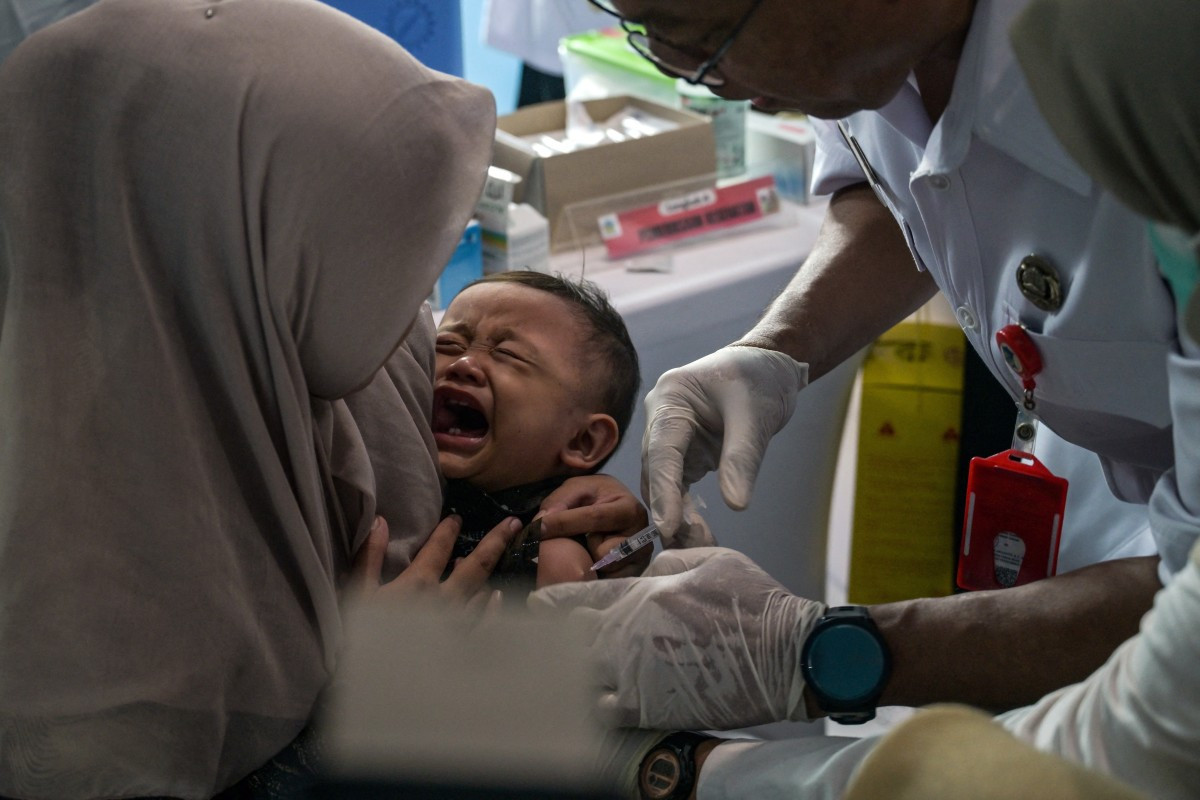 This photo taken on May 6, 2026 shows a child receiving a measles-rubella vaccine as part of the governments health program to combat childhood diseases in Surabaya. (AFP/Juni Kriswanto)
A
surge in measles cases in Indonesia has made stay-at-home mother Fitri Fransiskha uneasy -- but not enough to vaccinate her four children against the highly contagious and deadly virus.
The 40-year-old is one of a growing number of parents in the world's fourth most populous country to spurn infant inoculations, even as the government rushes to quell a public health crisis.
Fitri's fears -- sparked when her first-born contracted a fever after receiving the tuberculosis jab as a baby -- were led by misinformation circulating on social media about vaccines causing paralysis, behavioral problems, or worse.
"Posts like that worried me, and it made me think my decision not to vaccinate my children was probably the right one," she told AFP by phone from Banten.
The phenomenon has become an issue as the number of measles cases in Indonesia has soared, becoming the second-highest in the world behind only war-torn Yemen, according to the Indonesian Pediatric Society (IDAI).
More than 8,000 suspected cases and 10 deaths were recorded in the first three months of 2026, according to official data.

Cases more than doubled from 2024 to over 63,000 last year, resulting in 69 deaths.
Once nearing elimination globally, measles "has returned as a significant public health threat" in the country, according to a paper published in the Indonesian Journal of Internal Medicine in January.
"As a mother, of course I'm nervous. But I try to keep [my children] healthy by giving them nutritious food and vitamins," Fitri said.
'Outspoken' anti-vaxxers
"A lot of anti-vaccine sentiment [...] emerged in urban areas" due to disinformation, lawmaker Putih Sari warned last month, cautioning the House of Representatives to be "mindful".
Anti-vaccine rhetoric was found on almost all of the country's main social media platforms according to a study last month by data firm Drone Emprit, with the number of people exposed "quite large", the firm's founder Ismail Fahmi said.
"Anti-vaxxers, though smaller in number, are usually [...] more outspoken than those who are pro-vaccine," he said, adding that many influencers used their platforms to sell unproven herbal remedies as alternatives.
AFP's fact-checking team in March debunked harmful claims spreading online in Indonesia that getting sick with measles confers better protection than vaccines.
The result of the misinformation has been that "our herd immunity has been compromised", said Riris Andono Ahmad, an epidemiologist from Gadjah Mada University in Yogyakarta.
Herd immunity is achieved when enough people in a given population have been vaccinated against an infectious disease to prevent its easy spread.
For many in the Muslim-majority nation -- where pigs are "haram" or forbidden -- the hesitancy is religious, as certain vaccines contain porcine-derived components.
Entrepreneur Yusran, 46, has not vaccinated any of his five children due to his concern that the ingredients are not halal or permissible in Islam.
"Even without the vaccine, my children are just fine, thank God; they are healthy," Yusran, who requested to be identified by one name, told AFP in Makassar, South Sulawesi.
The Indonesian Ulema Council (MUI), the country's most authoritative Islamic body, issued a fatwa in 2018 declaring vaccines permissible for the sake of population health even if they contain porcine gelatin.
'Dropped a lot'
With a target to eradicate measles and rubella this year, the government in March launched an emergency mass vaccination campaign in around 100 of the country's more than 500 regencies and cities.
This includes measles and rubella (MR) booster shots for more than 220,000 health workers.
The government is working with religious organizations to encourage people to inoculate their offspring, Health Ministry’s director of immunization Indri Yogyaswari told reporters.
Measles spread "has dropped a lot" as a result of the campaign, she said.
But last year, Indonesia saw a 10 percentage point drop in the number of infants receiving a first dose of the MR vaccine from 2024, according to the health ministry.
But the goal of eradication appears out of reach with just over three-quarters of children receiving both doses of the MR vaccine, according to Riris -- a far cry from the 95 percent required to achieve herd immunity.