TheJakartaPost
Please Update your browser
Your browser is out of date, and may not be compatible with our website. A list of the most popular web browsers can be found below.
Just click on the icons to get to the download page.


Popular Reads
Top Results
No results found. Please check your search term and try again
Can't find what you're looking for?
View all search results
Popular Reads
Top Results
No results found. Please check your search term and try again
Can't find what you're looking for?
View all search resultsRegions tighten livestock monitoring ahead of Idul Adha amid disease risks
This year’s Idul Adha is expected to fall on May 27, with around 2.3 million animals projected to be slaughtered nationwide, according to the Agriculture Ministry.
Change text size
Gift Premium Articles
to Anyone
Share the best of The Jakarta Post with friends, family, or colleagues. As a subscriber, you can gift 3 to 5 articles each month that anyone can read—no subscription needed!
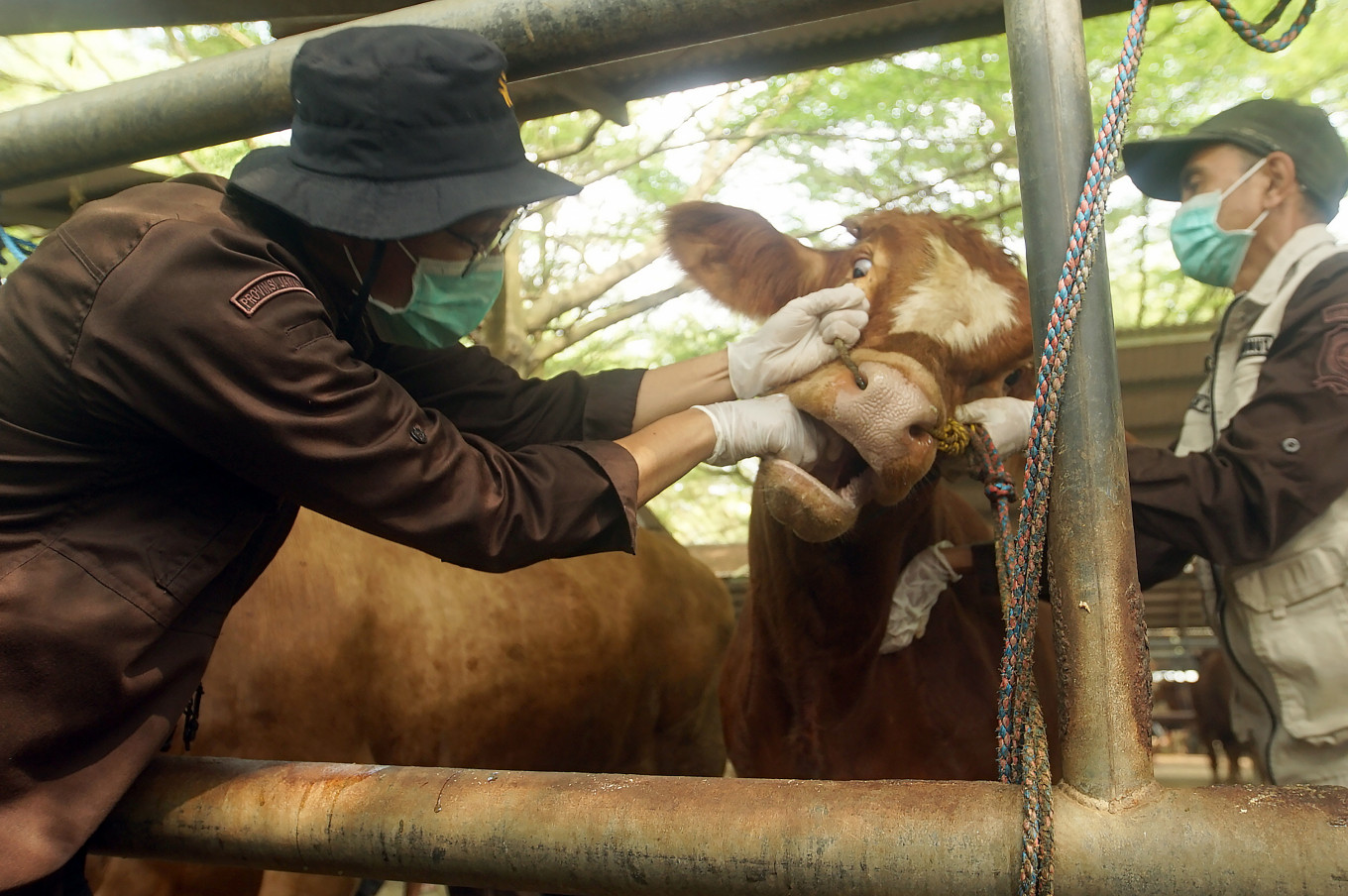 Urgent checks: An officer checks the dental and oral health of cattle on May 20, 2026, at the Tulungagung integrated cattle market in Tulungagung, East Java. The inspections were carried out to ensure the health and suitability of sacrificial animals ahead of Idul Adha amid rising cattle and goat prices in the market. (Antara/Destyan Sujarwoko)
A
uthorities across Indonesia are intensifying the monitoring of livestock trade and animal health ahead of next week’s Idul Adha holiday in an effort to prevent the spread of zoonotic and infectious animal diseases.
In Pekanbaru, the capital of Riau province, the local Agriculture and Fisheries Agency (Distankan) has deployed veterinary officers to inspect livestock at farms and temporary animal markets across the city ahead of the holiday.
“The team conducts thorough examinations of the animals’ physical condition, including body shape and size, legs, eyes, nose, mouth and teeth, as well as their appetite,” Pekanbaru Distankan head Maisisco said on Wednesday.
“The goal is to ensure the animals are free from zoonotic diseases that could potentially spread from animals to humans, while also ensuring they are healthy, free from physical defects and meet the requirements for sacrificial animals under Islamic law,” he added.
Maisisco said authorities had inspected 3,754 sacrificial animals so far and found no signs of disease among the livestock examined. He added that inspections and monitoring would continue throughout the Idul Adha slaughtering period.
Riau Livestock and Animal Health Agency head Mimi Yuliani Nazir said tighter supervision was necessary to ensure that sacrificial animals sold to the public were healthy and free from infectious diseases, allowing residents to observe Idul Adha safely and with peace of mind.

“Besides ensuring that residents can carry out the Idul Adha ritual safely and comfortably, the monitoring is also intended to curb the spread of foot-and-mouth disease (FMD), which remains a threat to livestock farmers in Riau,” she said.
Data from the Riau Livestock and Animal Health Agency showed that, as of mid-May 2026, a total of 758 livestock animals in the province had contracted FMD. Of those, 532 have recovered following intensive treatment and monitoring efforts.
“Officers are continuing to treat and monitor infected livestock so they can recover as quickly as possible,” Mimi added.
Read also: Chili prices rise as fuel costs climb, Idul Adha demand surges
Meanwhile, in Pekalongan, Central Java, authorities have deployed monitoring teams, consisting of veterinarians, medical personnel and veterinary paramedics, to inspect sacrificial animal trading points that have begun operating across the city ahead of Idul Adha.
“We routinely conduct inspections of sacrificial animals ahead of Idul Adha. Pekalongan’s livestock supply is still insufficient, so many sacrificial animals are brought in from other regions,” Lili said on Monday.
“That is why our teams are conducting direct inspections at animal trading sites to ensure that livestock entering the city are healthy and free from disease,” she added.
According to Lili, the inspections cover the animals’ physical condition, the cleanliness of temporary holding pens and livestock health documentation. The monitoring is intended to prevent the spread of infectious animal diseases, particularly FMD.
She added that authorities had also intensified FMD vaccination efforts for livestock owned by local farmers to maintain herd health ahead of the expected surge in sacrificial animal trade during the Idul Adha period.
In Surabaya, East Java, the Food Security and Agriculture Agency (DKPP) has deployed officials, along with dozens of veterinary students from local universities, to inspect livestock as part of a nine-day monitoring operation ahead of Idul Adha.
“All personnel have been deployed across Surabaya’s 31 districts to inspect sacrificial animal trading sites. As of the third day of inspections, 61 trading locations had been examined, and monitoring will continue until May 26,” Surabaya DKPP head Nanik Sukristina said.
“So far, the team has identified one animal suspected of having scabies. The animal was immediately examined and isolated to prevent it from being sold to the public,” she added.
Meanwhile, the West Java DKPP has inspected nearly 14,000 livestock ahead of the Idul Adha holiday to ensure that sacrificial animals being sold are healthy.
“During the inspections, authorities had still found cases of FMD and lumpy skin disease [LSD] in several areas, although the overall situation remained under control,” said West Java DKPP head Linda Al Amin, as quoted by Metro TV.
She added that from Jan. 1 to May 13, 2026, a total of 628 FMD cases were recorded across seven districts and cities, while 79 LSD cases were reported in four districts and cities.
“These figures are relatively small compared to the total livestock population in West Java. The regional government’s vaccination program has been a key factor in controlling the spread of these infectious animal diseases,” she said, adding that the diseases remain preventable and can be effectively controlled through sustained vaccination and monitoring efforts.
Read also: Celebrating Idul Adha without single-use plastic bags
This year’s Idul Adha is expected to fall on May 27, with around 2.3 million animals projected to be slaughtered nationwide, according to the Agriculture Ministry.
The ministry said demand for sacrificial animals in 2026 is estimated to increase by around 3.82 percent, or approximately 86,727 heads, compared with the previous year.








Your Opinion Matters
Share your experiences, suggestions, and any issues you've encountered on The Jakarta Post. We're here to listen.
Enter at least 30 characters
0
/ 30
Thank you
Thank you for sharing your thoughts. We appreciate your feedback.


