TheJakartaPost
Please Update your browser
Your browser is out of date, and may not be compatible with our website. A list of the most popular web browsers can be found below.
Just click on the icons to get to the download page.


Popular Reads
Top Results
No results found. Please check your search term and try again
Can't find what you're looking for?
View all search results
Popular Reads
Top Results
No results found. Please check your search term and try again
Can't find what you're looking for?
View all search resultsOil production still below target despite Cepu supply
Indonesia's oil production will remain below government expectation despite additional oil from the promising Banyu Urip field at the Cepu block in Central Java, an official has said
Change text size
Gift Premium Articles
to Anyone
Share the best of The Jakarta Post with friends, family, or colleagues. As a subscriber, you can gift 3 to 5 articles each month that anyone can read—no subscription needed!

I
ndonesia's oil production will remain below government expectation despite additional oil from the promising Banyu Urip field at the Cepu block in Central Java, an official has said.
Under this year plan, the government aims to see oil lifting reach 818,000 barrel per day (bpd). However, to date, the output figure remains at around 800,000 bpd, according to the Upstream Oil and Gas Regulatory Task Force's (SKK Migas) acting chief, Johannes Widjonarko.
'By year-end, we estimate that the oil lifting to be at 808,000 to 810,000 bpd,' Widjonarko said.
The oil lifting figure, according to Widjanarko, includes additional production from the Banyu Urip field at the Cepu block of around 10,000 bpd.
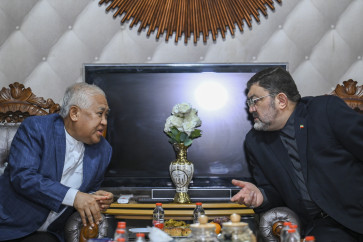
The field is now able to deliver up to 40,000 bpd from previously around 30,000 bpd. The start of the higher delivery was officially inaugurated by Coordinating Economic Minister Chairul Tanjung, who is also the Energy and Mineral Resources Ministry's ad interim minister, on Wednesday.
'The additional production is important as we are currently consuming more than we can produce. Imports have contributed to our current-account deficit,' Chairul said.
Indonesia, a former member of the OPEC, has been struggling to halt production decline, particularly as old oil fields have been depleted.
The government has been calling for more exploration works to find new hydrocarbon to secure energy security in the future.
However, a lengthy permit acquisition process and complicated bureaucracy have hampered the move.
The country had initially planned to see oil production of 1 million barrels this year. The plan was made based on the assumption that Cepu would hit peak production of 165,000 bpd early this year. However, the completion of development works in Cepu has been delayed and its field will only be in peak production in the third quarter of 2015.
The Cepu block, the biggest finding in Indonesia after several years, will remain a main contributor to next year's lifting target of 900,000 bpd.
- Cepu block to produce 10,000 bpdthis year
- Total production remains below target despite supply from Cepu
- Govt expects oil output to reach 818,000 bpd this year
Energy and Mineral Resources Deputy Minister Susilo Siswoutomo said the country had no other option other than to encourage more exploration to secure resources for the future.
'If we are not boosting exploration within the next five to six years, our production will be only at 600,000 bpd by 2020 when our consumption is estimated to be at 2.2 million,' Susilo said.
He pointed out that the country would only see small additional production after Cepu, such as 25,000 bpd from the Ande-ande Lumut field and 20,000 bpd from Kedung Keris.
Apart from the announcement of additional production at Cepu, Chairul also inaugurated 12 other projects in the energy sector, consisting of nine coal-fired power plants, one geothermal power plant, the Gresik-Semarang pipeline project and the Donggi Senoro liquefied natural gas (LNG) project.
The Donggi Senoro LNG project would commence production in mid-2015, around three months later than a previous target provided by one of its major shareholders, a spokeswoman for the project said.
'Our position is still on schedule in mid-2015 for the first LNG shipment,' Donggi Senoro internal and public communication supervisor Doty Damayanti told Reuters on Wednesday, declining to comment on a possible delay from the March date.
The country is currently the world's fourth-biggest exporter of LNG. By 2020, however, Southeast Asia's largest economy is expected to import up to 3.5 million tons of LNG per year as it increasingly turns to gas to generate power for industry and to fuel trains and trucks.
The US$2.8 billion Donggi Senoro is one of several major gas infrastructure projects that the country hopes will meet mushrooming energy demands at home and around the region.
LNG projects often run behind schedule and over budget. Donggi Senoro, Indonesia's fourth LNG project, was originally expected to commence in 2014, but the target was later pushed back to March 2015.