TheJakartaPost
Please Update your browser
Your browser is out of date, and may not be compatible with our website. A list of the most popular web browsers can be found below.
Just click on the icons to get to the download page.


Popular Reads
Top Results
No results found. Please check your search term and try again
Can't find what you're looking for?
View all search results
Popular Reads
Top Results
No results found. Please check your search term and try again
Can't find what you're looking for?
View all search results'Garuda' is yet to determine course: Expert
There is nothing brand new in the foreign policy of the current President, a distinguished professor emeritus from the University of South Carolina says
Change text size
Gift Premium Articles
to Anyone
Share the best of The Jakarta Post with friends, family, or colleagues. As a subscriber, you can gift 3 to 5 articles each month that anyone can read—no subscription needed!

T
here is nothing brand new in the foreign policy of the current President, a distinguished professor emeritus from the University of South Carolina says. Instead, he argues, there is something missing that his predecessor had: some emotion in democracy.
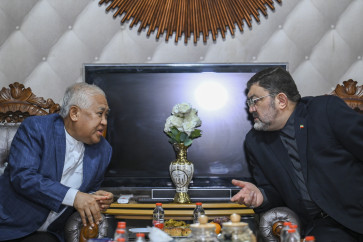
Donald E. Weatherbee ' a Southeast Asia expert from the US ' used the Garuda, the mythological bird and Indonesia's state symbol, to describe the country's course of foreign policy, suggesting that the bird was still up there looking for the best way to go.
'During the first three presidencies of the new democracy, the Garuda was still struggling. I call it the wounded Garuda,' he told a forum jointly held by the US-Indonesia Society (USINDO) and the Foreign Ministry on Wednesday.
During Susilo Bambang Yudhoyono's term, Weatherbee describes the Garuda as being 'in flames; global flames, not just local flames'.
'The Garuda hovered and looked for a direction, for which course it would follow in the future. We're not quite sure where it's flying, and that is the question that I am posing,' Weatherbee said.
'Bebas dan aktif; an independent and active foreign policy, is not a foreign policy. It explains the way foreign policy should be conducted, and its terminology is unchallenged, but what is its content?'
The term bebas dan aktif was coined by Indonesia's co-founder and first vice president Mohammad Hatta to describe the country's non-alignment policy and its willingness to actively be engaged in promoting world peace and justice.
Weatherbee saw signals of a break in continuity during the 2014 presidential campaign, with then Jakarta governor Joko 'Jokowi' Widodo and retired general Prabowo Subianto seemingly trying to distance themselves from Yudhoyono by emphasizing national interest in their campaigns.
He said that when Jokowi, a businessman seemingly uninterested and ill-informed on foreign policy, rose to become president, none of his policy was brand new or not previously considered by his predecessors.
The fact was, claimed Weatherbee, that although almost every point was inherited from his predecessors, there was one case of discontinuity (...) and it was the emotion of democracy, which he said had faded during Jokowi's presidency.
'The promotion of democracy as the overall goal of Indonesia's foreign policy has led to international backlash, some saying that Indonesia itself is failing in democracy on questions of human rights and the rights of minorities,' he said.
Jokowi, who pledged during his campaign to end the impunity shrouding Indonesia's long list of past human-rights abuses, has garnered criticism from a number of human-rights groups for failing to fulfill this promise and for increasingly encroaching on freedom of expression.
Dewi Fortuna Anwar, an international relations scholar and advisor to Vice President Jusuf Kalla, disagreed with Weatherbee.
Regardless of who the president was and what their interpretation of bebas dan aktif and national interest was, she said, Indonesian foreign policy was clearly mandated by the 1945 Constitution. Thus, Indonesia could not recognize Israel as a state as it opposed colonialism in the Constitution, she offered as an example. Continuity, she said, was guaranteed by the Constitution.
She added that Yudhoyono enunciated 'democracy, moderate Islam and modernity' as key elements in Indonesia's identity in his first speech on foreign policy, because Indonesia's image on the international stage was badly tarnished then by internal conflicts and borders issues.
During the Jokowi era, she said, Indonesian foreign policy has become more pragmatic as economic interests have received more attention and the focus has been on bilateral relations with key countries, without forgetting historical legacies in multilateralism being honored, such as the celebration of the Asia-African Conference's 60th anniversary in 2015.
'The Garuda knows where it is flying, and picks its selective targets, conserving energy if possible, but when we need to take flight, we do,' Dewi said.