TheJakartaPost
Please Update your browser
Your browser is out of date, and may not be compatible with our website. A list of the most popular web browsers can be found below.
Just click on the icons to get to the download page.


Popular Reads
Top Results
No results found. Please check your search term and try again
Can't find what you're looking for?
View all search results
Popular Reads
Top Results
No results found. Please check your search term and try again
Can't find what you're looking for?
View all search resultsIn the midst of fake news epidemic
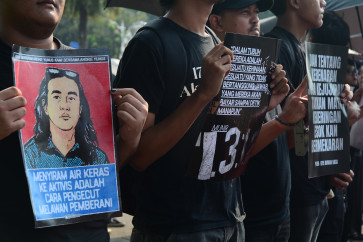
Truth crisis: People demonstrate on Yogyakarta’s iconic Jl
Change text size
Gift Premium Articles
to Anyone
Share the best of The Jakarta Post with friends, family, or colleagues. As a subscriber, you can gift 3 to 5 articles each month that anyone can read—no subscription needed!

T
span class="caption">Truth crisis: People demonstrate on Yogyakarta’s iconic Jl. Malioboro, calling for an end to the propagation of fake news. Indonesia is waging a war on false news, which has given rise to hate speech and prejudice.(JP/Tarko Sudiarno)
Indonesia, like many other countries, is doing everything it can to curb the flood of fake news, which has been exacerbated recently by political tensions building up ahead of next week’s simultaneous regional
elections. In conjunction with National Press Day, The Jakarta Post’s Nani Afrida and Pandaya examine what the country and world media players such as Google, Facebook and Twitter are doing to combat lies told across their sites.
When the saucy news about alleged romantic relations between Islam Defenders Front (FPI) leader Rizieq Shihab and treason suspect socialite Firza Husein was leaked and went viral on social media, Kompas chief editor Budiman Tanuredjo was torn between his heart and brain.
After some thought, he decided not to go with the flow and refrained from running the story.
“I thought the information was still somewhat unsubstantiated. It was more of a private domain and we shouldn’t treat it as public consumption,” he said. But he promised Kompas, Indonesia’s largest daily, was following every development surrounding the issue and may run stories once the issue becomes clear.
Budiman’s prudent wait-and-see tactic reflects a new strategy deployed by the mainstream media to combat false news articles propagated across newspapers, online media and social media and to defend their credibility.
“We should not follow the social media agenda. Journalism should stand by the values we defend by implementing verification and clarification procedures — something that doesn’t exist on social media.”
Like many other countries, Indonesia is struggling to curb fake news, which have been blamed for thriving hate speech. The biggest stake, as our leaders have rightly warned, is the plurality that binds the culturally, ethnically and religiously diverse country together.
Fabricated news has been propagated at an industrial proportion amid the heated political climate in the run-up to the Feb. 15 simultaneous regional elections in 101 provinces, regencies and cities across Indonesia.
Jakarta has been the hottest spot where hate speech and fabricated news have been used particularly against Basuki “Ahok” Tjahaja Purnama, who is targeted for being a Christian of Chinese descent.
Media pundits agree that public distrust in the mainstream media has contributed to the crisis. The waning trust has led people, especially those less educated, to turn to other sources. Now when 132 million of the 250 million population have access to the internet, social media and hoax websites are the obvious options.
Alliance of Independent Journalists (AJI) chairman Suwarjono notes that the 2014 presidential election marked the beginning of people’s distrust in the mainstream media. Then, the robust social media began to gain ground as an important source of information.
In 2014, it became obvious that some media were partisan, with one camp siding with presidential candidate Joko “Jokowi” Widodo and the other taking side with Prabowo Subianto. Owners of major media outlets such as Metro TV, TVOne and MNC group, to name a few, are senior leaders of political parties.

“People are at lost as to which media they can possibly trust,” Suwarjono said. “They turn to alternative media without realizing that the other media also belong to certain interest groups and are used to promote their business or propaganda.”
Never before have the national media and institutions joined forces to combat fake news like now. Last week, the Indonesian Press Council launched a “verification initiative,” requiring media to register with the Press Companies Association (SPS). The aim was to improve journalism, boost journalists’ competence and maintain media credibility.
“The initiative will not only to maintain the media’s reputation but also to improve journalists’ sense of responsibility,” Press Council chairman Joseph “Stanley” Adi Prasetyo said.
Press Council statistics show there are 2,000 print media, 43,300 online media, 674 radio stations and 523 TV stations in Indonesia. Of those, only 321 print media and 243 online news portals have been verified.
But not all journalists are happy with it. AJI is among those that have objected to the idea on concerns that it poses a threat to the freedom of the press that the Constitution guarantees.
“We know that many of the mainstream media are supporters of political parties. We also know many alternative media are highly professional but they cannot meet the Press Council’s requirements to get verified,” Suwarjono said.
On its part, the government is establishing the National Cyber Agency in addition to the various internet monitoring bodies already in place with institutions such as the police and the Communications and Information Ministry. The new cyber agency is to deal with the promotion of radicalization online. It will coordinate with the cyber divisions of the police, the Indonesian Military (TNI) and State Intelligence Agency (BIN).
The agency will have more to do with cyberattacks and not internet content. Its effectiveness in curbing the spread of false news would be questionable. Last year, the government claimed it had blocked 800,000 websites propagating hate, gambling, pornography and radicalism.
Amid the global frenzy, Google, Twitter and Facebook have taken measures to curb the fake
news propagated across their sites albeit in early stages. As most popular platforms, they have come under pressure to protect users from the onslaught of fake news.
Scott Spencer, Google product director, said in a blog post that last year, Google suspended 1,300 accounts from its AdSense for “tabloid cloaking,” a new type of scamming that tries to game its system by pretending to be news. The con artists would post ads that look like news about popular topics but when you click them, what you find would be ads on weight loss products, food supplement and so on.
Twitter, which has an estimated 50 million users in Indonesia, has taken steps in response to criticism that it has been doing little to curb hate speech on the grounds of freedom of expression. It has tightened its rules against threats and abuse, suspending thousands of accounts suspected of links with terrorism. Soon, abusive users will be removed and banned from creating a new account.
On Tuesday, it announced that in a few weeks, it would introduce a safe search feature that takes down tweets with potentially sensitive content and messages from blocked accounts from search results. Potentially abusive and low quality replies will be singled out and deleted, leaving only relevant conversations visible.
Major steps to combat fake news have also been taken by Facebook, which boasts 88 million users in Indonesia. It has introduced changes to its trending topic feature to promote only trusted news stories.
On a Jan. 25 blog post, Facebook introduced a feature that shows popular topics discussed on the platform that they might not see on their news feed: Trending topics will feature a publisher headline below each topic name, an improved system to determine what is trending and everyone in the same region will see the same topics.
“Today’s update may also help prevent hoaxes and fake news from appearing in Trending because the updated system identifies groups of articles shared on Facebook instead of relying solely on mentions of a topic,” the post said.
There has been an increase in social media users in Indonesia every year. Last year, nearly 93 million people used social media in Indonesia and the number is expected to jump to 100 million by the end of this year, according to Statista, a statistics portal.
The global effort is under way and requires hard work to succeed.