TheJakartaPost
Please Update your browser
Your browser is out of date, and may not be compatible with our website. A list of the most popular web browsers can be found below.
Just click on the icons to get to the download page.


Popular Reads
Top Results
No results found. Please check your search term and try again
Can't find what you're looking for?
View all search results
Popular Reads
Top Results
No results found. Please check your search term and try again
Can't find what you're looking for?
View all search results‘Ojol’ drivers band together on streets
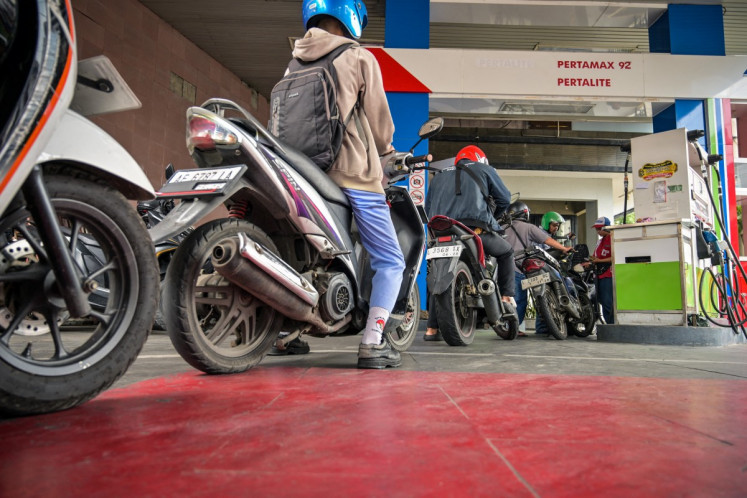
For many app-based ojek (motorcycle taxi) drivers, the phrase “strength in numbers” may echo deep in their daily lives
Change text size
Gift Premium Articles
to Anyone
Share the best of The Jakarta Post with friends, family, or colleagues. As a subscriber, you can gift 3 to 5 articles each month that anyone can read—no subscription needed!

For many app-based ojek (motorcycle taxi) drivers, the phrase “strength in numbers” may echo deep in their daily lives.
With most of their time spent on the road, many drivers from both homegrown firm Gojek and Malaysia-based ride-hailing service Grab have forged a bond in the form of organized communities with the main purpose of looking out for each other.
According to ojol (online ojek) driver Wahyudi, there are 300 ojol communities around Greater Jakarta whose members comprise drivers from both companies.
“Everyone says it is good to be a member of the communities as not only do we make new friends, we also get information on traffic. We help each other in any situation; it feels like a family to me,” he said on Thursday.
The self-organized groups were mentioned in the recent findings of a study carried out on ride-hailing communities by a University of California, Los Angeles (UCLA) doctorate candidate in urban geography, Sam Nowak. In his research conducted from March to June in Jakarta and satellite city Tangerang, Banten, he discovered that these ojol communities could be divided into three categories: komunitas (community), wadah (umbrella organization) and lintas (cross regions).
Komunitas consists of drivers that either live or operate in a certain geographic area. The community has a basecamp usually in the form of a stall or in a specific neighborhood.
Some basecamps are equipped with televisions, electrical sockets and even restrooms. For basecamps located inside a neighborhood, the community unit (RW) head usually builds the camp in exchange for drivers volunteering as security guards in the area.
Wadah is a larger, Whatsapp-based organization consisting of basecamp communities. The main purpose is to coordinate between communities in the case of an accident, engine failure or if an ojol driver becomes involved in an altercation with a conventional ojek driver, security guards or begal (violent robbers).
Nowak explained that during his research, he encountered a driver named Muchlis from Cilincing, North Jakarta, whose motorcycle broke down on his way to deliver a package. Muchlis asked a wadah group called Info Laka Sejabodetabek (Information on Traffic Accidents in Greater Jakarta) for assistance from the nearest komunitas.
“He was then helped by a nearby community who repaired his motorcycle and [he] was even escorted to the customer’s address,” Nowak said during a recent discussion on his findings.
Lintas is a massive, regional and cross-island Whatsapp-based organization that primarily functions as an information-sharing and socializing platform for drivers who move to another city or island and decide to become an ojol.
Each of the three communities has its own field coordinators and fast reaction units.
A field coordinator’s task is to assist all drivers in his group for cases such as accidents, altercations or coordination with other communities. Meanwhile, a fast reaction unit’s duty is to be the first to arrive and assist drivers who experience accidents or motorcycle breakdowns.
Most komunitas charge a fee of Rp 20,000 (US$1.43) per month from each member. The fees help finance the medical bills of drivers who experience accidents or the repair costs of motorcycles.
Both Gojek and Grab have made efforts to protect their drivers through the Workers Social Security Agency (BPJS Ketenagakerjaan) and health insurance from private insurance companies.
However, Online Drivers Communication Forum coordinator Aries Rinaldy said many drivers were not registered in the insurance program as they got confused by the lengthy process to claim funds through the insurance scheme.
“The [basecamp] teams are usually quick to help a driver in need and it’s more convenient to use the membership fees to finance the medical treatments of a driver who got into an accident or fell ill,” Aries said.
However, Aries underlined the reality of the tenuous relationship between drivers and ride-hailing companies.
“They keep emphasizing that we are partners, while in fact, we are no more than just informal workers. The drivers practically rely on each other for help,” he added. (bry)