The Jakarta Post
Please Update your browser
Your browser is out of date, and may not be compatible with our website. A list of the most popular web browsers can be found below.
Just click on the icons to get to the download page.


Popular Reads
Top Results
No results found. Please check your search term and try again
Can't find what you're looking for?
View all search results
Popular Reads
Top Results
No results found. Please check your search term and try again
Can't find what you're looking for?
View all search resultsInvesting in people needs fresh collaboration
World Bank vice president for East Asia and Pacific Victoria Kwakwa was more than correct when underlining the importance of ASEAN in investing in people as key to better development (The Jakarta Post, Sept
Change text size
Gift Premium Articles
to Anyone
Share the best of The Jakarta Post with friends, family, or colleagues. As a subscriber, you can gift 3 to 5 articles each month that anyone can read—no subscription needed!
 Set as preferred source

W
orld Bank vice president for East Asia and Pacific Victoria Kwakwa was more than correct when underlining the importance of ASEAN in investing in people as key to better development (The Jakarta Post, Sept. 10).
She wrote that while ASEAN “as a whole has been a standout success story”, “[y]et on average, education, skill development and health indicators are below what is expected given ASEAN’s income levels. There are also wide disparities in life expectancy, job productivity and education quality across the region”.
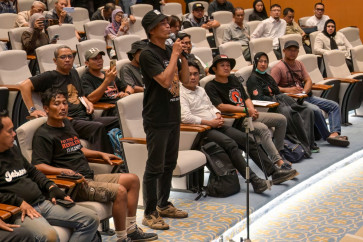
This high enthusiasm in investing in people was also palpable among members countries of the Southeast Asian Minister of Education Organizations (SEAMEO), which recently gathered in Kuala Lumpur to discuss strategic plans for years ahead. The conference saw a handover of the SEAMEO presidency from Indonesian education minister Muhadjir Effendy to Malaysian education minister Maszlee Malik, who will lead the organization from this year to 2021.
The festive handover was filled with the spirit of siblinghood, but the consciousness of hard-hitting reality ahead soon tainted the jovial mood.
Maszlee has a staggering task ahead as the competitiveness of the region is still low and the disparities and inequalities of education in the region are troublesome.
The IMD World Digital Competitiveness Ranking 2018 study shows the disconsolate picture that most countries in Southeast Asia have witnessed a relative drop in the ranking of overall and digital competitiveness.
Worse, dropping three ranks to 62nd in the overall digital ranking, Indonesia is the lowest ranking country in the region.
With a total population of 641.77 million and a growing middle class, the region is a money-spinning market to tap for big educational digital industries such as those from United States and China. Nevertheless, being digitally uncompetitive will only make the population of Southeast Asia a mere captive market.
And the disparity and inequalities exist not only between less developing and more developing countries but also within the countries in a form of rural-urban areas and public-private education institutions or among provinces of the countries.
There are also gender and socioeconomic conditions that result in disparities in the delivery of quality learning opportunities.
For example, the rate of female enrollment in upper secondary education is relatively lower than that of male enrollment in Vietnam. Ethnic minority school girls are considered the most disadvantaged in upper secondary education.
In Indonesia, educational disparities are obvious across geographical areas, urban and rural, between the western and eastern part of Indonesia and among groups of people with varying incomes and gender.
President Joko “Jokowi” Widodo’s determination to focus on the development of human resources in his second term is promising, though concrete steps need a reality check.
In Malaysia, a main focus is already in achievement gaps, since subject matters like English, science and mathematics all emphasize the need to narrow the gaps between urban and rural students.
“We should embrace the spirit of regionalism and the spirit of one big Asian family […] we should work together based on our strengths [...],“ Maszlee said in his speech.
SEAMEO, established in 1965, two years before ASEAN, can be effectively treated as a focus entry of education, as it supervises 26 educational centers with certain expertise across Southeast Asian countries.
However, the collaboration should depart from a typical “Asian” way, where polite words are more palpable than concrete work.
First, the leadership of every party in the collaboration needs to be deeply involved and continually supportive of successful results. Every education minister should be committed to translating decisions into policy.
Second, for effective decision-making, regional cooperation needs to carefully balance the needs of the multiple units of the involved parties through wide consultancy with the relevant units of respective education ministries. And third, both SEAMEO and ASEAN should focus on common interests.
The seven priorities of SEAMEO areas are achieving universal early childhood care and education, addressing barriers to inclusion, resiliency in the face of emergencies, promoting technical and vocational education and training, revitalizing teacher education, harmonizing higher education and research and adopting a 21st century curriculum.
The eight subgoals of ASEAN’s work plan include ASEAN awareness, quality and access to basic education, information and communication technology (ICT) in education, technical and vocational education and training; and lifelong learning, education for sustainable development, higher education quality assurance, university-industry partnership and capacity building for teachers and community.
Certainly, there are interspersed points that can be worked out. For example, addressing barriers to inclusion can be addressed with the use of ICT in education.
Last, aside from public funding that the organizations receive from respective governments, the collaborative efforts should also devise an “entrepreneurial mechanism” by involving private sectors to generate more support for their agreed agenda, thus delivering more to the people of the region.
The involved parties should be able to anticipate and act swiftly upon any emerging development, bypassing the sometimes sluggish government bureaucracy if necessary, and collaborate more prolifically with more partners to unleash the very potential of this rich but still sleepy region.
_________________
Director, Southeast Asian Ministers of Education Organization, Regional Open Learning Center and lecturer at the School of Education, University of Sultan Ageng Tirtayasa.