TheJakartaPost
Please Update your browser
Your browser is out of date, and may not be compatible with our website. A list of the most popular web browsers can be found below.
Just click on the icons to get to the download page.


Popular Reads
Top Results
No results found. Please check your search term and try again
Can't find what you're looking for?
View all search results
Popular Reads
Top Results
No results found. Please check your search term and try again
Can't find what you're looking for?
View all search results[ANALYSIS] 2021: A vaccine-led recovery
The biggest risk to economic growth is still the escalation of the COVID-19 pandemic.
Change text size
Gift Premium Articles
to Anyone
Share the best of The Jakarta Post with friends, family, or colleagues. As a subscriber, you can gift 3 to 5 articles each month that anyone can read—no subscription needed!
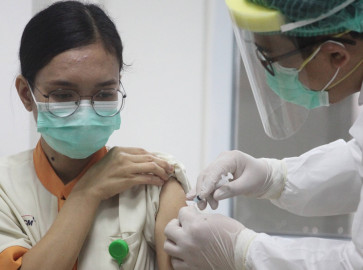
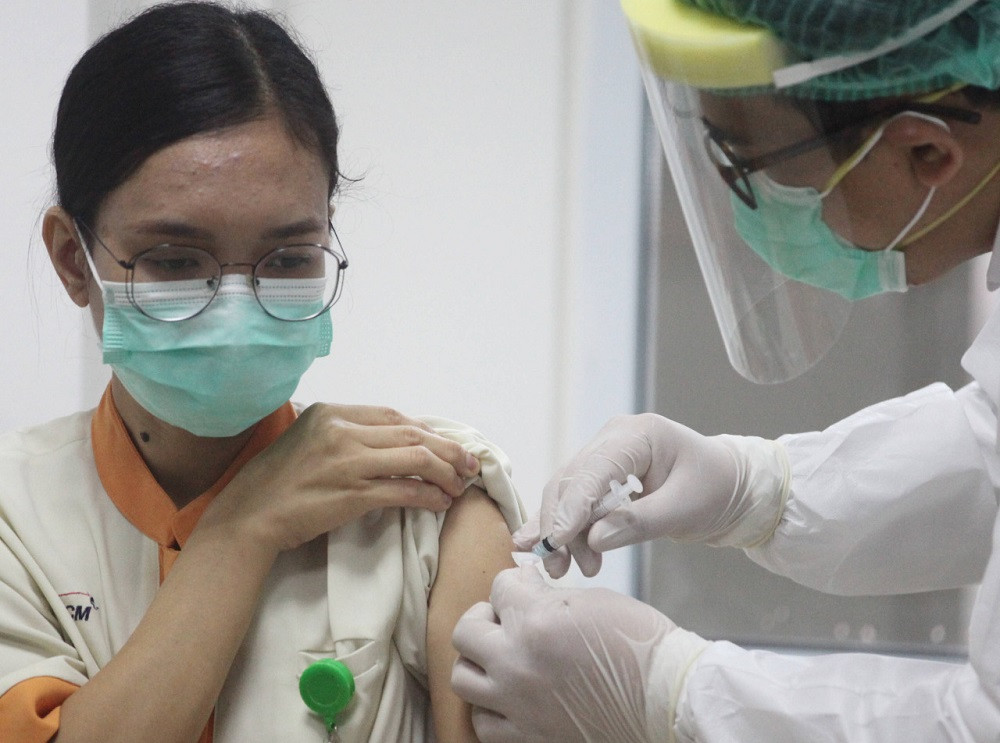 New line of defense: A health worker receives a COVID-19 vaccine at Cipto Mangunkusumo General Hospital in Central Jakarta on Thursday, Jan. 14, 2021, a day after Indonesia began its mass vaccination program, with health workers given top priority. (JP/Dhoni Setiawan)
T
he global economy is on the path to recovery this year. The International Monetary Fund’s most recent outlook projects the global economy to be at 5.5 percent this year, slightly higher than initially forecasted. The baseline view is that the economy will recover as the pandemic should be contained along with the massive distribution of vaccines throughout the world. Various indicators have shown mild improvement recently. The global manufacturing Purchasing Manager’s Index (PMI), an index that measures global manufacturing activity, has shown a steady improvement in the last couple of months.
Yet it is important to note several downside risks that may disrupt the process of a global recovery. Currently, the biggest risk to economic growth is still the escalation of the COVID-19 pandemic. The distribution of vaccines may require some time to be evenly implemented across the world. Meanwhile, there is already the discovery of a new virus variant that threatens the recovery pace, as currently, the number of infections is still rising in many countries.
On the bright side, the risks from the geopolitical perspective should be lower. We may assume geopolitical tensions to be relatively milder with President Joe Biden taking the helm of the United States government. Biden’s approach to foreign policy is expected to be more subtle and avoid confrontation, despite the lingering tension with China. Thus, the risk of volatility in the financial market should be lower. The more favorable sentiment in the financial market will also raise the prospects of capital flows. If signs of recovery continue to emerge, investors will have more incentives to invest in riskier assets. The currently flush global liquidity condition, due to the massive global stimulus, also has the potential to flow, especially into the emerging market.
From the domestic perspective, Indonesia’s economy surpassed the deepest impact of the pandemic in the second quarter of 2020, when economic growth contracted by 5.3 percent year-on-year (yoy), its lowest level since the 1998 Asian financial crisis. The economy has gradually improved ever since and is expected to continue toward the path of recovery this year. The main challenge to sustain the recovery is mainly how to restore businesses’, investors’ and consumers’ confidence. Yet restoring confidence highly depends on the success of pandemic containment efforts.
Containing infections and the distribution of vaccines are currently the focal point of the efforts to restore confidence and start the economic recovery process. The distribution of vaccines has started and is expected to be finished in about 15 months. But as it turns out, the virus is harder to contain than initially expected, which forces us to enter another, tighter and wider phase of social restrictions.
We have gone through four stages of social restrictions since the onset of the pandemic. The first large-scale social restrictions (PSBB) in the second quarter of 2020, was the tightest and had the deepest impact to the economy, especially consumer spending. Spending generally improved when restrictions were relaxed. This year, beginning on Jan. 11, the government imposed tighter and wider public activity restrictions (PPKM). However, we expect that the impact on consumer spending may not be as significant as in the first and second PSBB. This is due to the fact that consumers have had time to adjust and some were able to shift their spending to online platforms. Nevertheless, this may impact the pace of recovery this year, depending on how long the PPKM is in place.
Indonesia’s economic recovery strategy this year involves a balance of extending the fiscal stimulus and continuing the longer-term structural reform strategy. Some infrastructure projects were delayed in 2020 and will be continued this year. However, the priority will be focused on labor-intensive projects, so they can also function as a stimulus for the economy by absorbing unemployment. The government will also focus on developing information communication technology (ICT), which involves increasing the country’s satellite capacity, developing a national data center, developing a social welfare database and digitalizing education. Developing the ICT sector is crucial, especially during the pandemic, to increase online access throughout countries with the growing need for the new-normal way of life.