TheJakartaPost
Please Update your browser
Your browser is out of date, and may not be compatible with our website. A list of the most popular web browsers can be found below.
Just click on the icons to get to the download page.


Popular Reads
Top Results
No results found. Please check your search term and try again
Can't find what you're looking for?
View all search results
Popular Reads
Top Results
No results found. Please check your search term and try again
Can't find what you're looking for?
View all search resultsRethinking the responsibilities of Indonesian universities
Forcing all lecturers and universities to publish hinders the advancement of their careers and creates an incentive for both lecturers and universities to cheat and tick the boxes on the checklist.
Change text size
Gift Premium Articles
to Anyone
Share the best of The Jakarta Post with friends, family, or colleagues. As a subscriber, you can gift 3 to 5 articles each month that anyone can read—no subscription needed!
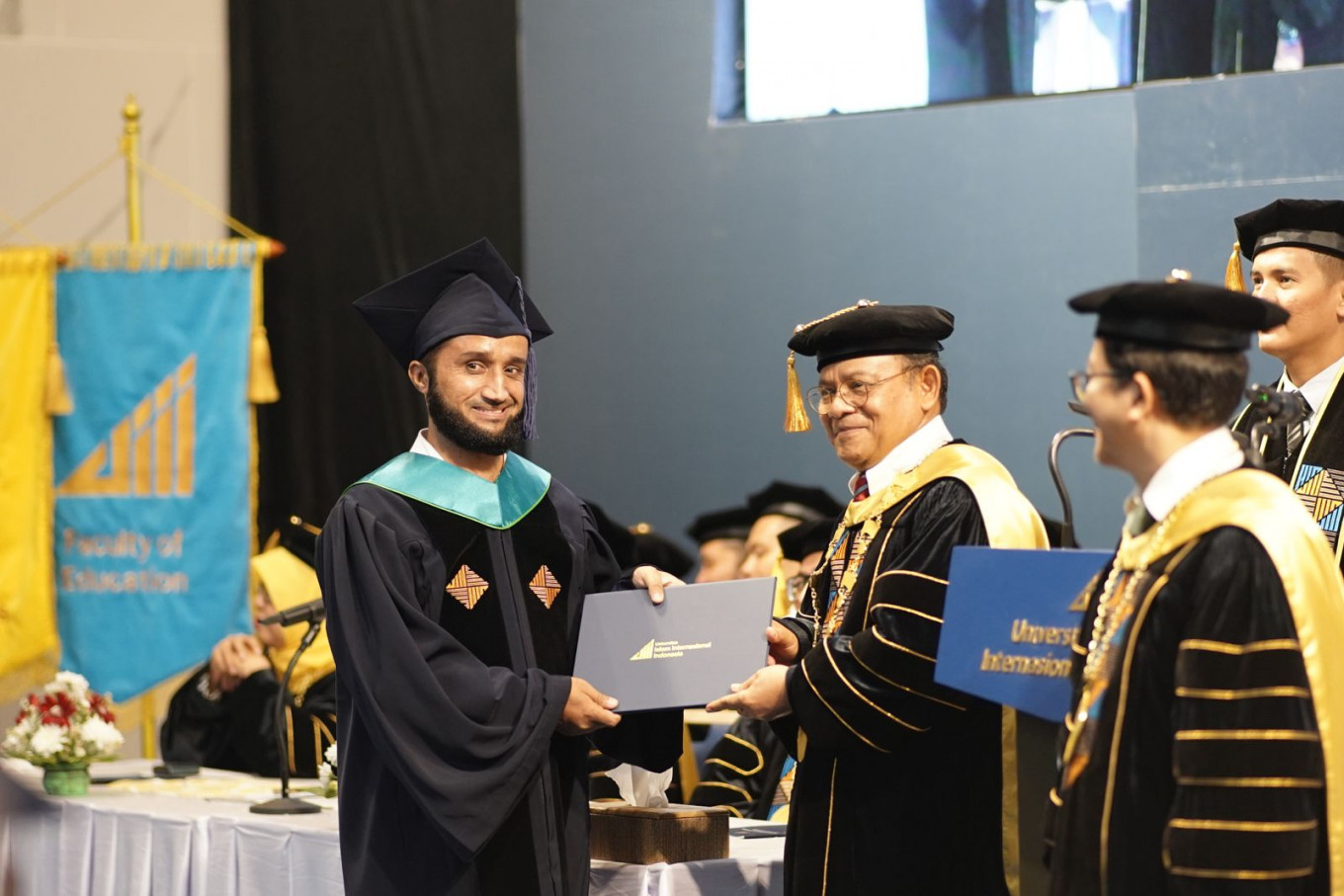 Indonesian International Islamic University (UIII) rector Komaruddin Hidayat (center) hands a diploma on Aug. 31, 2023, to Samiullah Adel (left), a 33-year-old Master's degree graduate from Afghanistan, during the university's inaugural graduation ceremony in Depok West Java. (Handout/Courtesy of UIII)
T
he controversy over awarding professorships to officials and political figures from several universities has been going on for quite some time. Academics complain about the perceived injustice: they must put in a significant amount of time and effort, with no guarantee of success, to achieve professorship status, while politicians who may only teach part-time and publish in predatory journals easily obtain the title.
The Education, Culture, Research and Technology Ministry can no longer stubbornly maintain its single standard for all lecturers and universities. Not all lecturers can write research articles, and not all universities can become research universities.
Forcing all lecturers and universities to publish hinders the advancement of their careers and creates an incentive for both lecturers and universities to cheat in order to tick the boxes on the checklist.
The most fundamental function of a university is to teach and educate students. Regardless of which university it is, it must have qualified educators. After achieving this basic function, the university can become a research center producing scholarly works.
This is why in the United States and other countries considered centers of technology and higher education, not all universities force their faculty to conduct research. In the US, for instance, universities are classified into several types based on the level of support and encouragement for faculty research.
The R1 institutions, such as Harvard University, Stanford University, Ohio State University and the University of Wisconsin-Madison, have very high research activity.

The R2 institutions have moderate research activity, but it is not a primary focus, such as Illinois State University or San Francisco State University.