TheJakartaPost
Please Update your browser
Your browser is out of date, and may not be compatible with our website. A list of the most popular web browsers can be found below.
Just click on the icons to get to the download page.


Popular Reads
Top Results
No results found. Please check your search term and try again
Can't find what you're looking for?
View all search results
Popular Reads
Top Results
No results found. Please check your search term and try again
Can't find what you're looking for?
View all search resultsAgriculture at the heart of security
While many factors have contributed to rising food insecurity, the most important is conflict.
Change text size
Gift Premium Articles
to Anyone
Share the best of The Jakarta Post with friends, family, or colleagues. As a subscriber, you can gift 3 to 5 articles each month that anyone can read—no subscription needed!
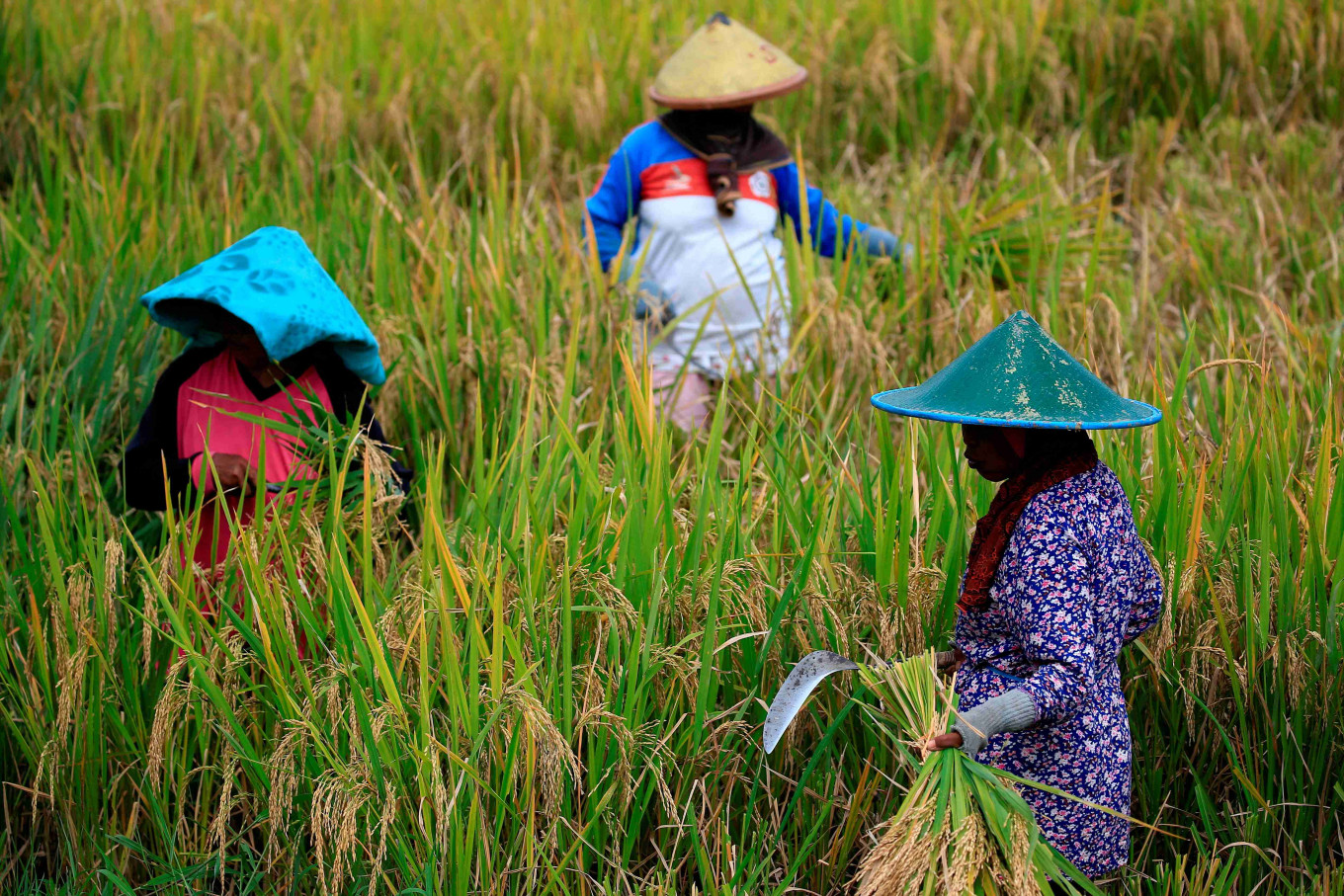 Farmers collect paddy during harvest time on Dec. 9, 2021, at a rice field in Candipuro district, Lumajang, East Java. (Reuters/Willy Kurniawan)
E
ven though the world produces enough food to feed all of humanity, the United Nations World Food Program found that more than 295 million people faced acute hunger in 2024, a record high. While many factors have contributed to rising food insecurity, the most important is conflict. That is especially true in Sub-Saharan Africa (SSA).
For example, the protracted civil war in Sudan has been brutal and is getting worse, pushing parts of the country into famine. This misery, in turn, has led to a deterioration in the security situation and destabilized neighboring countries.
Of course, hunger is far from the only driver of insecurity in Sudan and other SSA countries. But food is essential for stability, meaning that the agriculture sector can be a force for peace building in Africa and worldwide. To that end, our organizations, CIMMYT and AGRA, have worked with African farmers to help stabilize areas beset by conflict and violent extremism.
In Sudan’s eastern Kassala state, a women-led cooperative showed how small interventions can improve community well-being. One of the cooperative’s leaders, Imtithal Atta, was able to increase her yields and earnings dramatically after learning better cultivation techniques and getting access to higher-quality seeds. Her success not only raised her self-confidence and influence, but also helped lower food prices for thousands of displaced people who had sought safety in the region.
In northern Nigeria, long plagued by terrorism, Habiba Abdulkarim and her cooperative faced many obstacles to securing land and reliable inputs. But by coming together to advocate for their needs with local leaders, the group gained access to more farmland and quality seeds. This resulted in better harvests and lower costs, encouraged other women to join forces in cooperative farming, and generated benefits for households and the wider community.
These are not isolated cases. As societies emerge from conflict, the restoration of agriculture is often an important sign of recovery. A steady food supply delivers tangible peace dividends: families can eat, farmers can earn and local economies can recover. Humanitarian aid can help these communities get back on their feet, but only functioning farms and markets can restore lasting stability.

While this is food security in the traditional sense, reliable access to sufficient and safe nutrition, it also highlights how food can be a strategic commodity. In addition to sustaining households, agriculture anchors fragile states, gives legitimacy to governments and creates an opening for cooperation in an increasingly fragmented world. Even as developing economies focus on food sovereignty, with self-sufficiency signifying geopolitical resilience, this goal does not have to be at odds with interdependence. A robust national agri-food sector can put countries in a better position to collaborate with international partners on their own terms, improving stability further.