TheJakartaPost
Please Update your browser
Your browser is out of date, and may not be compatible with our website. A list of the most popular web browsers can be found below.
Just click on the icons to get to the download page.


Popular Reads
Top Results
No results found. Please check your search term and try again
Can't find what you're looking for?
View all search results
Popular Reads
Top Results
No results found. Please check your search term and try again
Can't find what you're looking for?
View all search resultsBahasa Indonesia at a crossroads: Emblem, ecology and policy
Language policy is not a matter of imposing the top-down dos and don’ts about how language is used, but one of active engagement with diverse language users.
Change text size
Gift Premium Articles
to Anyone
Share the best of The Jakarta Post with friends, family, or colleagues. As a subscriber, you can gift 3 to 5 articles each month that anyone can read—no subscription needed!
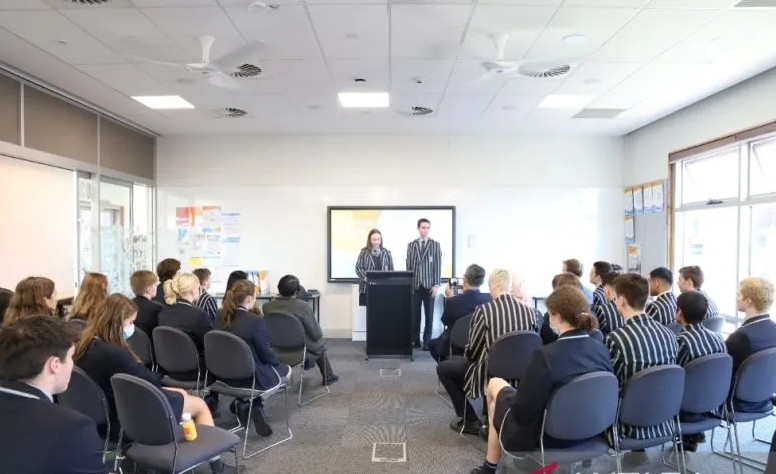 Canberra Grammar School (CGS) students join an Indonesian language class on May 17, 2022, attended by Indonesian Ambassador to Australia Siswo Pramono. (Antara/Indonesian Embassy in Canberra)
T
he Language Month of October has passed, but the opportunity to reflect on how the so-called national or official language, bahasa Indonesia, has co-existed with both indigenous and foreign languages within its own linguistic ecology remains.
This contemplation is of paramount importance as the language is now dynamically evolving, continuously shaped and reshaped by innumerable emerging linguistic codes and non-linguistic resources, churned out by the mobility of people, material goods and ideas in the contexts of trans-localism and trans-nationalism.
What is more, mediated by advances in information technology, language speakers from different localities and nationalities easily cross linguistic, cultural and ideological boundaries, bringing with them their own linguistic versions and blending language norms in a complex and unpredictable way to meet their communicative needs.
In the dynamic communicative practices of today’s world, the practice of naming languages has become patently problematic because of the intermingling of different linguistic codes, identities, cultures and ideologies. As communicative practices become unbounded, borderless and fluid, they dynamically evolve and get sedimented into an entity we call “language”.
In its development, bahasa Indonesia originally came into being as a product of diverse indigenous or local language practices, and gained its official status as a national language after the promulgation of the 1928 Youth Pledge. It was the spirit of unity as one motherland, one nation and one language that eventually became the impetus for naming these diverse language practices bahasa Indonesia.
However, what once was deemed the product of a nationalist ideology (hence the politics of national language) is now a product of complex and mobile linguistic and non-linguistic resources produced among people in trans-local and trans-national connectivity.

Construed in this contemporary and fluid perspective, the language is ipso facto no longer a “language per se” as understood in a conventional sense. That is, a language as a fixed, bounded and static system. It is instead an emblem that is preserved only to sustain the ideology of the nation-state, and to the exclusion of everyday, vibrant communicative practices.