TheJakartaPost
Please Update your browser
Your browser is out of date, and may not be compatible with our website. A list of the most popular web browsers can be found below.
Just click on the icons to get to the download page.


Popular Reads
Top Results
No results found. Please check your search term and try again
Can't find what you're looking for?
View all search results
Popular Reads
Top Results
No results found. Please check your search term and try again
Can't find what you're looking for?
View all search resultsHeroes are not saints: Rethinking the National Hero Law
Soeharto resembled Dhritarashtra, the blind king who fathered the Kauravas. Dhritarashtra’s failure was not in what he did, but in his permissiveness.
Change text size
Gift Premium Articles
to Anyone
Share the best of The Jakarta Post with friends, family, or colleagues. As a subscriber, you can gift 3 to 5 articles each month that anyone can read—no subscription needed!
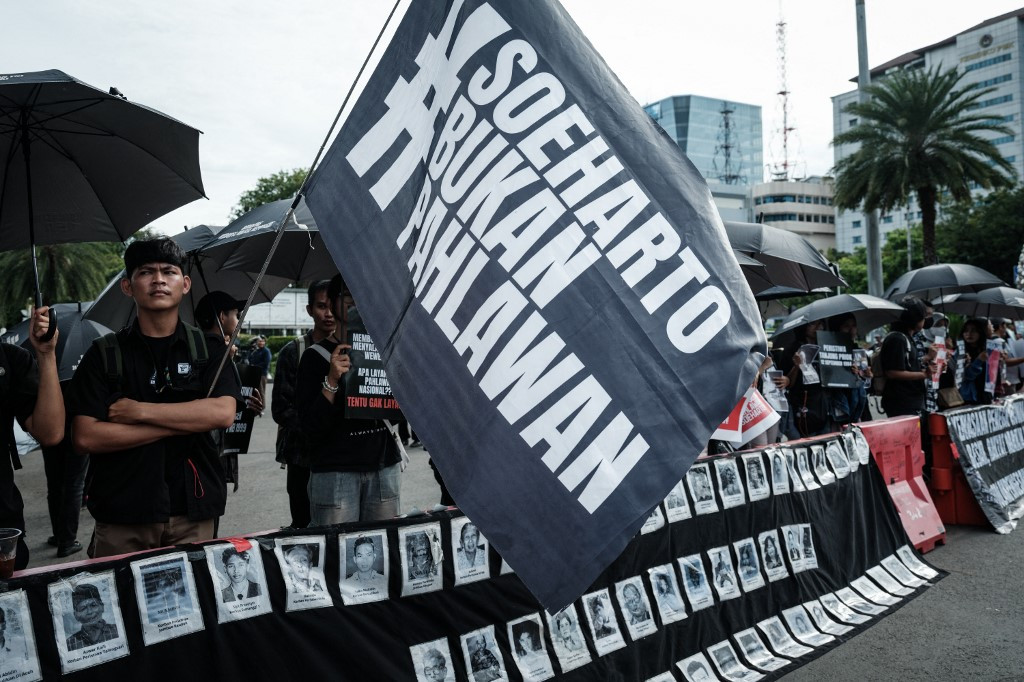 A member of civil society movement groups holds a banner reading “Soeharto is not a hero“ during a Thursdays (Kamisan) rally on Nov. 6 opposing the government's plan to grant former president Soeharto a national hero title near the presidential palace in Jakarta. Former president Soeharto, who died in 2008 aged 86, ruled Indonesia with an iron fist for more than three decades after grabbing power in 1967 following a failed military coup. (AFP/Yasuyoshi Chiba)
I
f we gather a gambler, a womanizer, a glutton and two vain brothers, we call them the Pandavas, a family in Mahabharata mythology. Far from saints, each carried serious flaws.
Yudhishthira gambled away his kingdom and even staked his wife in a dice game. Bhima was ruled by appetite, Arjuna struggled between desire and duty, while Nakula and Sahadeva were vain about their beauty. Yet together, they are remembered as heroes who fought to uphold dharma, the moral order of the world.
Conversely, their rivals, the Kauravas, were not without merit. Duryodhana was courageous and loyal to his brothers. Karna, though born outside the royal line, became legendary for his generosity, even at the cost of his life. Many of the Kauravas embodied bravery and discipline, yet history remembers them as villains because they sided with adharma. The lesson is simple: Heroism is not about being flawless but about standing for values greater than oneself.
This tension between imperfection and virtue echoes in Indonesia’s current debate over whether former president Soeharto should be named a national hero. Commemorating Heroes Day on Monday, President Prabowo Subianto awarded a national hero title posthumously to his former father-in-law Soeharto, despite public resistance.
I grew up hearing stories of Soeharto’s discipline, decisiveness and sense of order. His era brought stability and lifted millions from poverty. For that, admiration is warranted. Yet even admiration must coexist with truth. Soeharto’s legacy also carries unresolved shadows of authoritarian control, the suppression of dissent, and a network of corruption that became institutionalized.
Here, the analogy with the Pandavas must be qualified. Their flaws were personal. These weaknesses did not shape the institutions of their kingdom.

Soeharto, as a person, was not without virtues. Those who served with him often recalled his calm demeanor, loyalty to colleagues and genuine concern for order and stability. Yet leadership is judged not only by intention but by the structure it leaves behind. His flaws ceased to be merely personal, they became embedded in the very order he built.