The Jakarta Post
Please Update your browser
Your browser is out of date, and may not be compatible with our website. A list of the most popular web browsers can be found below.
Just click on the icons to get to the download page.


Popular Reads
Top Results
No results found. Please check your search term and try again
Can't find what you're looking for?
View all search results
Popular Reads
Top Results
No results found. Please check your search term and try again
Can't find what you're looking for?
View all search resultsASEAN inaction on cybercrime poses a risk to regional security
If left unaddressed, these criminal networks will not only destabilize individual member states but also threaten the credibility, security and economic future of the ASEAN as a whole.
Change text size
Gift Premium Articles
to Anyone
Share the best of The Jakarta Post with friends, family, or colleagues. As a subscriber, you can gift 3 to 5 articles each month that anyone can read—no subscription needed!
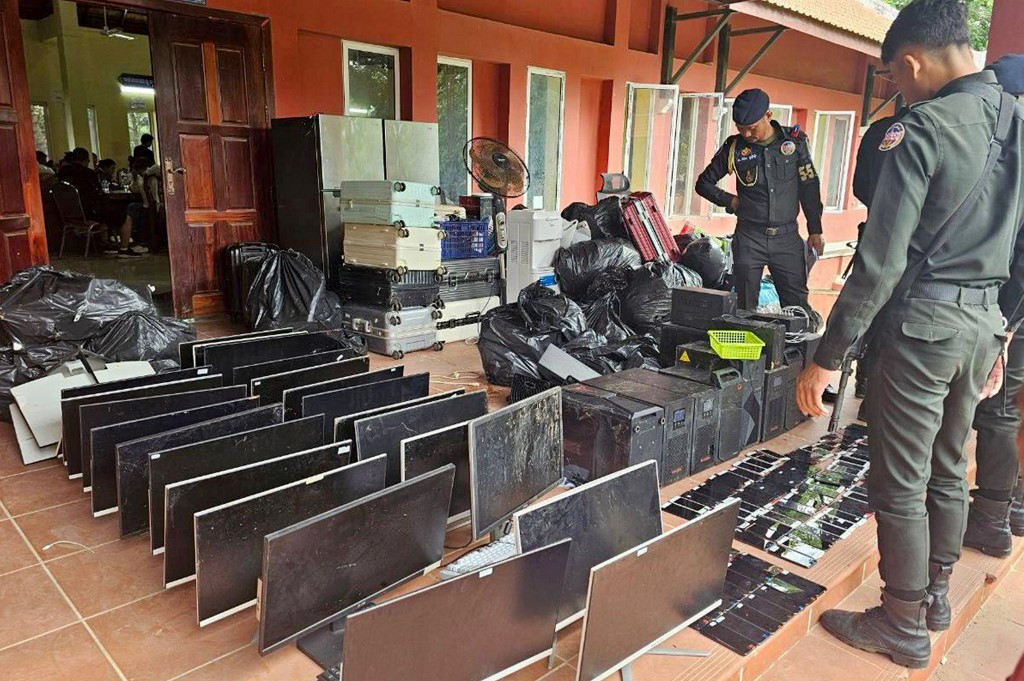 This photo taken on July 17 and released on July 18 by Agence Kampuchea Presse (AKP) shows military police personnel looking at computers, smartphones and other equipment seized during a raid on a scam center in Kandal province, Cambodia. (AFP/Pool)
A
SEAN stands at a critical crossroads. What began as a regional partnership founded on peace, prosperity and shared development is now being undermined by the unchecked rise of transnational, state-backed organized crime.
Across the Mekong subregion, criminal syndicates, largely backed by compliant regimes and powerful individuals in Cambodia and Myanmar, have established operational hubs for human trafficking, online scam centers, cybercrime and money laundering. Indonesian citizens reportedly lost Rp 476 billion rupiah (US$29.7 million) to cyber-related scams across the period November 2024 and January 2025, while losses to AI scams have so far totaled Rp 7.8 trillion rupiah in 2025. With the country facing 3.6 billion attacks across the first seven months of this year, the impact both domestically and regionally cannot be ignored.
If left unaddressed, these criminal networks will not only destabilize individual member states but also threaten the credibility, security and economic future of the ASEAN as a whole.
Thousands of citizens from across Asia and beyond have been lured into forced labor in “fraud factories” under the guise of job opportunities and better prospects for their families. The reality, for many, however, is a life of exploitation, where failure to meet ambitious targets is met with brutal torture and detainment.
From 2020 until February this year there were 6,800 cases of Indonesian citizens involved in online scam networks, with the majority registered in Cambodia, the Philippines and Myanmar. Those responsible are not unknown, many of these operations are run by well-connected criminal groups, including Chinese mafia networks, who have acquired Cambodian and Lao citizenship through corruption, giving them legal protection and political leverage.
Earlier this year, a United States Trafficking Persons report highlighted several individuals who own property known to be used for the derailment of those trafficked into scam centers. In September, many of these individuals along with others were named in a new US Dismantle Foreign Scam Syndicates Act (H.R.5490). Among those mentioned included advisors, ministers and deputy prime ministers within the Cambodian administration.

The corruption at the heart of the Hun regime can no longer be ignored. Instead of protecting victims, the political elite in Phnom Penh has arrested and criminalized them, while shielding those who own and run the criminal compounds. What was once a domestic issue has transformed into a regional emergency threatening the security and prosperity of the region.