The Jakarta Post
Please Update your browser
Your browser is out of date, and may not be compatible with our website. A list of the most popular web browsers can be found below.
Just click on the icons to get to the download page.


Popular Reads
Top Results
No results found. Please check your search term and try again
Can't find what you're looking for?
View all search results
Popular Reads
Top Results
No results found. Please check your search term and try again
Can't find what you're looking for?
View all search resultsThe early warning that Sumatra never received
In the event of disasters, what protects people is not a perfect environment, but a reliable flow of information and a clear structure of action.
Change text size
Gift Premium Articles
to Anyone
Share the best of The Jakarta Post with friends, family, or colleagues. As a subscriber, you can gift 3 to 5 articles each month that anyone can read—no subscription needed!
 Set as preferred source
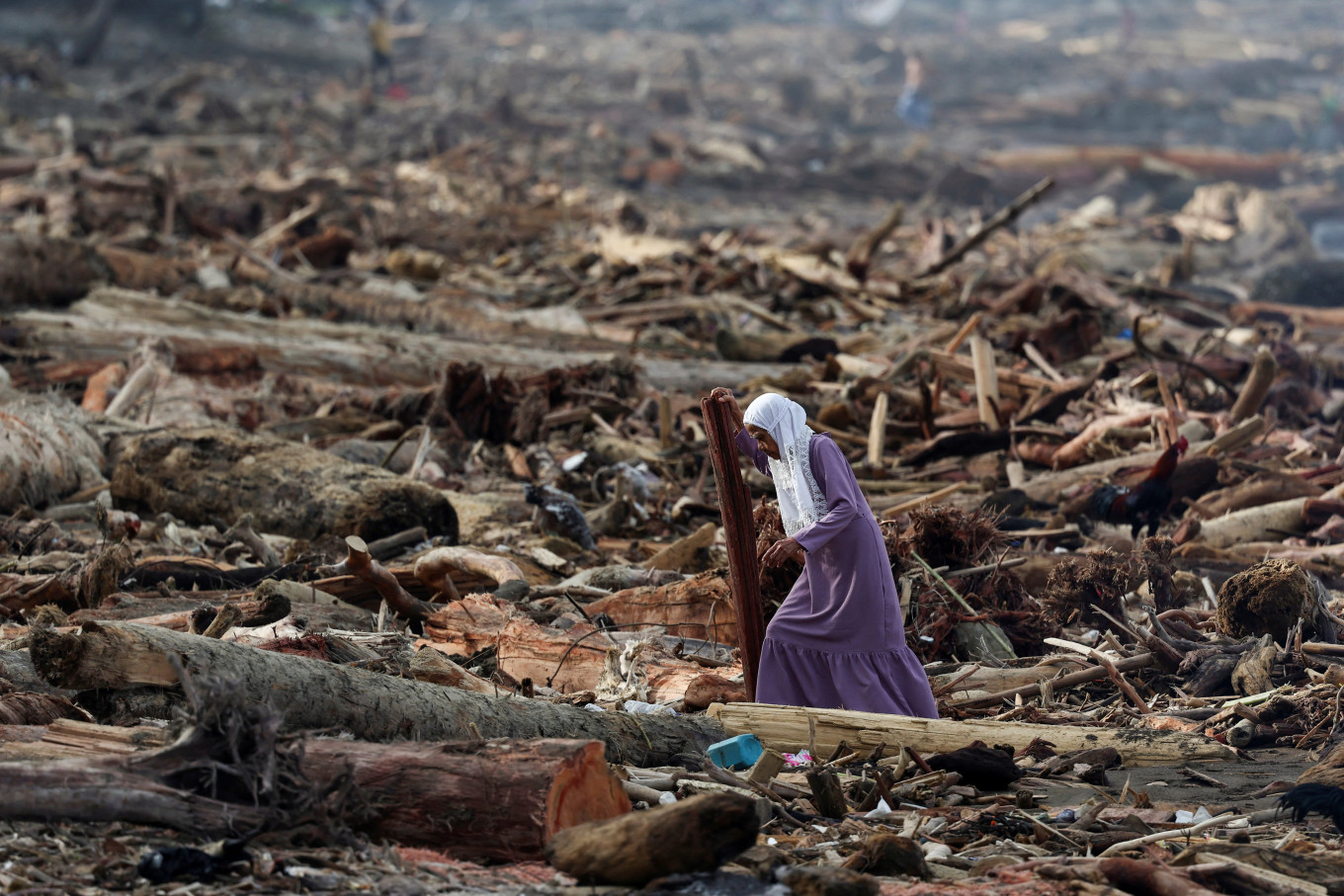 A woman walks among tree trunks on the shore on Sunday following deadly flash floods and landslides, in Padang, West Sumatra. The death toll from floods that hit Indonesia this week has reportedly risen to more than 400 people. (Reuters /Willy Kurniawan)
I
still remember a cold winter night in Hiroshima in 2021. It was past two in the morning when both of my phones suddenly erupted with an alarm so loud that it pulled me out of sleep.
The screens were filled with several lines of kanji that I could barely understand, especially in that half-awake moment. But the meaning was unmistakable. A strong earthquake was coming, and it was striking fast.
Barely three minutes later, the entire house began to shake violently. The warning had arrived before the danger did. It was frightening, but it was also strangely reassuring. A system had reached me in time.
Living in Hiroshima has shown me that disasters here are not treated as unpredictable shocks. They are expected, prepared for and practiced. Warnings do not arrive late. They are not uncertain. They are not debated. They are immediate, unified and trusted.
From my first weeks in campus, I noticed how disaster awareness is embedded in daily routines. In my language class, the teacher explained evacuation procedures alongside grammar.
On ordinary walks around the city, I would see clear signage pointing toward evacuation routes and shelters. School yards serve not only students but entire neighborhoods when emergencies happen. Public facilities display hazard information year-round, not only when a storm is approaching.

Every household receives a printed hazard map. Rivers across the city are equipped with sensors that monitor water levels in real time. Public screens update residents about heavy rain or potential landslides.