The Jakarta Post
Please Update your browser
Your browser is out of date, and may not be compatible with our website. A list of the most popular web browsers can be found below.
Just click on the icons to get to the download page.


Popular Reads
Top Results
No results found. Please check your search term and try again
Can't find what you're looking for?
View all search results
Popular Reads
Top Results
No results found. Please check your search term and try again
Can't find what you're looking for?
View all search resultsSumatra floods: A test of national coordination, not just status
Indonesia has real-time disaster maps using crowdsourced reports and a national portal for disaster risk reduction, but they lack integration
Change text size
Gift Premium Articles
to Anyone
Share the best of The Jakarta Post with friends, family, or colleagues. As a subscriber, you can gift 3 to 5 articles each month that anyone can read—no subscription needed!
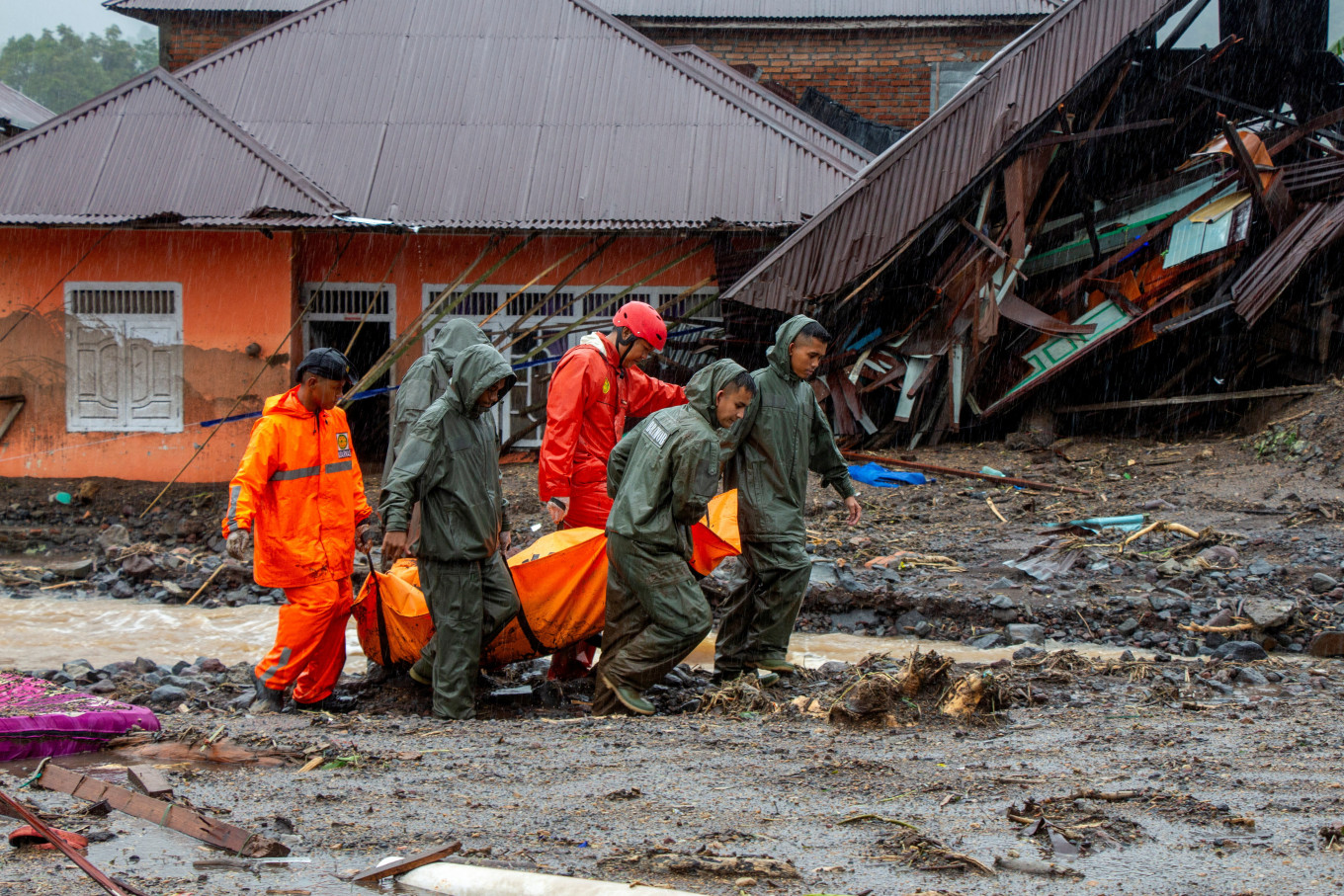 Rescuers carry a body bag of a victim recovered on Friday from an area hit by flash floods following heavy rains in Malalak district, Agam regency, West Sumatra. (Reuters/Stringer)
T
he images emerging from Aceh, North Sumatra and West Sumatra in recent days have been harrowing. Entire villages have been submerged, bridges severed, and families left waiting on rooftops for food and medicine. Official figures already confirm several hundreds have been killed or still missing, and hundreds of thousands have been displaced.
In the ensuing public outcry, one question has dominated the headlines: Should this be declared an official national disaster?
This is, undeniably, a vital legal discussion. The status of a disaster dictates budget allocation, institutional authority and the mobilization of state assets. National leaders are understandably cautious, aware that a "national disaster" label can trigger external fears regarding Indonesia’s economic stability and investment climate.
National Disaster Mitigation Agency (BNPB) head Lt. Gen. Suharyanto has said that the floods and landslides, affecting the three provinces, do not yet meet the criteria for a national disaster.
However, while policymakers debate legal terminology, civilians isolated from responders are not asking about the status of the law. They are asking a much simpler, more brutal question, will help reach us today?
For this reason, the true test for Indonesia right now is not merely the bureaucratic classification of the tragedy. The real test is whether the nation can construct a fast, integrated system of coordination that fuses government, business, philanthropy and citizen volunteers into one shared operational picture.

Consider a traffic accident. When a collision occurs, bystanders do not debate which article of the Traffic Law applies before helping. They clear the road, the ambulance moves, and the only metric that matters is the time it takes to reach the hospital.

Your Opinion Matters
Share your experiences, suggestions, and any issues you've encountered on The Jakarta Post. We're here to listen.
Enter at least 30 characters
0
/ 30
Thank you
Thank you for sharing your thoughts. We appreciate your feedback.