TheJakartaPost
Please Update your browser
Your browser is out of date, and may not be compatible with our website. A list of the most popular web browsers can be found below.
Just click on the icons to get to the download page.


Popular Reads
Top Results
No results found. Please check your search term and try again
Can't find what you're looking for?
View all search results
Popular Reads
Top Results
No results found. Please check your search term and try again
Can't find what you're looking for?
View all search resultsOutrage alone won’t save the Philippines
Democracies move slowly; but when paired with civic education, vigilance and public participation, their institutions stand a better chance of surviving and renewing themselves.
Change text size
Gift Premium Articles
to Anyone
Share the best of The Jakarta Post with friends, family, or colleagues. As a subscriber, you can gift 3 to 5 articles each month that anyone can read—no subscription needed!
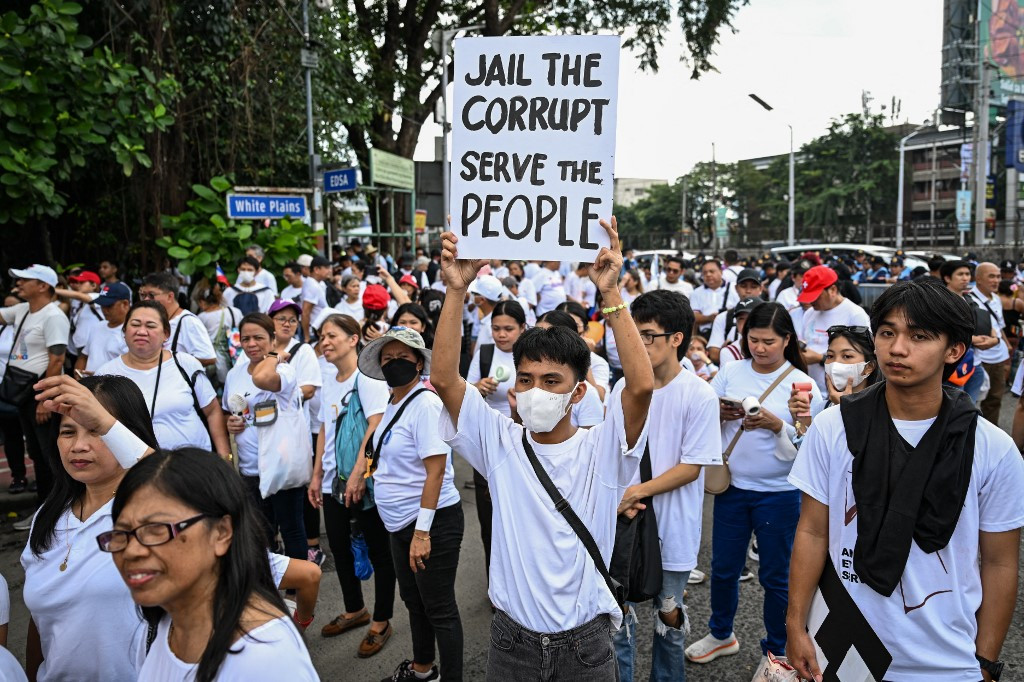 Protesters take part in an anti-corruption rally on Nov. 30, 2025, along Epifanio de los Santos Avenue in Quezon City, Metro Manila. (AFP/Jam Sta Rosa)
A
s outraged Filipinos once more poured into the streets last week to express their indignation over the Philippines President Ferdinand Marcos Jr’s administration’s failure to halt the massive looting of public funds, two calls seem to confront them.
The first is for the outright removal of the present leadership, whether by forcing it to step down or to flee. The second is to demand that the administration itself repair the damage it has caused, under the close and unrelenting watch of a vigilant citizenry.
Given the scale of corruption and the extent to which it implicates the highest levels of government, it is not surprising that many find the first path more emotionally satisfying and politically urgent. With every fresh revelation of official negligence or complicity, the public feels so robbed and betrayed that regime change appears not only justified, but morally necessary.
By contrast, allowing the slow machinery of investigation, prosecution, restitution and reform to run its course requires patience and trust, which, understandably, are in short supply today. At almost every juncture, citizens see politics intervening to save allies and relatives, while punishment is reserved for low-level bureaucrats and perceived enemies.
But these choices are not as freely made as they might appear. Moments of popular outrage, such as the quiet anger that accompanied the funeral of Filipino statesman Benigno S. Aquino Jr in 1983 or the significant protests that arose at Epifanio de los Santos Avenue in 1986, cannot be summoned at will. Nor can the political upheavals they spark be planned or predicted.
For this reason, I believe the current debate is misplaced. What unites the movements gathering today in different venues is far more important than what separates them. No one who supports the work of the Independent Commission for Infrastructure or the Office of the Ombudsman is defending the Marcos Jr administration or the system it represents “at all costs”.

Likewise, no one calling for the ouster of the president and the vice president wishes the country to plunge into disorder. All seek structural transformation, not merely a purge of those in power.
This is why it is crucial to look beyond the immediate demand for accountability in the flood control scandal. If we hope to address corruption at its roots, we must confront the premodern features of our political system: dynastic networks, pork barrel politics, electoral clientelism, loyalty-based appointments and informal hierarchies within the civil service. None of these can be dismantled overnight. Some require constitutional revision, others demand bureaucratic restructuring. All require civic engagement and a citizenry that refuses to retreat into despair.
It is not enough to ban political dynasties, we need genuine political parties and strict campaign finance rules. Eliminating pork requires curbing discretionary funds at every level of government. Patronage will persist as long as access to public services depends on connections rather than on a rules-based system. A professional civil service is impossible while presidents appoint the unqualified to critical posts. And we cannot hope for competent governance if the congressional confirmation process remains a venue for extracting favors and settling scores, instead of testing merit.
When former president Ferdinand Marcos Sr. declared martial law in 1972, he inaugurated an authoritarian regime that allowed him to redesign the bureaucracy by decree. He believed the old system was prone to gridlock, and to be fair, he attempted certain institutional reforms. The Development Academy of the Philippines was conceived as a research and training center for civil servants. The Career Executive Service System established a path for merit-based advancement in the bureaucracy. These innovations endured.
Yet, authoritarianism always carries with it its own fatal flaw: the concentration of power and the centralization of corruption flourishing in the absence of checks and dissent. Democracies, in contrast, move slowly. But when paired with civic education, vigilance and public participation, their institutions stand a better chance of surviving and renewing themselves.
This difficult moment, as painful, infuriating, and uncertain as it is, makes us reflect not just on who should govern, but on the kind of political order that can prevent the recurrence of the massive betrayal we have seen. That slow and exacting work is the only real guarantee that today’s anger will not simply lead us back to the same broken place.
---
The writer is a columnist for the Philippine Daily Inquirer.