TheJakartaPost
Please Update your browser
Your browser is out of date, and may not be compatible with our website. A list of the most popular web browsers can be found below.
Just click on the icons to get to the download page.


Popular Reads
Top Results
No results found. Please check your search term and try again
Can't find what you're looking for?
View all search results
Popular Reads
Top Results
No results found. Please check your search term and try again
Can't find what you're looking for?
View all search resultsDisasters, women and the people we choose not to see
Indonesia needs to reform its disaster management system so it is designed with vulnerable groups at the center, or we will continue to see the same established cycle of response with each disaster that strikes.
Change text size
Gift Premium Articles
to Anyone
Share the best of The Jakarta Post with friends, family, or colleagues. As a subscriber, you can gift 3 to 5 articles each month that anyone can read—no subscription needed!
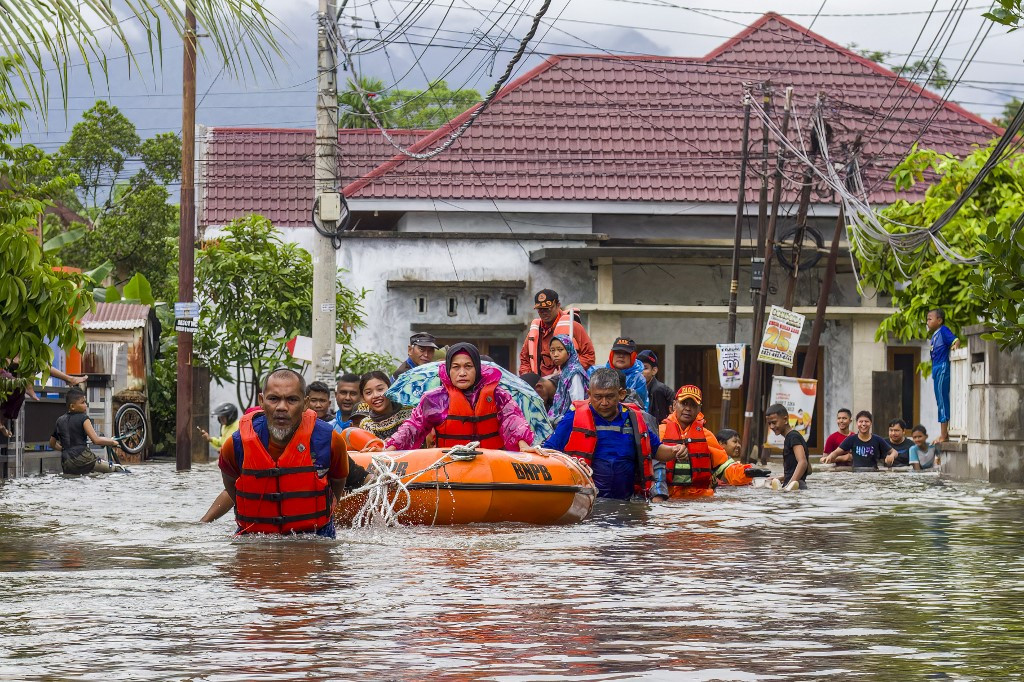 Members of a search and rescue team use a rubber dinghy on Nov. 25, 2025, to evacuate residents from a flooded neighborhood in Padang, West Sumatra. (AFP/Ade Yuanda)
There is one thing the country does with remarkable consistency, without even trying: We keep failing the same disaster exam.
We have laws, national and local agencies, annual drills and handbooks thicker than Russian realism novels on managing disasters, yet the moment rivers overflow or the ground shifts, we are once again startled by chaotic coordination, sluggish aid and a government too distracted by bureaucratic semantics.
As of Thursday, the media reported that thousands of people across Sumatra have been affected: by displacement, power outages, stalled logistics. Meanwhile, public debate circles obsessively around whether the event qualifies as a “national disaster”, mistaking an administrative checkbox for the crisis itself.
We are a nation perfectly aware of our geological lottery yet perpetually unprepared for the ticket we hold. Disasters unfold like an annual ritual: the flood comes, homes are submerged, the news rolls, jacketed officials appear for photo ops, the cameras leave and so does political memory. The cycle is so entrenched that economists might envy its very predictability.
The frightening part is not that disasters happen frequently: Our geography guarantees this. It is that we have learned to live with them so casually.
Policymakers love to say that women and children are the most vulnerable in disasters. It is a phrase that reads well on banners, sounds empathetic in speeches and is media-friendly by design. Yet rarely do we question it: Vulnerable in what way? Compared to whom? And how should this shape policy?

We often settle for moral poetry instead of designing actual solutions. The evidence is embarrassingly simple: Many shelters have no private space for women, no wheelchair access and no breastfeeding rooms. Lighting is often so dim that women avoid the toilets at night for fear of harassment.