TheJakartaPost
Please Update your browser
Your browser is out of date, and may not be compatible with our website. A list of the most popular web browsers can be found below.
Just click on the icons to get to the download page.


Popular Reads
Top Results
No results found. Please check your search term and try again
Can't find what you're looking for?
View all search results
Popular Reads
Top Results
No results found. Please check your search term and try again
Can't find what you're looking for?
View all search resultsQuantum geopolitics and Indonesia’s grand strategy 2025-2045
Indonesia must embrace the quantum geopolitics paradigm to safeguard Indonesia’s sovereignty, harness its geoeconomic potential and maintain strategic autonomy amid the intensifying contest between the United States and China.
Change text size
Gift Premium Articles
to Anyone
Share the best of The Jakarta Post with friends, family, or colleagues. As a subscriber, you can gift 3 to 5 articles each month that anyone can read—no subscription needed!
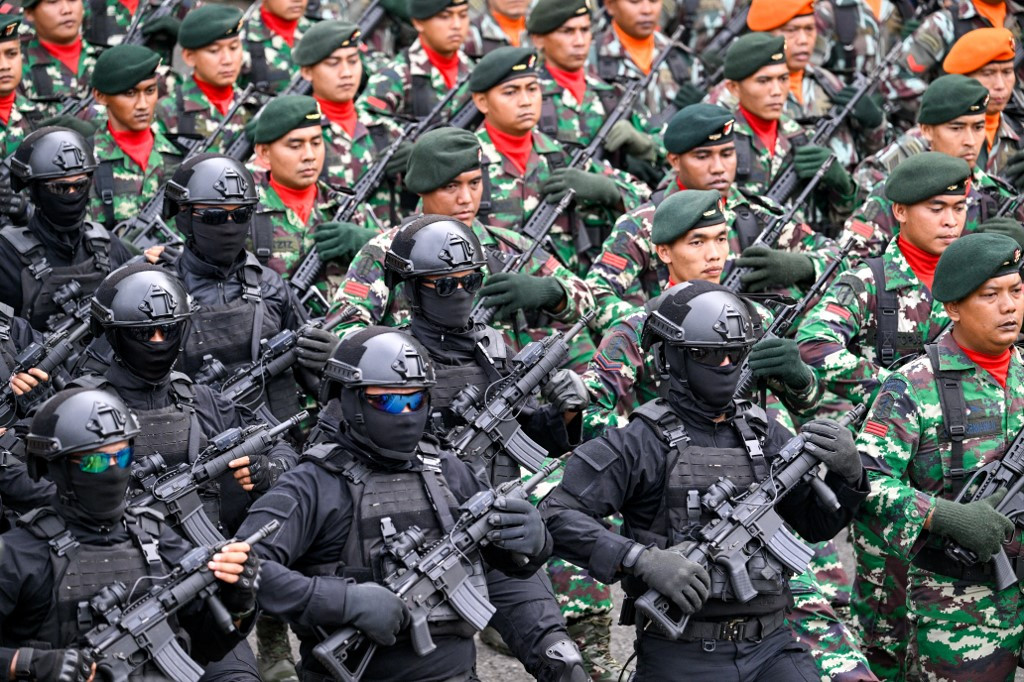 Army personnel march on Oct. 5, 2025, during an event marking the 80th anniversary of the Indonesian Military (TNI) in Banda Aceh, Aceh. (AFP/Chaideer Mahyuddin)
T
he world is entering an era of strategic transformation that is more complex, nonlinear and unpredictable than any previous moment in modern history. Conventional geopolitical frameworks - rooted in realism, balance of power and strategic rivalry - no longer fully capture the dynamics shaping state behavior and global competition.
The emergence of multidomain conflicts, asymmetric warfare, weaponized interdependence, disruptive technologies and great-power competition has created a global ecosystem that behaves less like a predictable Newtonian machine and more like a quantum system: uncertain, probabilistic, interconnected and deeply paradoxical.
This environment demands a new way of thinking: quantum geopolitics. This is not a metaphorical gimmick, but an analytical necessity. It is a strategic paradigm that draws from the principles of quantum mechanics - uncertainty, superposition, entanglement and probability - to navigate an era where traditional linear logic fails.
For Indonesia, which stands at the crossroads of the Indo-Pacific and aspires to become a major global power by 2045, quantum geopolitics offers the intellectual architecture to craft a grand strategy that is adaptive, resilient and decisive. President Prabowo Subianto’s administration must embrace this paradigm to safeguard Indonesia’s sovereignty, harness its geoeconomic potential and maintain strategic autonomy amidst the intensifying contest between the United States and China.
Four major quantum principles illuminate this new landscape.
First, the uncertainty principle. We cannot fully know a state’s intention and capability simultaneously. China’s military buildup is cloaked in ambiguity, the US Indo-Pacific strategy vacillates between engagement and containment, and Russia’s actions appear opportunistic yet unpredictable. ASEAN states, including Indonesia, are forced to balance cautiously amid unclear signals and contested narratives.

Closely related is the concept of superposition, where states occupy multiple strategic positions simultaneously. The US and China are rivals, partners and competitors in different domains at the same time. Similarly, Jakarta is concurrently a friend to Washington, a key economic partner to Beijing, a leader in ASEAN and a nonaligned actor. In classical geopolitics, these positions appear contradictory; in quantum geopolitics, they are expected.