TheJakartaPost
Please Update your browser
Your browser is out of date, and may not be compatible with our website. A list of the most popular web browsers can be found below.
Just click on the icons to get to the download page.


Popular Reads
Top Results
No results found. Please check your search term and try again
Can't find what you're looking for?
View all search results
Popular Reads
Top Results
No results found. Please check your search term and try again
Can't find what you're looking for?
View all search resultsThe prevailing sachet economy: An engineered poverty trap
The sachet economy's environmental burden attacks the core asset of the poor, their health, confirming the decline of human capital.
Change text size
Gift Premium Articles
to Anyone
Share the best of The Jakarta Post with friends, family, or colleagues. As a subscriber, you can gift 3 to 5 articles each month that anyone can read—no subscription needed!
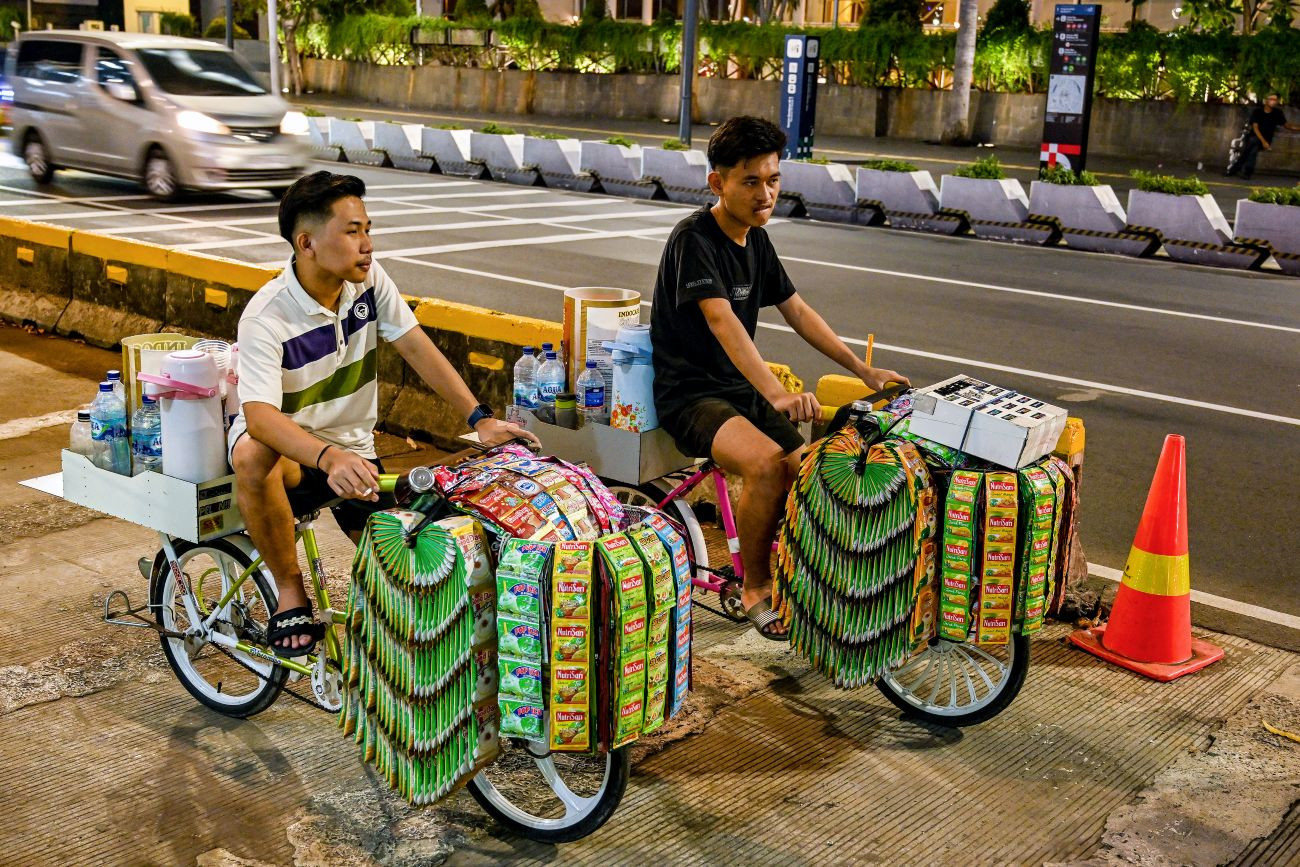 On the road: Mobile coffee vendors wait for customers in a shopping area near the Hotel Indonesia traffic circle in Central Jakarta on Oct. 27, 2024. (AFP/Juni Kriswanto)
T
he price of a single-use instant coffee or shampoo sachet seems cheap. But for the average Indonesian, the true cost is hidden: the consumption of nearly 15 grams of microplastics every month, an amount equivalent to eating a whole ATM card.
This torrent of pollution, overwhelmingly dominated by single-use sachets and pouches, contributes to approximately 76 percent of Indonesia’s plastic waste. This is not merely an environmental problem; it is a direct health crisis. These microplastics contaminate our blood, breast milk and amniotic fluid, risking a stunning 36-fold reduction in cognitive function.
Far from being "pro-poor" or a mechanism for affordability, the sachet economy is an engineered poverty trap. It systematically destroys the health and productivity of the nation's most vulnerable, acting as the root cause of a vicious cycle of poverty.
The problem begins with a market model known as the "sachet economy," prevalent in developing regions. It is characterized by the widespread sale of fast-moving consumer goods (FMCGs) such as shampoo, detergent and coffee, packaged in small, single-use plastic pouches.
This strategy was originally designed to target the “bottom of the pyramid” market, making products accessible to low-income consumers who could not afford to buy in bulk. The commercial strategy began in the early 1980s when India’s CavinKare pioneered selling shampoo in small packets. Recognizing the immense profitability and market penetration potential, multinational corporations (MNCs) scaled the strategy across Asia, Africa and Latin America in the 1990s.
However, the economic benefit of affordability comes with a severe environmental cost. Sachets are typically made of multi-layered plastic and foil, rendering them virtually impossible to recycle. Consequently, this single-use packaging ends up in landfills where it degrades into microplastics, setting the stage for the poverty trap.

The link between sachet pollution and generational poverty is supported by key economic frameworks, specifically the Neoclassical Theory. The Grossman Model (1972) defines health as a form of "human capital." It asserts that health is both a consumption good (providing quality of life) and a capital good (determining the "healthy time" available for work).