TheJakartaPost
Please Update your browser
Your browser is out of date, and may not be compatible with our website. A list of the most popular web browsers can be found below.
Just click on the icons to get to the download page.


Popular Reads
Top Results
No results found. Please check your search term and try again
Can't find what you're looking for?
View all search results
Popular Reads
Top Results
No results found. Please check your search term and try again
Can't find what you're looking for?
View all search resultsThe information monopoly: Why the disinformation bill threatens human rights
The President's recent instruction to formulate a bill to combat disinformation and "foreign propaganda" walks a fine line between the constitutionally guaranteed right to freedom of expression and ratified international agreements stipulating the standards that must be met before basic rights can be legislatively curtailed.
Change text size
Gift Premium Articles
to Anyone
Share the best of The Jakarta Post with friends, family, or colleagues. As a subscriber, you can gift 3 to 5 articles each month that anyone can read—no subscription needed!
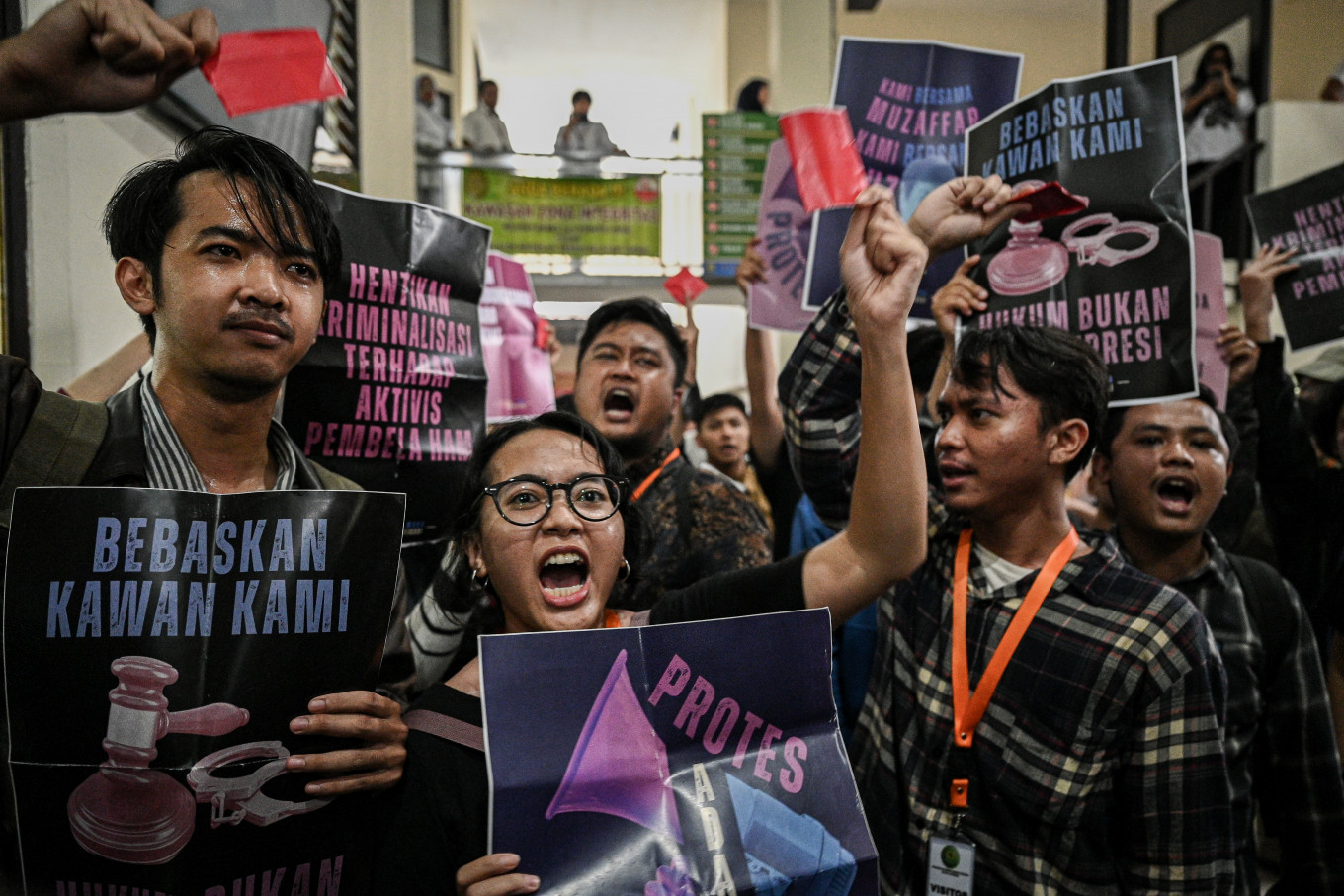 Activists rally at the South Jakarta District Court on Oct. 27, 2025, after the court rejected fellow activist Delpedro Marhaen’s pretrial motion against the police for naming him a suspect of inciting riots during the August protests without due process. (Antara/Fauzan)
P
resident Prabowo Subianto has instructed his administration to draft a bill on countering disinformation and foreign propaganda. According to Yusril Ihza Mahendra, the coordinating minister of law, human rights, immigration and correctional services, such legislation is vital to shield national interests from harmful narratives.
While the government’s initiative may appear well-intentioned, a law designed to regulate the flow of information in a globalized, borderless digital environment risks significant blowback. Without a precise definition for "disinformation" or "national interest", the government creates a regulatory vacuum that can be filled by arbitrary enforcement and systematic suppression of dissent.
In its standards on the right to freedom of expression, the National Commission on Human Rights (Komnas HAM) defines disinformation as false information that is disseminated deliberately.
However, in an era of massive information flows and competing constructions of truth produced by governments, academics, research institutions and indigenous communities, any effort to counter disinformation that relies solely on a government-mandated version of reality risks silencing legitimate discourse.
Such measures often lead to the criminalization of critics or a pervasive climate of fear, as evidenced in late August 2025, when hundreds of protesters were detained on the charge of incitement for what was effectively a legitimate exercise of freedom of expression.
In today’s world, the monopoly on information has been shattered: Every citizen is now a producer and distributor of content. If information contradicting the state’s position is labeled as "foreign propaganda", the result is an information monopoly that violates the constitutional rights to know and access information, which are protected by both the Press Law and the Law on Public Information Disclosure.

The country’s digital landscape is expanding at a staggering rate. Data from the Indonesian Internet Providers Association (APJII) show that the number of internet users reached 229 million in 2025, representing a penetration rate of over 80 percent. However, this rise in connectivity is shadowed by a troubling decline in digital literacy, which dropped to 49.28 points in 2025.