TheJakartaPost
Please Update your browser
Your browser is out of date, and may not be compatible with our website. A list of the most popular web browsers can be found below.
Just click on the icons to get to the download page.


Popular Reads
Top Results
No results found. Please check your search term and try again
Can't find what you're looking for?
View all search results
Popular Reads
Top Results
No results found. Please check your search term and try again
Can't find what you're looking for?
View all search resultsWhen geopolitics fractures the world, culture keeps societies whole
In a world fractured by geopolitical rivalry and rising polarization, the quiet resilience of cultural expression, from Aceh to the global stage, may be the most enduring foundation for social peace.
Change text size
Gift Premium Articles
to Anyone
Share the best of The Jakarta Post with friends, family, or colleagues. As a subscriber, you can gift 3 to 5 articles each month that anyone can read—no subscription needed!
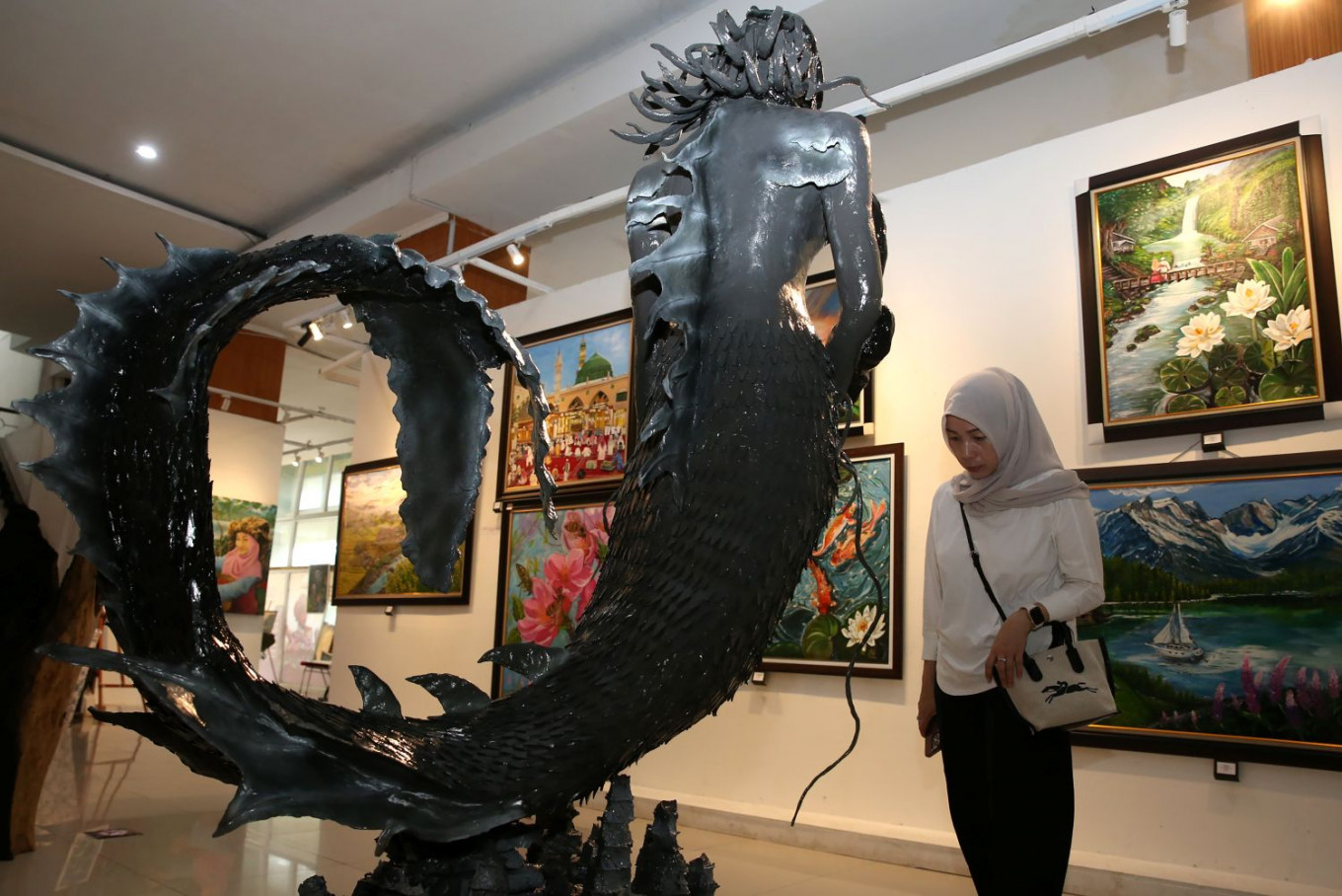 The art of charity: A visitor takes a close look at a statue on display during an art exhibition featuring collaborative works by Acehnese artists at the Aceh Arts and Culture Park in Banda Aceh, Aceh on Feb. 11, 2026. Featuring 96 works, the exhibition, titled “Creating and Giving”, was held to support victims of the November 2025 flash floods in Aceh. (Antara/Irwansyah Putra)
F
rom Eastern Europe to the Middle East and the Indo-Pacific, global politics today is increasingly defined by tension and fragmentation. Armed conflicts, like the one now unfolding in the Middle East, persist; ideological polarization deepens, and narratives of identity grow more rigid. Even societies far from active battlefields feel the consequences as public discourse becomes more divided and social trust more fragile.
Governments and international institutions are expected to manage these crises through diplomacy, law and policy. Yet history suggests that the deeper foundations of social stability rarely emerge from institutions alone. They also grow from cultural processes: the ways communities interpret difference, sustain collective memory and negotiate values across generations.
In many societies, art quietly performs this work. The experience of Aceh province, offers a reminder that cultural expression can play an important role in sustaining social resilience during times of uncertainty.
The anthropologist Clifford Geertz once described culture as a “web of significance” that humans themselves create and inhabit. Within these webs, artistic traditions function not merely as entertainment but as systems through which communities interpret their histories, ethics and identities. Songs, narrative poetry and ritual performances often encode historical memory and moral reflection; they transmit values and shared experiences in ways that formal institutions rarely can.
In Aceh, musical and poetic traditions frequently weave together stories of struggle, reflections on social dilemmas and guidance on communal ethics. Performances recount episodes from the past while offering subtle commentary on the present. Rather than prescribing rigid rules, these artistic forms cultivate ethical sensibilities through aesthetic experience.
This understanding resonates with contemporary discussions of transdisciplinary knowledge. The late scholar Julie Thompson Klein argued that knowledge relevant to complex societal challenges often exists beyond universities and policy institutions, embedded instead in cultural practices and community traditions. Traditional arts, in this sense, are not only cultural heritage; they are reservoirs of social knowledge.

Acehnese society has long been shaped by the interaction between Islamic norms and customary traditions known as adat. This relationship is captured in the well-known proverb: adat bak poe teumeureuhom, hukom bak syiah kuala, reflecting the complementary roles of custom and religious authority. Legal scholars describe such arrangements as "legal pluralism." The late anthropologist Sally Engle Merry defines this as the coexistence of multiple normative systems within the same social environment.