The Jakarta Post
Please Update your browser
Your browser is out of date, and may not be compatible with our website. A list of the most popular web browsers can be found below.
Just click on the icons to get to the download page.


Popular Reads
Top Results
No results found. Please check your search term and try again
Can't find what you're looking for?
View all search results
Popular Reads
Top Results
No results found. Please check your search term and try again
Can't find what you're looking for?
View all search resultsA brutal warning shot: The decisive moment for Indonesia’s fragile democracy
This cycle of impunity sends a clear and dangerous message: those who silence dissent through violence operate with the implicit protection of the state’s inaction.
Change text size
Gift Premium Articles
to Anyone
Share the best of The Jakarta Post with friends, family, or colleagues. As a subscriber, you can gift 3 to 5 articles each month that anyone can read—no subscription needed!
 Set as preferred source
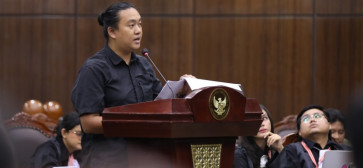
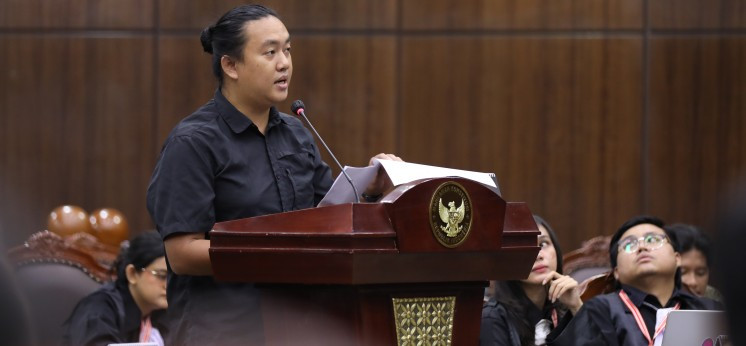 Commission for Missing Persons and Victims of Violence (Kontras) Andrie Yunus testifies on July 14, 2025, during a judicial review hearing against the revised Indonesian Military (TNI) Law at the Constitutional Court in Jakarta. (Courtesy of Constitutional Court/Ifa)
W
e are once again confronted with a dark moment in the nation’s democratic trajectory. Andrie Yunus, an activist and deputy coordinator of the Commission for the Disappeared and Victims of Violence (Kontras), was targeted in an acid attack. The assault left him with burns covering 24 percent of his body, including his face and eyes, requiring intensive medical treatment.
Violence against human rights defenders is far from unprecedented; it is a recurring feature of the Indonesian political landscape. Activists, journalists and outspoken citizens have long faced threats, physical and digital harassment, and so-called judicial harassment through the misuse of the draconian Electronic Information and Transaction (ITE) Law.
Most notable is the 2004 arsenic poisoning of Munir Thalib on a flight to Amsterdam, a case that remains a haunting symbol of state-sponsored impunity. These patterns of violence persist today without meaningful resolution, as seen in 2025 alone. Iqbal Damanik of Greenpeace Indonesia received a dead chicken and a handwritten threat at his home, while social media activist Virdian Aurellio was subjected to severe doxing and physical vandalism of his property.
Crucially, the attack on Andrie is not an isolated tragedy but part of a chilling historical continuity where justice is almost never served. Most, if not all, cases of violence against human rights defenders in Indonesia have remained unsolved, with the intellectual actors behind these crimes rarely identified, let alone prosecuted.
This cycle of impunity sends a clear and dangerous message: those who silence dissent through violence operate with the implicit protection of the state’s inaction. Kontras itself, where Andrie works, has described the nation’s human rights situation as a catastrophe, citing recurring violations such as extrajudicial killings, torture and enforced disappearances.
Regarding civil liberties, the organization recorded over 200 incidents in a single year, the vast majority of which involved police officers, with additional involvement from the military and government officials.

This wave of terror does not exist in a vacuum; it is the physical manifestation of a broader decline in Indonesian democracy. For the past decade, scholars have warned of democratic regression, but the nation is now witnessing what many describe as a transition toward a "neo-New Order".