The Jakarta Post
Please Update your browser
Your browser is out of date, and may not be compatible with our website. A list of the most popular web browsers can be found below.
Just click on the icons to get to the download page.


Popular Reads
Top Results
No results found. Please check your search term and try again
Can't find what you're looking for?
View all search results
Popular Reads
Top Results
No results found. Please check your search term and try again
Can't find what you're looking for?
View all search resultsAttacks on human rights workers are a manifestation of state terrorism
When a state uses acid to silence its critics, it ceases to be a protector and becomes a perpetrator of terrorism.
Change text size
Gift Premium Articles
to Anyone
Share the best of The Jakarta Post with friends, family, or colleagues. As a subscriber, you can gift 3 to 5 articles each month that anyone can read—no subscription needed!
 Set as preferred source
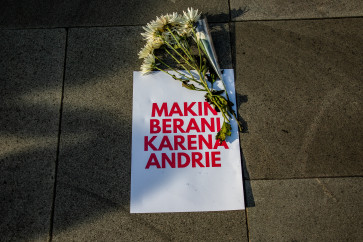
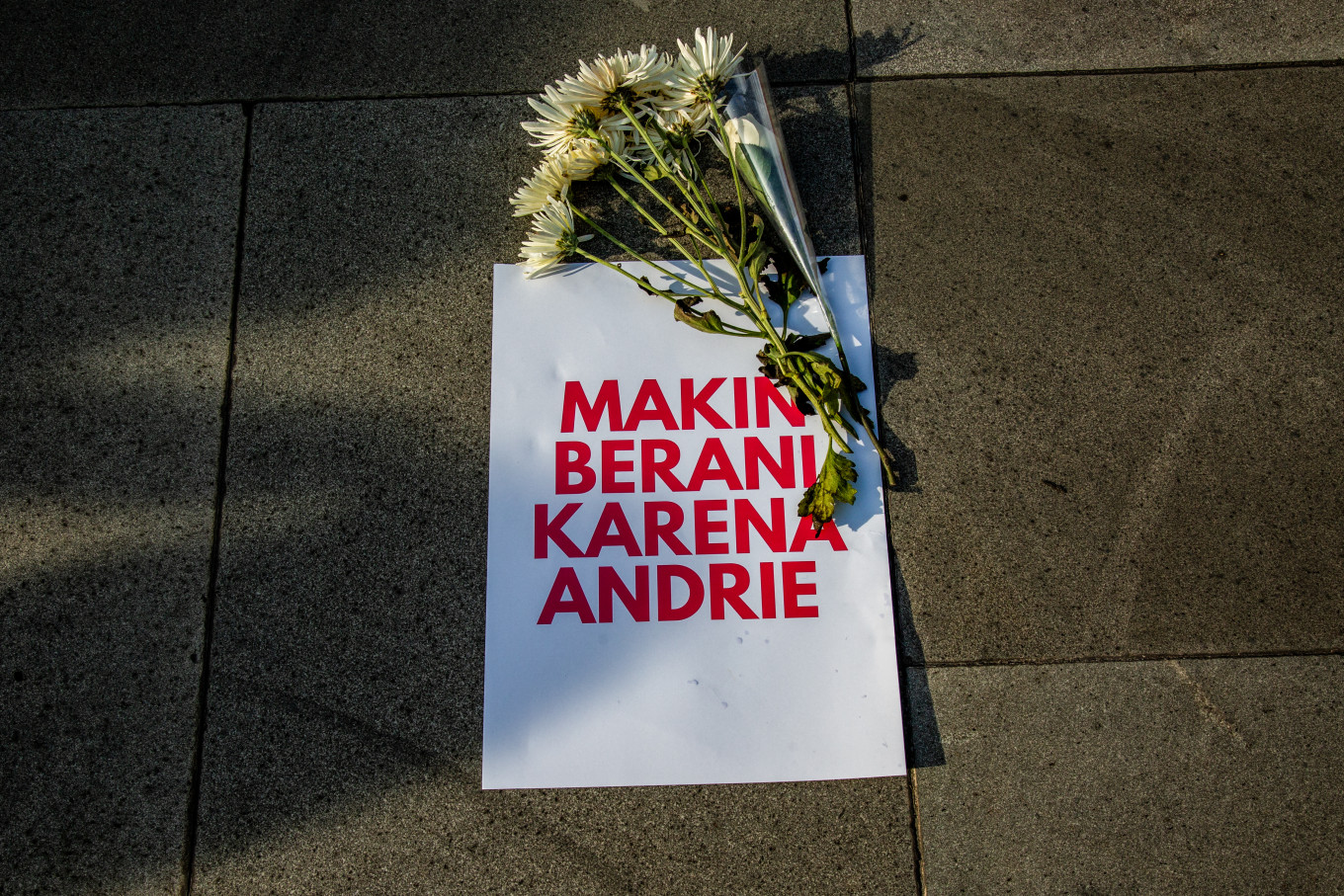 A poster with flowers is seen during a demonstration on March 14 in Yogyakarta, in support of activist Andrie Yunus of the Commission for the Disappeared and Victims of Violence (Kontras), who was attacked with acid by unidentified persons. (AFP/Devi Rahman)
O
n the evening of March 12, after recording a podcast titled “Remilitarization and Judicial Review in Indonesia” at the office of the Indonesian Legal Aid Foundation (YLBHI), Andrie Yunus, a human rights worker and deputy coordinator of the Commission for the Disappeared and Victims of Violence (Kontras), was violently attacked with acid by unknown assailants while heading home to Salemba, Central Jakarta.
Several CCTV cameras in the area captured the attack, recording Andrie's cries of pain and the ensuing panic. Following the incident, he was rushed to the hospital for urgent medical treatment. Examinations revealed severe burns covering nearly one fourth of his body, particularly on his arms, face and chest; he eventually required membrane implant surgery in one of his eyes.
The United Nations Human Rights Office (OHCHR) condemned the incident as a "horrific acid attack" and expressed deep concern via its social media platforms. This condemnation serves as both a litmus test and a bitter irony for Indonesia, which currently holds the presidency of the UN Human Rights Council.
The incident is deeply alarming. Whether by design or sheer audacity, the attackers chose a location monitored by multiple CCTV cameras, indicating they were likely aware their actions would be recorded. This suggests a deliberate choice to strike at a moment that would send a powerful message of terror to the public.
Kontras views this act of terror as an attempt to silence not only Andrie but the Indonesian people as a whole, including human rights workers, activists and other critical groups. This occurred despite the fact that Indonesia possesses legal instruments to protect such humanitarian efforts, as outlined in Law No. 39/1999 on Human Rights, Article 66 of Law No. 32/2009 on Environmental Protection and Management and Regulation No. 5/2015 from the National Commission on Human Rights (Komnas HAM) regarding protection procedures for human rights defenders.
The acid attack on Novel Baswedan, a former senior investigator of the Corruption Eradication Commission (KPK), on April 11, 2017, serves as a significant and haunting precedent. That assault caused severe injuries to Novel's left eye, resulting in long-term vision loss. While responding to the incident involving Andrie, Novel, himself a former police officer, expressed his belief that such an attack is nothing less than an attempt on a person's life.

Given the professional backgrounds of both Andrie and Novel, it is evident that these assaults are intrinsically linked to their work. Thus, they represent a clear manifestation of state-sanctioned violence.