TheJakartaPost
Please Update your browser
Your browser is out of date, and may not be compatible with our website. A list of the most popular web browsers can be found below.
Just click on the icons to get to the download page.


Popular Reads
Top Results
No results found. Please check your search term and try again
Can't find what you're looking for?
View all search results
Popular Reads
Top Results
No results found. Please check your search term and try again
Can't find what you're looking for?
View all search resultsAnalysis: When nutrition is crowding out education budget
Change text size
Gift Premium Articles
to Anyone
Share the best of The Jakarta Post with friends, family, or colleagues. As a subscriber, you can gift 3 to 5 articles each month that anyone can read—no subscription needed!
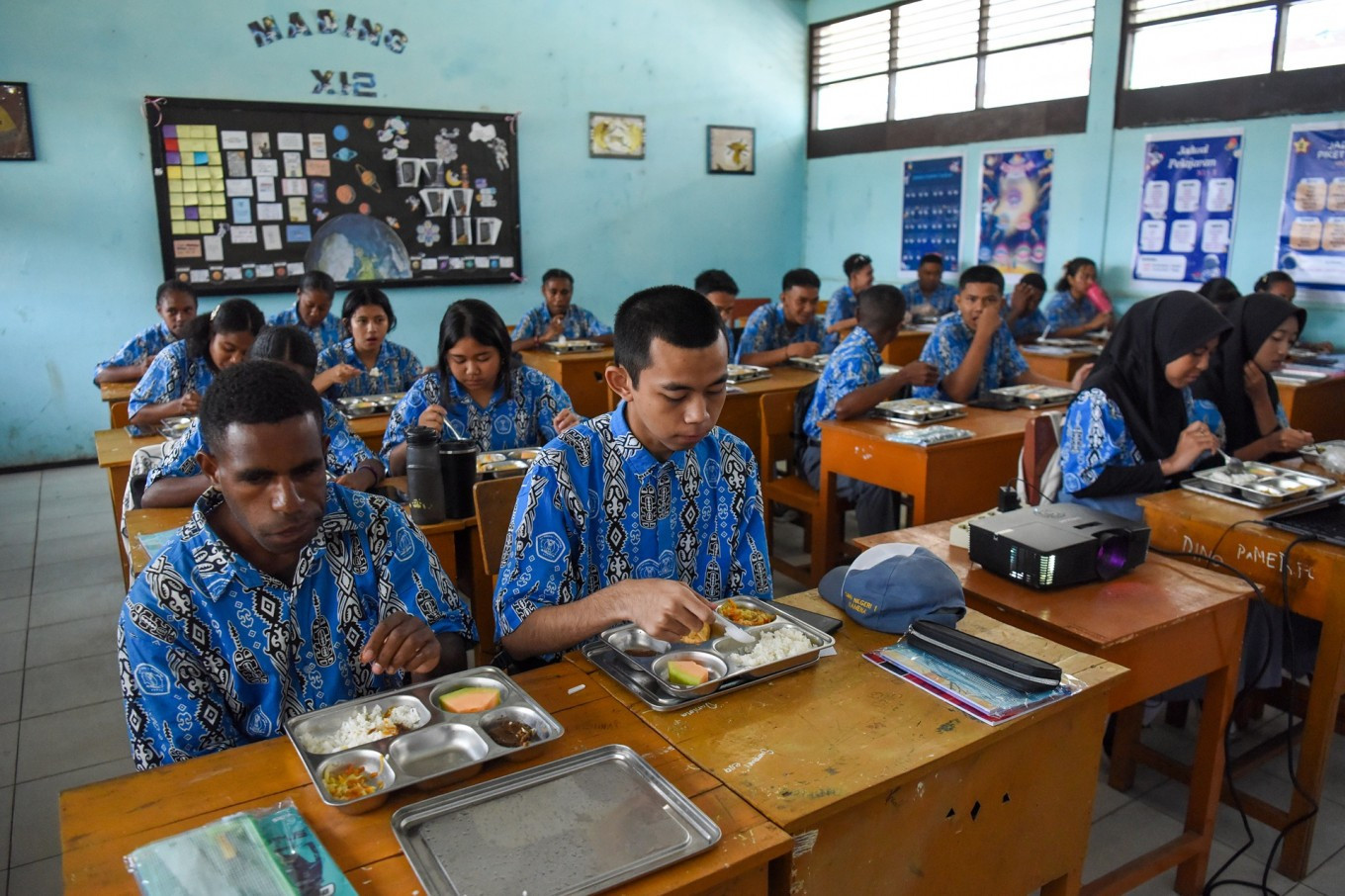 Students eat meals provided under the free nutritious meal program at SMAN 1 Wamena senior high school in Jayawijaya regency, on Jan. 14, 2026, when Vice President Gibran Rakabuming Raka inspected program rollout in Wamena district, Highland Papua. (Antara/Indrianto Eko Suwarso)
B
udget allocations for the free nutritious meal (MBG) program now dominate the education budget. A school feeding program that does not fundamentally serve a core educational purpose has instead become a primary focus within the government’s education spending framework. This shift raises significant questions about fiscal priorities and the long-term health of the nation’s pedagogical infrastructure.
According to Presidential Regulation (Perpres) No. 118/2025 on details of the 2026 state budget (APBN), total education spending is set at Rp 769.1 trillion (US$45.5 billion). This budget is distributed through three main channels, with 61.2 percent allocated to central government spending, 34.4 percent designated for transfers to regional governments and 4.4 percent managed through various financing schemes.
Under this structure, the National Nutrition Agency (BGN), which oversees the free meals program, has emerged as the institution receiving the largest single allocation from the education budget. The agency is set to receive Rp 223.56 trillion, equivalent to 29.1 percent of education spending this year. This share marks a sharp increase compared with the previous year: The 2025 state budget allocated only around 7.8 percent of the education budget to the BGN, meaning that its share has more than tripled in just 12 months.
The budget structure further highlights the free meals program's current standing as the flagship program of President Prabowo Subianto’s administration, now framed as a primary driver of education outcomes. Conceptually, however, categorizing the free meals program as an education budget item remains a point of contention in international finance standards.
The Organisation for Economic Co-operation and Development (OECD), for example, clearly distinguishes between core educational purposes and other education-related expenditure. School feeding programs fall into the latter category, as they are considered supportive social programs rather than a core component of education financing.
The allocation has garnered both support and criticism. The government insists that the new budget structure does not reduce fiscal space for education, with Cabinet Secretary Teddy Indra Wijaya insisting that no education program has been cut or discontinued due to funding the free meals program. House of Representatives Budget Committee chairman Said Abdullah, who hails from the from the Indonesian Democratic Party of Struggle (PDI-P), echoed this statement when he described the allocation as a joint decision made during budget deliberations.

While the raw budgets have technically increased for the three key ministries, the religious affairs, the primary and secondary education and the higher education ministries, the overall composition of education spending tells a different story.