The Jakarta Post
Please Update your browser
Your browser is out of date, and may not be compatible with our website. A list of the most popular web browsers can be found below.
Just click on the icons to get to the download page.


Popular Reads
Top Results
No results found. Please check your search term and try again
Can't find what you're looking for?
View all search results
Popular Reads
Top Results
No results found. Please check your search term and try again
Can't find what you're looking for?
View all search resultsDefending budget deficits amid war: Prabowo’s fiscal crossroads
As Indonesia’s 2026 budget faces an oil-fueled collision between campaign promises and market reality, the government must choose: protect its signature projects or save its fiscal credibility.
Change text size
Gift Premium Articles
to Anyone
Share the best of The Jakarta Post with friends, family, or colleagues. As a subscriber, you can gift 3 to 5 articles each month that anyone can read—no subscription needed!
 Set as preferred source
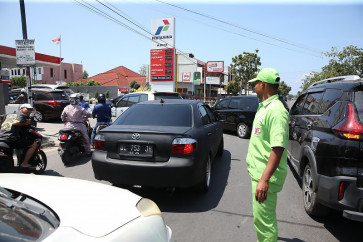
 An employee directs motorists lining up to buy fuel at a gas station in Banda Aceh on March 5, 2026. (Antara/Irwansyah Putra)
T
he soaring oil prices and other immediate consequences of the ongoing United States-Israeli war on Iran are set to hit the Indonesian economy through multiple channels, including disruptions to the supply of oil, liquefied petroleum gas (LPG), fertilizer and food, as well as heightened inflationary pressure.
Most critically, these factors threaten to undermine the 2026 fiscal budget. Without immediate adjustments, deficits will likely breach the legal limit of 3 percent of gross domestic product (GDP). This risk has been confirmed by various government scenarios modeled on the potential duration of the conflict and fluctuating oil prices.
Despite these pressures, Finance Minister Purbaya Yudhi Sadewa has stated that the government will not increase subsidized fuel prices before the end of the year. This is a bold and risky gamble. While the government seeks to demonstrate a commitment to prudent fiscal policy to maintain market confidence, the challenge of keeping the current budget intact will intensify as uncertainties mount and the war drags on.
Government "sensitivity analysis" for the 2026 budget reveals that every US$1 increase in the Indonesian Crude Price (ICP) widens the deficit by Rp 6.7 trillion ($390 million). Calculations suggest that if oil prices hover around $100 per barrel, the deficit would increase by Rp 200 trillion (0.8 percent of GDP) in the absence of adjustments. This would be in addition to the Rp 639 trillion (2.48 percent of GDP) already projected in the budget.
Technically, there are few purely economic reasons for the 3 percent deficit limit; it serves primarily as a reference point and a symbol of intent regarding disciplined fiscal management. The threshold has no direct correlation with economic growth.
Indeed, a fiscal deficit exceeding 3 percent does not necessarily stifle expansion. Several regional peers achieved high growth in 2025 despite higher deficits: Malaysia’s deficit was 3.8 percent with 5.2 percent growth; Vietnam’s was 3.8 percent with 8 percent growth; while China and India maintained deficits of 4 percent and 4.4 percent while growing at 5 percent and 7.4 percent, respectively. These examples suggest that good governance and strong institutions play a far more vital role in economic health than a rigid deficit cap.

However, the International Monetary Fund continues to use the 3 percent limit as a standard for surveillance, advising member countries to use it as a "fiscal anchor" to prevent excessive debt accumulation. Similarly, the European Union mandates that member states keep annual deficits below 3 percent under the Stability and Growth Pact (SGP).