The Jakarta Post
Please Update your browser
Your browser is out of date, and may not be compatible with our website. A list of the most popular web browsers can be found below.
Just click on the icons to get to the download page.


Popular Reads
Top Results
No results found. Please check your search term and try again
Can't find what you're looking for?
View all search results
Popular Reads
Top Results
No results found. Please check your search term and try again
Can't find what you're looking for?
View all search resultsThe anatomy of the Mideast war: 24 days that alter the nature of conflict
While Washington grapples with strategic disorientation, Tehran is inverting "Madman Theory" to build a new, lethal credibility through consistent execution. In this 24-day window, the nature of warfare has been altered, leaving neutral powers like Indonesia to navigate a world where ambiguity is no longer a shield.
Change text size
Gift Premium Articles
to Anyone
Share the best of The Jakarta Post with friends, family, or colleagues. As a subscriber, you can gift 3 to 5 articles each month that anyone can read—no subscription needed!
 Set as preferred source
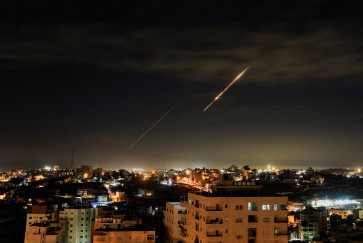
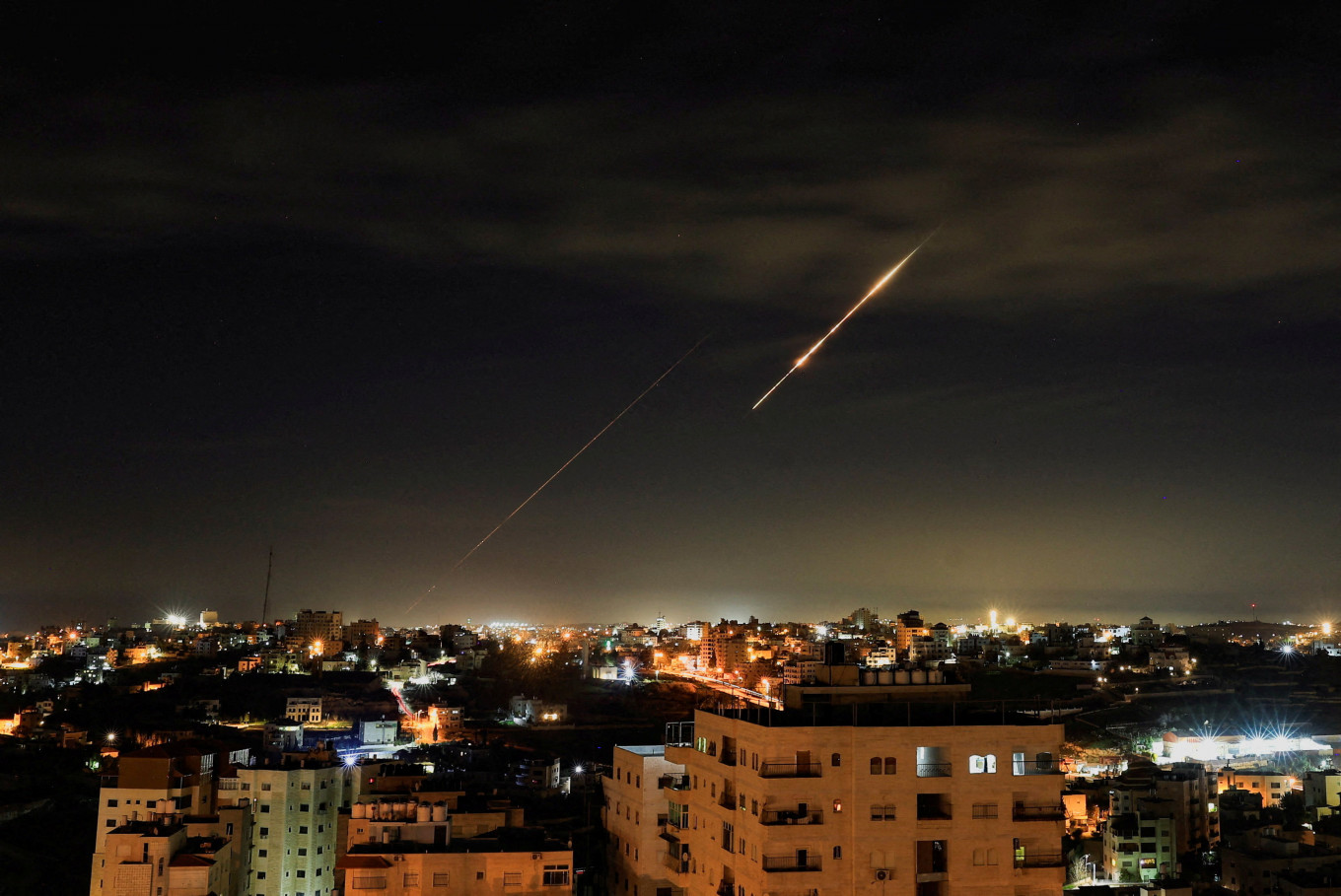 Iranian missiles fly toward Israel on March 13, amid the United States-Israeli war on Iran, as seen from Hebron, in the Israeli-occupied West Bank. Indonesia's government is drafting multiple contingency scenarios for this year’s haj pilgrimage due to the escalating conflict in the Middle East. (Reuters/Mussa Qawasma)
I
f there were a single turning point that fundamentally shifted the character of the war between Iran, the United States, and Israel, it was Saturday night, March 21—the 22nd day of the conflict. However, its full magnitude only became clear on the 24th day. Iran launched ballistic missiles at Dimona and Arad, two regions in the southern Negev located in close proximity to the Shimon Peres Negev Nuclear Research Center, a facility widely believed to house Israel’s illegal undeclared nuclear arsenal.
Latest reports confirm at least 180 casualties. For the first time, Israel’s multilayered defense system failed to intercept threats in its most sensitive sector. This was not merely a technical failure; it was a meticulously calibrated signal. Initial Israel Defense Force investigations revealed that interception failures at Arad and Dimona occurred at two distinct weak points in the air defense architecture, suggesting that the "Dome," once deemed impenetrable, now possesses tangible structural fissures.
Iran targeted the buffer zones around Dimona as a direct response to the US-Israeli strike on the Natanz facility earlier that same day. The logic presented by the speaker of the Iranian Parliament, Mohammad Bagher Ghalibaf, was stark: if Israel cannot secure its own nuclear threshold, then the war has entered a new operational phase.
Prominent Iran expert Danny Citrinowicz acknowledged that this strike proves Tehran maintains "effective command and control" through managed escalation. Iran did not destroy the reactor today; they proved they could do so at any moment of their choosing.
The latest developments in the conflict carry three critical implications.
First is the overt emergence of a nuclear dimension on both sides. When facilities such as Natanz and the perimeter of Dimona become targets, we are no longer discussing conventional warfare. We are facing a nuclear security crisis whose fallout respects no borders, Indonesia included.

Second, the Iranian strike against the Diego Garcia base in the Indian Ocean carries new geopolitical weight. Located approximately 4,000 kilometers from Iran, if these missiles are indeed Iranian, they represent the longest-range ordinance ever operated by Tehran. This is not just a threat to US assets; it is a signal to global powers that Iran can reach strategic nodes thousands of km away, threatening the stability of Indo-Pacific trade routes. The message to Europe and Asia is clear: no one is safe as long as escalation persists.