The Jakarta Post
Please Update your browser
Your browser is out of date, and may not be compatible with our website. A list of the most popular web browsers can be found below.
Just click on the icons to get to the download page.


Popular Reads
Top Results
No results found. Please check your search term and try again
Can't find what you're looking for?
View all search results
Popular Reads
Top Results
No results found. Please check your search term and try again
Can't find what you're looking for?
View all search resultsUS probe puts Indonesia’s nickel industry in the crosshairs
As the US pivots toward aggressive trade probes over concerns of forced labor, Indonesia’s nickel industry finds itself at a critical crossroads where only radical transparency can secure its place in the global EV supply chain.
Change text size
Gift Premium Articles
to Anyone
Share the best of The Jakarta Post with friends, family, or colleagues. As a subscriber, you can gift 3 to 5 articles each month that anyone can read—no subscription needed!
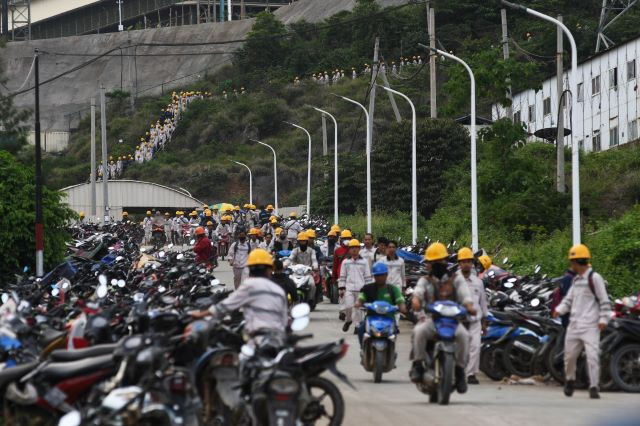 Workers start departing at the end of their workday on Jan. 26, 2024, from a parking lot at the Indonesia Morowali Industrial Park (IMIP) in Bahodopi district, Morowali regency, Central Sulawesi. (Antara/Mohamad Hamzah)
U
nder Section 301 of the Trade Act of 1974, the United States has initiated investigation into 60 countries, including Indonesia, over their failure to ban exports of goods produced by forced labor. This shift requires urgent attention from the central government.
In 2024, the US Department of Labor (DOL) highlighted concerns about forced labor in Indonesia’s nickel industry, specifically indigenous rights on Halmahera Island in North Maluku. These concerns prompted the United Nations’ Committee on the Elimination of Racial Discrimination (CERD) to request additional information. Largely due to the sector’s rapid expansion, Indonesia is once again under the international microscope.
Indonesia ratified International Labour Organization conventions 29 and 105 on the elimination of forced labor in 1950 and 1957, and further integrated these standards into Law No. 13/2003 on manpower. Significant concerns remain regarding actual enforcement, however, and these doubts persist despite the training of labor inspectors, a pending business and human rights regulatory framework and an existing ban on raw nickel exports.
The US investigation and its timing are significant due to a recent legal shift. Following the Supreme Court’s ruling that limits the executive branch's power to impose broad tariffs via the International Emergency Economic Powers Act (IEEPA), the White House has pivoted its focus toward an international forced labor probe as a primary trade tool.
The latest DOL report explicitly links Indonesia’s nickel industry to exploitative practices. Allegations include forced labor, poor working conditions, deceptive recruitment, forced overtime, wage theft and passport confiscation. It also notes over 100 safety incidents were recorded in the last decade.
While the situation calls for an urgent review, the probe’s international focus remains selective. Sectors with high Chinese investment, such as Indonesia’s nickel industry, are receiving intense scrutiny from the US, while similar labor concerns in other local sectors receive little interest.

This is largely because the primary targets of the US investigation are strategic nickel products, including EV batteries, which the US considers crucial to national security and the green energy transition.