TheJakartaPost
Please Update your browser
Your browser is out of date, and may not be compatible with our website. A list of the most popular web browsers can be found below.
Just click on the icons to get to the download page.


Popular Reads
Top Results
No results found. Please check your search term and try again
Can't find what you're looking for?
View all search results
Popular Reads
Top Results
No results found. Please check your search term and try again
Can't find what you're looking for?
View all search resultsSmart air defense systems: A new chapter in modern air warfare
Iran’s model of smart air defense, combining geographic fragmentation, asymmetric resource management and layered deterrence, warrants a close study by developing countries such as Indonesia toward restructuring the national security doctrine for an integrated, hybrid approach.
Change text size
Gift Premium Articles
to Anyone
Share the best of The Jakarta Post with friends, family, or colleagues. As a subscriber, you can gift 3 to 5 articles each month that anyone can read—no subscription needed!
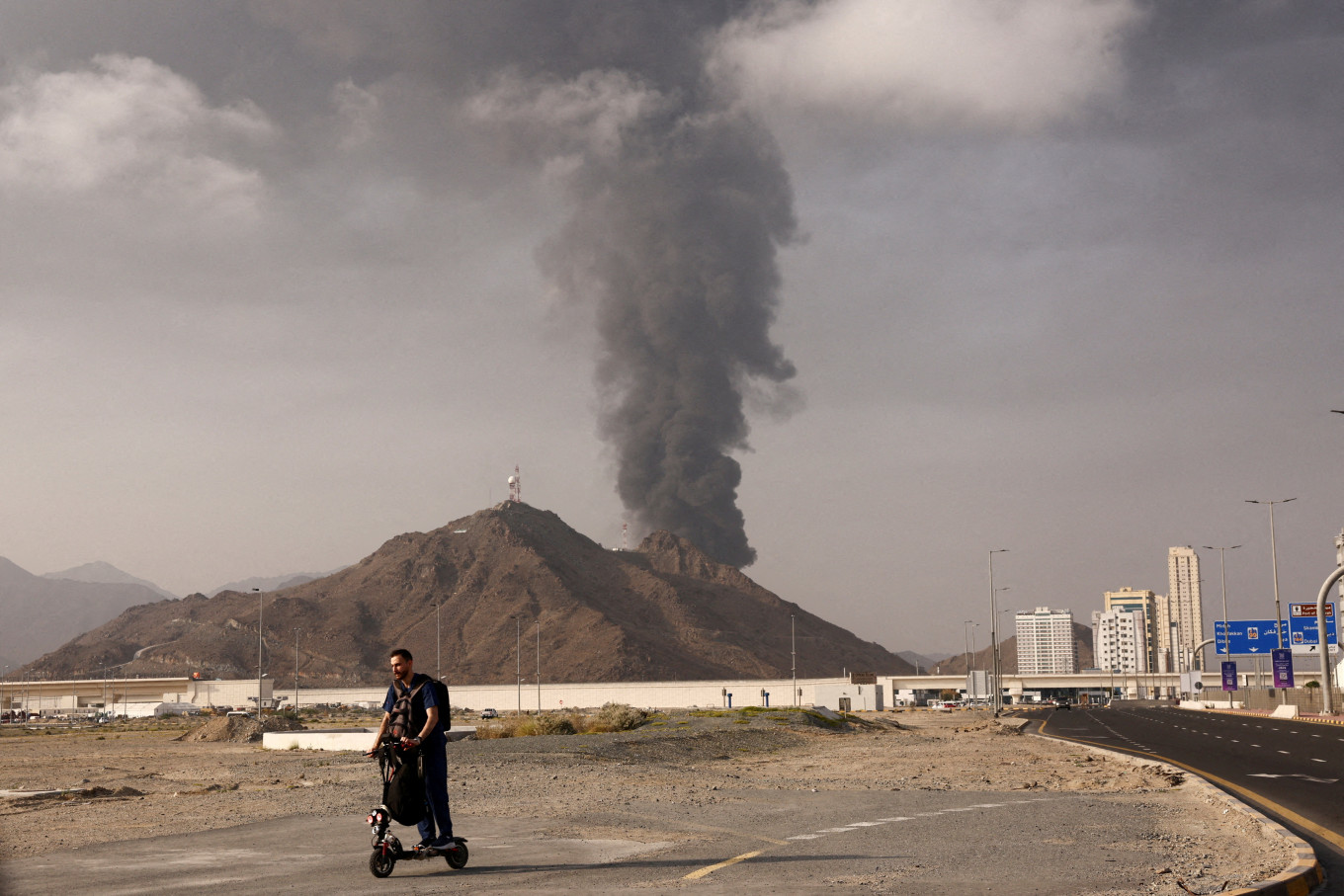 A person rides a scooter as smoke rises in the Fujairah oil industry zone in the United Arab Emirates on March 3, 2026, following a fire caused by debris after air defenses intercepted a drone during the United States-Israeli war on Iran. (Reuters/Amr Alfiky)
A
ir sovereignty remains a critical pillar of national integrity and security. In the modern era, airspace is no longer merely a geographical dimension; it is a strategic domain that determines a nation’s ability to protect its territory, control military movements and ensure the safety of vital infrastructure and civilian populations.
History has consistently shown that air superiority is a prerequisite for overall military success, a truth immortalized during the Battle of Britain in the summer and autumn of 1940 that saw Britain halt Nazi Germany’s northward expansion.
In recent developments, the complexity of threats has intensified. The emergence of technologies like hypersonic missiles and unmanned aerial systems (UAS) means that preserving air sovereignty now depends on more than just advanced hardware. It requires deep integration, strategic readiness and a high degree of adaptability.
Israel’s air defense architecture, featuring the Iron Dome, David’s Sling and the Arrow system and bolstered by United States assets like the Terminal High Altitude Area Defense (THAAD) and the Aegis Combat systems, has long been a global symbol of technological dominance. This layered shield was designed to counter everything from short-range rockets to intercontinental ballistic missiles. However, the escalations of 2026 have revealed that complexity does not guarantee invulnerability.
Iran’s retaliatory campaign, dubbed Operation True Promise, demonstrated that even the most sophisticated systems have limits when confronted with simultaneous, adaptive threats. In this conflict, Israel’s technological edge is being tested by Iran’s ability to identify and exploit operational vulnerabilities that had previously gone unnoticed.
Iran’s success stems from significant technological leaps, most notably the deployment of the Fattah-2 hypersonic missile. By combining extreme speed with high maneuverability in the atmosphere, these missiles fundamentally alter the logic of interception. Defense systems can no longer rely on the predictable trajectories of conventional ballistic missiles.

Simultaneously, Iran utilized the Khorramshahr missile, equipped with cluster warheads. These generate multiple targets from a single launch, narrowing the window for effective interception. Once submunitions are released, defenders must confront dozens of simultaneous threats, increasing the likelihood of a breach.