TheJakartaPost
Please Update your browser
Your browser is out of date, and may not be compatible with our website. A list of the most popular web browsers can be found below.
Just click on the icons to get to the download page.


Popular Reads
Top Results
No results found. Please check your search term and try again
Can't find what you're looking for?
View all search results
Popular Reads
Top Results
No results found. Please check your search term and try again
Can't find what you're looking for?
View all search resultsThe high stakes of Indonesia’s progressive mining royalties
Progressive royalties may create additional uncertainty, diminish Indonesia's comparative attractiveness and increase the perceived regulatory risk premium.
Change text size
Gift Premium Articles
to Anyone
Share the best of The Jakarta Post with friends, family, or colleagues. As a subscriber, you can gift 3 to 5 articles each month that anyone can read—no subscription needed!
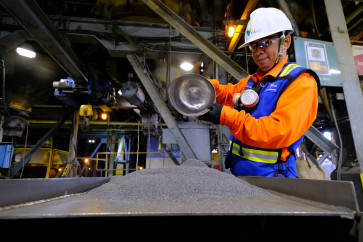
 A worker monitors production on Aug. 2, 2024, at the nickel smelter of PT Vale Indonesia in Sorowako, South Sulawesi. Nickel is a key component in the batteries of electric vehicles, and Indonesia is both the world’s largest producer and home to the biggest known reserves globally. (AFP/Muchtamir Zaide)
I
ndonesia has enacted new regulations on progressive royalties for minerals and coal through Government Regulations No. 18/2025 and No. 19/2025. These regulations restructure the royalty regime into a price-linked progressive system, under which rates increase in line with the Mineral Benchmark Price (HMA) and the Coal Benchmark Price (HBA).
Under the new framework, royalties are set as follows: nickel ore at 14–19 percent (progressive), copper at 10–17 percent, gold at 7–16 percent and coal up to 13.5 percent depending on the HBA. The policy is projected to enhance Non-Tax State Revenue (PNBP) from the mining sector.
From a fiscal standpoint, the rationale appears straightforward: When commodity prices surge, the state seeks to capture a share of the windfall. However, in the context of global competitiveness, this policy may be viewed as a bold yet high-risk measure, as it increases the cost structure of mining operations amid intensifying competition for global investment. It raises serious concerns regarding Indonesia's investment attractiveness.
The mining industry is highly capital-intensive, characterized by elevated geological and market risks, long payback periods and strong sensitivity to fiscal stability. Perceived fiscal overreach or policy uncertainty may delay Final Investment Decisions (FID), divert capital to alternative jurisdictions, and reduce greenfield exploration. Multiple global mining consultancy reports consistently identify fiscal stability as a primary determinant in extractive-sector investment decisions.
Compared internationally, Indonesia's royalty structure ranks relatively high for several key commodities. Most mineral-producing jurisdictions impose ad valorem royalties in the range of 2–10 percent for nickel, copper and gold.
Canada (Ontario) applies a profit-based royalty system with an effective rate of approximately 5–10 percent; Brazil imposes royalties of around 2–4 percent, depending on the mineral; and South Africa applies a profit-based formula ranging from 0.5 percent to 7 percent. The Philippines applies a rate of roughly 4–12 percent.

For coal, Australia (Queensland) applies a progressive royalty that can reach 20–40 percent at very high price levels. However, for minerals such as nickel and copper, rates typically remain in the 2.5–5 percent range.